Veronica liked homes that looked untouched by real life.
Nothing on her counters ever seemed used.
The towels in her guest bathroom were arranged like a magazine spread.
Her Christmas tree looked less like a family tree and more like a competition entry, every gold ornament placed with calculated precision.
Even the children in her holiday photos were expected to smile in a way that matched the furniture.
That was why the cruelty of what she did that Christmas Eve looked almost unreal at first.
It happened in one of those beautiful houses where people assume kindness must live simply because money does.
‘You and your kids can eat in the garage, Mariana,’ she said, handing me three paper plates.
‘Honestly, you’ve always been used to leftovers.’
She said it in front of my children.
She said it without lowering her voice.
And then she walked back into her glowing dining room as if she had merely solved a small inconvenience.
For one second I stood frozen in the hallway, staring after her.
I could hear the clink of crystal, the hum of soft Christmas music, my mother’s laugh from somewhere near the long dining table.
The entire house smelled like roasted turkey, warm bread, cinnamon candles, and Veronica’s expensive perfume.
Beside me, Diego and Sofia had gone silent.
Diego was twelve, at that fragile age where boys begin to understand humiliation too well and speak about it too little.
Sofia was nine, holding the apple salad we had made together that morning.
She had insisted on slicing the apples herself.
She had arranged the walnuts on top in a little star.
When Veronica took the bowl from her, she did not place it on the table with the other dishes.
She set it on top of the washing machine near the garage door.
As though it belonged with the bleach.
‘Are we really eating out there?’ Sofia whispered.
I smiled because mothers learn to do that when their hearts are splitting open.
‘Just for a little while,’ I told her.
The garage was cold enough that our breath showed when we sat down.
There was a folding table against the wall, two metal chairs, and an upside-down bucket for Sofia.
I could smell gasoline, damp cardboard, dust, and old paint.
Through the wall came bursts of muffled laughter from the dining room.
Our plates were an afterthought: cold turkey, dry mashed potatoes, a few limp vegetables.
The kind of meal assembled from what everyone else had refused.
Sofia stared at her plate and then looked at me.
‘Did we do something wrong?’
The question sliced through me more cleanly than Veronica’s insult.
‘No, baby,’ I said.
‘You did nothing wrong.’
Diego set down his fork.
‘Let’s go home.’
The firmness in his voice made me lift my head.
My children were not waiting for kindness anymore.
They were waiting for me to stop offering them up to people who treated them like an embarrassment.
That should have shamed me more than it did.
Instead it clarified everything.
I was gathering the paper plates when bright headlights washed across the driveway.
A long black limousine stopped in front of Veronica’s house.
The laughter inside dimmed.
Music dropped.
Somewhere in the dining room, chairs scraped.
The driver stepped out first.
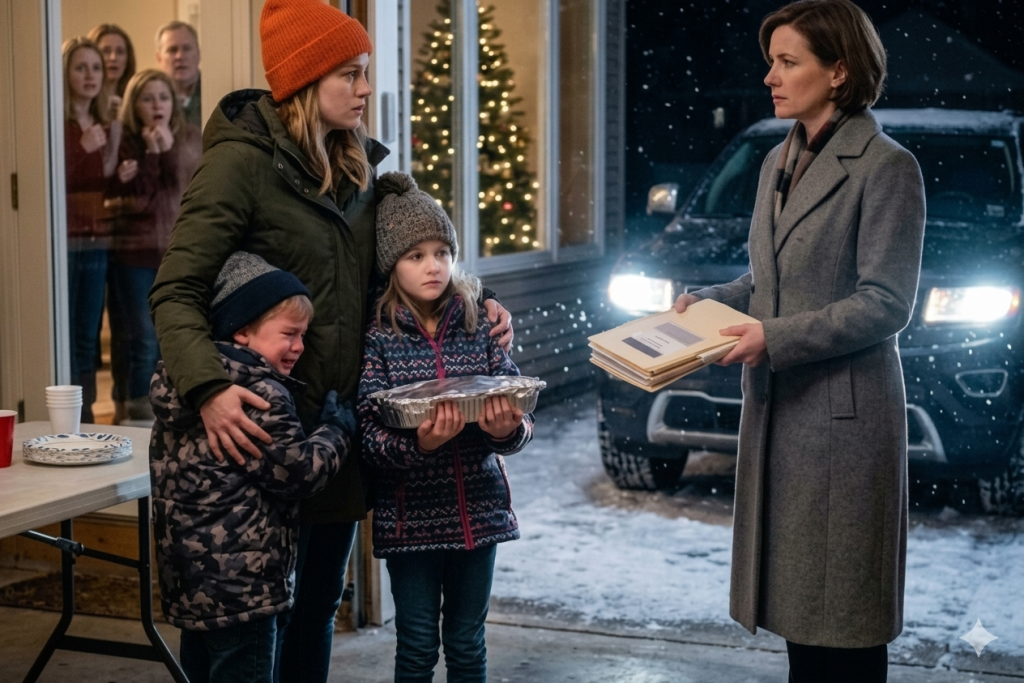
Thenthe rear door opened and an elegant woman in a dark wool coat emerged, a leather folder tucked beneath one arm.
She ignored the front door completely and walked straight toward the garage.
She stopped in front of me.
‘Are you Mariana Alvarez?’ she asked.
Behind her, the dining room curtains flew open.
My mother’s silhouette rose abruptly.
Veronica appeared in the hallway with a smile already collapsing off her face.
‘Yes,’ I said.
‘I’m Mariana.’
The woman’s eyes moved once over the scene: the paper plates, the folding table, the cold, the upside-down bucket, my daughter’s untouched salad on top of the washing machine.
Her expression changed.
‘I’m Isabel Mercer,’ she said.
‘Attorney for the late Mrs.
Celeste Navarro.
I’ve been under strict instructions to place these in your hands before midnight on Christmas Eve.’
She opened the folder.
Inside was a ring of keys, a cream envelope with my name written across it, and legal documents bearing the seal of the Navarro estate.
At the sight of that seal, my mother made a tiny choking sound.
Everybody in our town knew the Navarro name.
Celeste Navarro had been one of those women people wrote about in glossy local magazines.
Widow of a real estate developer.
Patron of museums.
Donor to hospitals.
The kind of older woman whose Christmas galas raised more money in one evening than most families saw in years.
What no one in Veronica’s house knew was that long before Celeste Navarro was a name in society columns to me, she had simply been a lonely woman in a rehab room with no one to eat with.
I met her five years earlier, after my husband Raul died in a highway accident on his way home from a double shift.
That kind of loss does not arrive alone.
It drags bills, fear, paperwork, and the quiet panic of two children depending on you into the room with it.
I started working every job I could find.
Day cleaning, night reception, weekend elder care.
For a while I worked evenings at St.
Gabriel Rehabilitation Center, wiping down rooms, changing linens, delivering trays when the nursing assistants were overwhelmed.
Celeste had been admitted there after hip surgery.
She was famous enough that staff whispered when they walked past her door, but fame did not make her less alone.
Her son sent flowers.
Her daughter sent a fruit basket.
Both sent excuses more often than visits.
The first time she spoke more than two sentences to me, I was adjusting her blankets and apologizing because the dinner tray had arrived late.
‘You always apologize for things you didn’t cause,’ she observed.
I laughed tiredly.
‘Occupational hazard.’
She studied me for a moment.
‘And who apologizes to you?’
At the time, no one.
Maybe that was why I remembered her.
Maybe that was why she remembered me.
On Christmas Eve that year, the center was running on a skeleton staff.
Families came through earlier in the day with flowers, cameras, and quick visits that smelled of perfume and guilt.
By evening most patients had either been collected or tucked away with reheated dinners.
Celeste was still in her room, alone, wearing a red cardigan and pearl earrings, trying to pretend she did not care.
I had Diego and Sofia withme because my sitter canceled.
They were small then, seven and four, exhausted and hungry.
We were sitting in the break room sharing the cheap apple salad I had made when Celeste’s nurse told me her family had called to cancel.
I do not know what made me do it.
Maybe I just could not bear the look on Celeste’s face when I peeked into her room and saw a beautifully wrapped gift box on her side table with no one to open it beside her.
So I brought my children and our plastic container of apple salad into her room.
‘Would you like to eat with us?’ I asked.
Celeste blinked at me as if she had been forgotten so thoroughly that an invitation itself felt shocking.
Sofia offered her the serving spoon.
Diego moved the rolling tray closer to her bed.
We ended up eating cafeteria turkey, instant potatoes, and my little apple salad under fluorescent lights while Christmas music crackled from an old radio in the hallway.
Celeste cried halfway through the meal and pretended she had something in her eye.
Before I left, she took my hand and said, ‘You have no idea what you just saved me from tonight.’
After that, I became one of the few people she trusted.
When she was discharged, she asked whether I would come two evenings a week to keep her company and help organize papers she could no longer manage alone.
I agreed because the pay was fair and because, unlike most wealthy people, she never mistook money for permission to be cruel.
I read to her.
Sorted mail.
Helped her label old photographs.
Listened to her talk about a life that looked grand from the outside and lonely from the inside.
She told me once that people reveal their real character by who they can humiliate without consequence.
‘Watch where they put the children,’ she said one afternoon while I folded blankets in her sitting room.
‘That tells you what kind of adults they are.’
She loved Diego’s seriousness and Sofia’s questions.
She sent them books on their birthdays.
She insisted on paying me more than I asked, but she also understood my pride.
When she tried to press a large check into my hand after hearing the school might cut Diego’s science program, I refused.
‘I don’t want charity,’ I told her.
Her face softened.
‘Good,’ she said.
‘Neither do I.’
A few months later I found a scholarship fund at the school with no donor name attached to it.
That was Celeste.
Toward the end, when her health began declining for real, I saw her less often.
She had round-the-clock care and children who suddenly visited more whenever lawyers were around.
The last time I sat with her alone, she was thinner, sharper somehow, as if weakness had burned away everything except truth.
‘If the world ever shoves you to the edge of the room again,’ she told me, ‘do not stay there out of politeness.’
I smiled and said something modest.
She looked annoyed.
‘I’m serious, Mariana.
Leave.
Take your children and leave.’
Standing in Veronica’s garage on Christmas Eve, I realized she had prepared for exactly that possibility.
Isabel handed me the envelope.
‘You should read it,’ she said.
Behind me, my mother’svoice changed instantly, turning warm and trembly in that false way I knew too well.
‘Mariana, come inside first, mija.
The children are freezing.’
Veronica stepped closer, smiling too hard.
‘There’s obviously some misunderstanding.’
Isabel did not even glance at her.
I opened the letter.
The first line read: To the woman who shared her children’s Christmas meal with me when my own family forgot I was alive.
Silence fell so hard I could hear the garage door motor ticking overhead.
I kept reading.
Celeste wrote that the house on Laurel Lane, a restored three-bedroom carriage house she had owned for years, was now mine outright.
She had also established education trusts for Diego and Sofia and a monthly stipend for five years so I would never again have to choose between dignity and survival.
There was one more gift: a salaried position directing a small foundation program she had dreamed of starting, one that would support elderly residents abandoned during the holidays and single parents trying to stay afloat.
At the bottom of the page was a line that made my eyes burn.
If this letter reaches you while you are standing outside someone else’s celebration, let that be the last time.
My mother put a hand to her chest.
Veronica had gone pale enough to look powdered.
Then Isabel removed a second document from the folder.
‘Mrs.
Navarro added an addendum after reviewing the guest list for several local charity events,’ she said evenly.
‘She requested that if Ms.
Alvarez was ever publicly humiliated by relatives seeking social access, those individuals be barred from foundation functions and grant committees going forward.’
Veronica made a sound I will never forget.
That was when I understood the full shape of Celeste’s final gift.
It was not revenge.
It was protection.
Veronica’s husband had spent the previous year trying to land contracts through people connected to the Navarro Foundation.
My sister’s charity committees, gala invitations, and cultivated society friendships depended on that world seeing her as polished, generous, and respected.
And now they would know exactly how she had treated her own sister and niece and nephew on Christmas Eve.
‘Please,’ Veronica said, the first real crack in her voice appearing.
‘Mariana, tell her this isn’t how it looked.’
Diego finally spoke.
‘You put us in the garage,’ he said.
It was not loud.
It did not need to be.
Nobody in the doorway had an answer for that.
Sofia tugged my coat.
‘Can I bring the salad?’
I looked at the bowl on top of the washing machine.
‘Yes,’ I said.
‘We’re taking our salad.’
I picked it up with one hand, the folder with the other, and followed Isabel to the limousine.
No one stopped us.
Maybe they were too ashamed.
Maybe they were only stunned.
Either way, for once, their silence worked in my favor.
The house on Laurel Lane was not a mansion.
It was better than that.
It felt lived in, loved, and warm.
White lights wrapped the front porch rail.
A tree glowed in the front window.
Someone inside had already set the table for three children’s plates and one adult place, with a note propped against a loaf of still-warm bread.
No leftovers tonight.
I stood in that kitchen and cried for the firsttime all evening.
Not because I had been rescued by money.
Because someone had seen what my children deserved and refused to let the world tell them otherwise.
Diego walked through the house in stunned silence before finally choosing a bedroom and sitting on the bed like he did not trust it to be real.
Sofia kept asking if she could touch things, as if warmth itself might be breakable.
We ate soup, bread, and the apple salad at a real table under soft yellow light.
No one rushed us.
No one made us earn our chairs.
The next morning Isabel returned with the rest of the paperwork.
The title transfer was complete.
The education trusts were funded.
The foundation job was mine if I wanted it.
Celeste had left a short video too, one I watched alone after the kids were asleep.
She looked tired in it, but her eyes were clear.
‘Love is not proved by blood, Mariana,’ she said into the camera.
‘It is proved by who makes room for you when they have no reason to perform goodness for an audience.’
Within twenty-four hours my phone exploded.
My mother called fourteen times.
Veronica called twenty-three.
There were messages from cousins, an aunt, even one from Veronica’s husband claiming the whole evening had been a misunderstanding caused by holiday stress.
By the third day the tone changed.
Veronica stopped talking about family and started asking whether I might smooth things over with the foundation board.
My mother suggested that since I had ‘come into such a blessing,’ perhaps we could all start fresh and help one another.
There it was.
Not remorse.
Opportunity.
A week later Veronica appeared on my porch carrying a bakery cake and wearing a beige coat that probably cost more than my monthly groceries used to.
She tried tears first.
Then nostalgia.
Then indignation.
‘You cannot let one night destroy the family,’ she said when I would not invite her inside.
I looked past her to the street, where her car idled by the curb.
‘One night?’ I asked quietly.
‘You think this began with one night?’
She swallowed.
‘I was stressed, Mariana.
The seating was complicated.
You always take things so personally.’
Behind me, I could hear Sofia laughing somewhere upstairs.
Diego was helping hang a shelf in his room.
Their voices sounded safe.
I finally looked back at my sister.
‘You were right about one thing,’ I said.
‘My children were used to leftovers.
Leftover attention.
Leftover seats.
Leftover apologies.
That ends now.’
Then I closed the door.
I did not slam it.
I did not need to.
In the months that followed, I stepped into the work Celeste had planned for me.
The foundation program started small.
Grocery cards for single parents.
Holiday meal deliveries for seniors whose children never came.
Transportation vouchers for patients being discharged with nowhere warm to return to.
Every time I approved help for someone, I thought about the rehab room where Celeste and my children once shared apple salad from a plastic bowl.
Diego joined his school robotics team.
Sofia started art classes and filled the refrigerator with drawings of houses that had all their windows lit.
As for my family, distance clarified them.
My mother alternated between guilt and blame, depending on who
PREV PART was listening.
Veronica spent months trying to repair her social standing.
None of it mattered much to me after a while.
Once you have seen your children flinch at the sound of relatives laughing through a wall, some things become impossible to unsee.
The following Christmas, we did not go anywhere we were merely tolerated.
We hosted dinner at Laurel Lane.
The table was not elaborate.
The plates did not match.
Sofia insisted on making the apple salad herself and arranged the walnuts in a star again.
Diego lit the candles.
I invited an elderly widower from two streets over and a young mother from our foundation program whose apartment had just flooded.
There was laughter, but nobody was performing for it.
Children were warm.
Adults made room.
Everyone ate the good portions first.
At one point I looked around the table and felt that strange ache that comes when gratitude and grief sit down side by side.
I thought of Celeste.
I thought of Raul.
I thought of that garage, that bucket, those paper plates.
And I wondered what the ugliest part of that night had really been.
The cold? The insult? The way my children had quietly assumed they were the ones who did something wrong?
Or the speed with which people who had forgotten us suddenly remembered we were family the moment wealth entered the room.
I still do not know.
But I know this: my children never again had to stand at someone else’s doorway waiting to be let into warmth.
And once you learn the difference between a home and a performance, you stop confusing beautiful houses with loving people forever.
