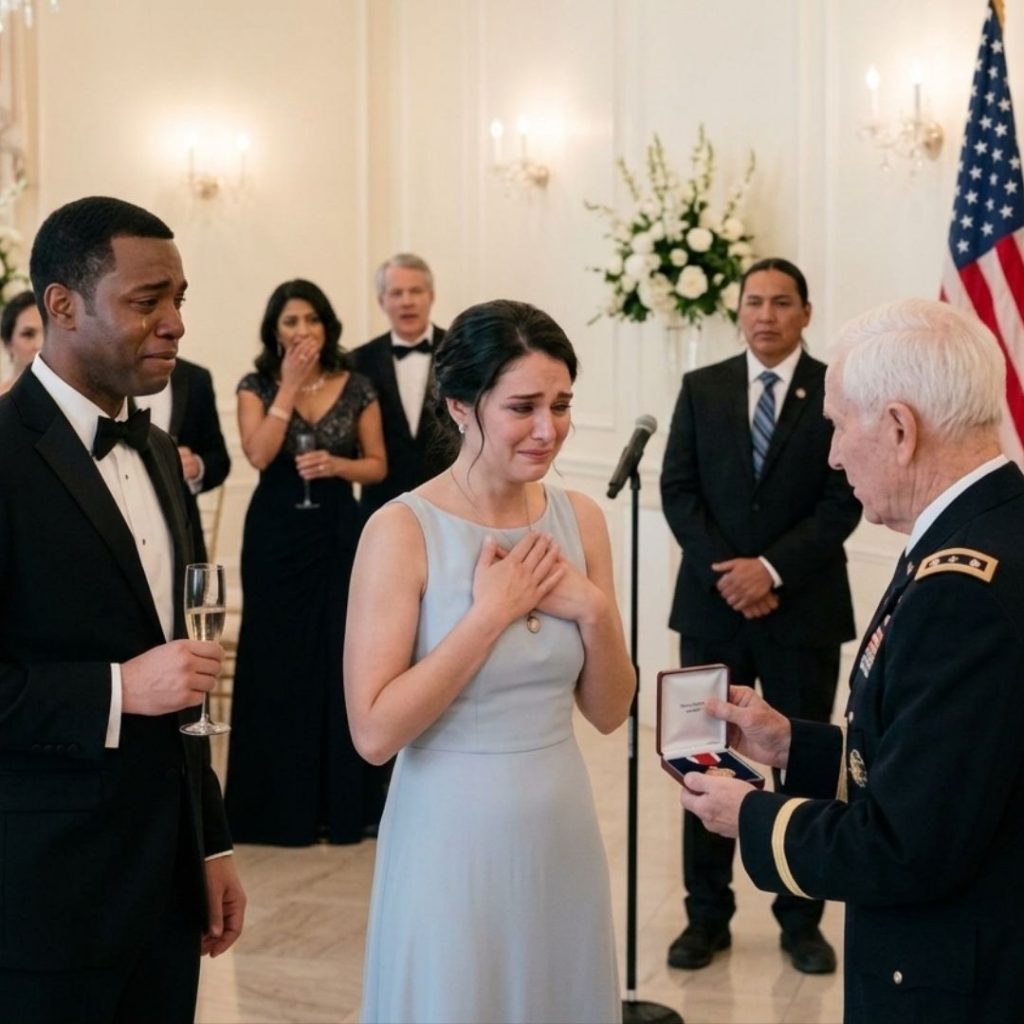
The night Preston Whitmore ended our marriage, he did not take me aside gently. He did not sit across from me at our kitchen table, where the varnish had worn thin from all the years I had balanced our bills, corrected his speeches, and eaten cold dinners while he chased a future he promised would someday belong to both of us.
No, Preston chose a ballroom.
He chose chandeliers, television cameras, senators, donors, and champagne glasses so delicate they looked as if they might shatter if anyone in that room dared to tell the truth.
The Hawthorne Imperial Hotel glittered that night like a place built to hide cruelty beneath gold trim. Crystal lights hung from the ceiling in tiers. White roses spilled from silver vases on every table. Men in dark tuxedos leaned close to women in jeweled gowns and laughed with the soft confidence of people who had never once wondered whether they belonged in a room.
I sat near the front in a pale blue dress I had altered myself, because Preston had said the original neckline was “too modest for the image we’re trying to project.” I had smiled when he said it. I had gone upstairs, taken out my sewing kit, and changed the dress by hand while he practiced remarks in front of the bedroom mirror. By then, I had become very good at altering myself to fit whatever version of his life he needed that day.
Onstage, my husband stood beside Lydia Ashcroft.
She was everything Preston had started pretending to admire once his name appeared in newspapers. Tall, polished, careful, and wealthy in a way that never needed to announce itself. Her emerald silk gown caught every flash of light. Diamonds rested at her ears. Her smile stayed lowered and soft, the kind of smile a woman wears when she wants people to think she is innocent of the very thing she has already accepted.
I knew about her before that night.
A wife always knows before the proof arrives.
I knew from the way Preston angled his phone away from me at breakfast. I knew from the sudden gym membership, the new cologne, the late meetings that ended with him coming home smelling faintly of someone else’s perfume. I knew from the way he stopped looking guilty and started looking irritated, as if my hurt had become an inconvenience.
But knowing privately is different from being humiliated publicly.
Preston lifted his champagne glass, and the ballroom obeyed him. Conversations dissolved. Cameras shifted. Red recording lights blinked near the back wall like tiny warnings.
He had learned to love silence once he realized he could control it.
“Claire stood beside me when I had nothing,” he said.
A few heads turned toward me.
Heat rose from my chest to my throat. I folded my hands in my lap because they had begun to tremble, and I refused to let anyone in that room see it.
Preston smiled.
It was the same smile he used when he wanted a donor to feel chosen. Warm enough to be believed. Empty enough to be safe.
“She was loyal in the early years,” he continued. “And for that, I will always be grateful.”
Grateful.
Not loving. Not devoted. Not proud.
Grateful.
The word landed like a tip left on a table after bad service.
Then he turned slightly toward Lydia, just enough for the cameras to understand the composition.
“But every future requires honesty.”
The air changed.
I felt it before I understood it. A shift among the guests. A tightening of attention. The curiosity of people who sensed a wound was about to be opened, and who were too well-mannered to look away.
My fingers found the old silver locket at my throat.
I had worn it every day since I was old enough to understand it was the only thing that came with me from wherever I had begun.
The sisters at Saint Agnes Church in Pennsylvania told me I had been found with it. A blue blanket. A thunderstorm. A baby left near the side door at 3:42 in the morning. No birth certificate. No note. No family record. Just a silver locket clutched so tightly in my tiny fist that Sister Margaret had written in the intake file that they had to warm my hand before my fingers would open.
For most of my life, that was all I had.
Preston knew it.
He knew the story because I had trusted him with it before I trusted him with anything else. When we were young, when we were broke, when we lived in a third-floor apartment with noisy pipes and a radiator that hissed all winter, he used to touch the locket and say, “That means somebody loved you once.”
Back then, I thought that was tenderness.
Back then, I believed a man who could speak gently to my oldest wound would never use it against me.
But ambition changes weak people. Or maybe it only reveals what was already there.
For seven years, I helped Preston build the man who now stood under those chandeliers pretending he had outgrown me. I rewrote his résumé at our kitchen table when he was too proud to admit he did not know how to frame failure as experience. I polished his speeches after midnight while he slept. I corrected donor letters he drafted in stiff, clumsy language and let him receive praise for eloquence. I skipped dinners so he could host men who never learned my name. I stood beside him at fundraisers, smiling until my cheeks ached, while he told the same story about sacrifice and ambition.
The sacrifice was usually mine.
The ambition was always his.
Preston set down his champagne glass on the podium.
“I cannot pretend anymore,” he said, “that a woman found outside a church in Pennsylvania, with no birth certificate, no family, and no history beyond a broken trinket, is prepared to stand beside me in the future I have been called to build.”
The ballroom went still.
Not silent.
Still.
A waiter froze beside table seven with a tray balanced on one hand. A senator’s wife lowered her fork but did not put it down. One camera operator bent slightly toward his viewfinder, as if cruelty required a better angle.
For a moment, I could not breathe.
It was not only what he said. It was that he had planned it. He had taken the loneliest part of my life, dressed it in formal language, and delivered it to a ballroom full of strangers as proof that I was beneath him.
Then someone clapped.
One sharp sound from the left side of the room.
Another followed.
Then another.
Soon applause traveled across the ballroom with the clean, terrible confidence of people deciding that humiliation was acceptable because the man holding the microphone seemed important.
Preston raised his glass again.
“To new beginnings.”
Lydia placed her hand lightly on his sleeve.
That small touch told me everything. Maybe she had not written the speech. Maybe she had not chosen the words. But she had known she would be standing beside him when he said them.
I thought I would cry.
I had cried so many times by then that my body knew the road. I had cried in the laundry room at midnight while his shirts spun in the dryer. I had cried in the passenger seat of our SUV after he told me not to mention Saint Agnes around donors because my “orphan story” made people uncomfortable. I had cried in the guest bathroom at a gala after he corrected my pronunciation of a foreign ambassador’s name in front of four men who laughed. I had cried when he changed his phone passcode. I had cried when he said, “You mistake shelter for love, Claire. That’s what abandoned people do.”
But in that ballroom, beneath the chandeliers, with Lydia’s diamonds glittering beside my husband’s hand, something colder than tears moved through me.
I stood.
The chair legs scraped softly over the polished floor.
It was not loud, but Preston heard it.
His eyes snapped to mine. His smile remained in place, but something sharp moved behind it.
“Claire,” he said into the microphone, “please don’t make this uncomfortable.”
A few people laughed.
That laughter almost did what his speech had not. It almost made me small again.
For one ugly second, I imagined walking onto the stage and slapping the glass from his hand. I imagined champagne running down his tuxedo. I imagined Lydia stepping back in horror. I imagined every camera capturing the perfect crack in his perfect evening.
Then I let the image go.
Rage is easy when cruel people expect you to perform it.
Dignity is harder because it makes them wait for consequences they were certain they could avoid.
I kept my hand on my locket.
I did not step toward the stage.
That was when the ballroom doors opened.
They did not drift inward the way hotel doors usually did. They swung open with the force of command.
The first men through wore dark suits and earpieces. Behind them came guards in midnight-blue uniforms marked with a crowned white stag holding a rose in its mouth. They moved with such controlled purpose that even the most powerful people in the room instinctively straightened.
A murmur traveled through the tables.
“The Ardenian Embassy…”
“Is that the royal guard?”
“Is the king here?”
Preston’s face changed so quickly it was almost embarrassing to watch. The cruelty drained out. Polish rushed in to replace it. He stepped down from the stage, smoothing his lapel with a trembling hand.
An older man entered behind the guards.
I recognized him because anyone who had watched enough state funerals, charity broadcasts, or diplomatic interviews would have recognized him. King Alistair of Ardenia. Preston kept a framed magazine article in his office because the king’s name appeared three paragraphs above his own, and Preston liked anything that suggested proximity to power.
In person, King Alistair looked older than the photographs. His formal black military jacket was immaculate. A blue sash crossed his chest. Silver hair framed a face carved by discipline, age, and something deeper than either.
Grief.
Not fresh grief.
Old grief.
The kind that stops being an event and becomes part of the face.
Preston hurried forward with the smile he saved for men who could open doors.
“Your Majesty,” he said, bowing his head with awkward eagerness. “What an extraordinary honor. Had we known you would attend, we would have prepared—”
King Alistair walked past him.
Not around him.
Past him.
The insult was so quiet that half the room understood it before Preston did.
The king’s gaze moved across the ballroom with desperate precision. Past the senators. Past the donors. Past Lydia. Past the television cameras.
Then it stopped on me.
No.
Not on me.
On the locket against my chest.
The entire room seemed to lose air.
King Alistair stared at the pendant as if it had spoken.
His lips parted.
“No,” he whispered. “After all these years…”
Preston tried again, though panic had begun to fray the edges of his voice.
“Your Majesty, allow me to introduce my wife, Claire—”
“Silence,” the king said.
One word.
The ballroom obeyed.
Preston stopped as if an invisible hand had pressed against his chest.
King Alistair came toward me slowly. Every step looked careful, as if he feared one sudden movement might make me vanish.
“My dear,” he said.
His voice broke on the second word.
He stopped a few feet away. Close enough for me to see that his eyes were wet, but not so close that I felt trapped.
“Where did you get that locket?”
My mouth went dry.
“I was found with it,” I said.
His eyes closed.
For a moment, all the strength seemed to leave his face.
When he opened his eyes again, they looked at me not like a king looking at a stranger, but like a man standing at the edge of a grave that had suddenly opened into a path.
“Found where?”
“Pennsylvania,” I whispered. “Outside Saint Agnes Church.”
Behind me, someone gasped.
Preston’s face went pale.
Lydia removed her hand from his sleeve.
King Alistair turned slightly toward one of his aides. The man stepped forward immediately, carrying a slim leather case and a folder sealed with the same crowned white stag.
The king’s hands trembled as he opened the case.
Inside was an old photograph.
The image was not sharp, but it was clear enough to wound me.
A young woman with my eyes held a baby wrapped in a blue blanket. Around the woman’s throat hung a silver locket identical to mine.
My knees weakened.
One of the guards shifted closer, ready to catch me if I fell.
I did not fall.
The king turned the photograph over. On the back was an archive stamp, a date, and a line of handwriting faded brown at the edges.
Princess Elara with infant daughter, private chapel, 31 years ago.
The words did not fit inside my head.
Princess Elara.
Infant daughter.
Thirty-one years ago.
Numbers were easier than emotions, so my mind grabbed the number first. Thirty-one years matched my age. The blue blanket matched the intake record. The locket matched the only object I had carried from the life before my life.
“My daughter disappeared thirty-one years ago,” King Alistair said. “She vanished during a private diplomatic trip with her infant child.”
Preston whispered, “That’s impossible.”
The king turned toward him.
“What did you say about this woman?”
No one answered.
No one needed to.
The cameras had recorded it. The donors had applauded it. Lydia had stood beside it. Preston had called me nameless in front of a man who might have just recognized me as blood.
Then the king looked back at me.
“May I see the inside of the locket?”
He did not reach for it.
He waited.
That mattered.
After years of Preston touching my history whenever it suited him, shaping it into pity when he needed sympathy and shame when he wanted control, this stranger with a crown waited for permission.
I nodded.
My fingers shook as I opened the locket.
I had opened it thousands of times. I knew the empty hollow where a picture should have been. I knew the worn hinge. I knew the faint crest on the front, too soft and old for any county clerk to identify. But I had never looked closely at the inside rim because the metal there was dark and narrow.
The aide handed me a small penlight.
I tilted the locket beneath it.
At first, I saw nothing.
Then the light caught a tiny line of engraving along the curve.
E.A. to C.M.A.
The king covered his mouth with one hand.
“My daughter’s initials were Elara Arden,” he said. “She told me once that if she had a daughter, she would name her Claire, after her grandmother.”
The ballroom blurred.
My name had always felt borrowed. The sisters had chosen it because no one knew what else to call me. Claire Miller, written on a temporary form that became a life. But now a king was standing in a hotel ballroom telling me my name might have been chosen before I was lost.
Preston gave a brittle laugh.
“A locket is not proof.”
“No,” the king said. “It is not.”
Relief flickered across Preston’s face.
Then the aide opened the leather folder.
“But records are,” the king continued. “Blood tests are. Thirty-one years of open embassy files are. And so is the fact that a child matching my granddaughter’s age was found in Pennsylvania within the exact window when my daughter’s transport disappeared.”
The aide removed copies of missing-person documents, transport logs, and personal effects lists. At the top of one page was the crowned white stag. Beneath it were descriptions that made my skin go cold.
Blue infant blanket.
Silver locket with interior engraving.
Private chapel photograph.
No ransom confirmed.
Last verified route included rural Pennsylvania roads during severe storm.
My hand tightened around the locket until the chain bit into my neck.
Lydia looked at Preston.
“Preston,” she whispered. “What did you do?”
The question made no sense at first. He had not stolen me from a royal family. He had not abandoned me outside a church in a thunderstorm. But he had done something that looked uglier every second the king stood beside me.
He had taken the one wound in me he knew best and used it as evidence that I was unworthy.
He had mocked the only object that might lead my family back to me.
And he had done it because he believed no one powerful would ever stand behind me.
Preston straightened, trying to gather authority from what little remained of his reputation.
“This is a private marital matter,” he said. “Claire has always been sensitive about her background. Your Majesty, with respect, she can become emotional when—”
The king’s face hardened.
“That sensitivity did not trouble you when you placed it before cameras.”
A low murmur moved through the room.
One of the television cameras shifted angle.
The red light stayed on.
That little red light mattered. It meant the ballroom could not pretend later that it misunderstood. It meant every person who clapped had left a record of what they were willing to applaud.
The king’s aide asked whether I had my Saint Agnes file.
I almost laughed because, for the first time in my life, the folder I had carried from office to office, clerk to clerk, and appointment to appointment had value. Preston had called that habit pathetic once.
“Stable people don’t carry proof that nobody claimed them,” he had said.
But stable people are not asked to prove they exist.
I opened my clutch and removed the folded packet.
Saint Agnes intake note.
Pennsylvania child services summary.
A photocopy of the blue blanket description.
The old line about the locket.
The aide took the papers with both hands. He read them carefully, not like sad trivia, but like evidence that mattered. Then he looked at King Alistair and gave one small nod.
The king inhaled as if that nod hurt.
“Claire,” he said.
My name sounded different in his voice.
Not owned.
Not claimed.
Recognized.
“I cannot tell you tonight what happened to my daughter,” he said. “I cannot give you thirty-one years back. But I can tell you that the search never ended.”
The ballroom remained silent.
This was not the silence Preston had owned minutes earlier. That silence had waited to see whether cruelty would be rewarded.
This silence understood that it already had been.
The king turned toward Preston.
“You questioned whether she was prepared to stand beside you,” he said.
Preston swallowed.
The king’s eyes stayed cold.
“I question whether you were ever prepared to stand beside her.”
No one clapped.
No one dared.
That was worse for Preston than applause would have been. Applause might have made it a performance. Silence made it a verdict.
Lydia stepped farther away from him.
“You told me she had no one,” she said quietly.
The words struck harder than I expected.
They did not defend me.
They revealed him.
He had needed Lydia to believe I was alone. He had needed the donors to believe it. He had needed me to believe it most of all.
Preston looked at me then.
For years, I had wondered what it would feel like if he finally looked afraid to lose me. I thought it would be satisfying. I thought some wounded part of me might rise in triumph at the sight of him exposed.
It did not feel like triumph.
It felt like standing inside a house after a fire and realizing the flames had only shown me what had already been gone.
“Claire,” Preston said.
He used the soft voice.
The old one.
The voice from cheap apartments and winter nights when we slept under borrowed blankets because we could not afford proper heat. The voice that once made me feel safe enough to tell him about the church door, the blue blanket, and the locket.
“I didn’t know,” he said.
That was all.
Not I was wrong.
Not I hurt you.
Not I should never have said those things.
I didn’t know.
As if my worth depended on who might walk through the door.
As if I became human only when a king recognized the locket he had mocked.
I touched the pendant again.
This time, it no longer felt like proof that somebody had loved me once.
It felt like proof that Preston’s failure to love me had never meant I was unlovable.
King Alistair looked at me with a gentleness that made my throat ache.
“My embassy can arrange a private confirmation process,” he said. “Nothing will be forced. Nothing will be announced without your consent.”
Consent.
The word nearly broke me.
Preston had treated my life like material for years. My loyalty was useful until it bored him. My wound was touching until it embarrassed him. My silence was elegant until he needed a public sacrifice.
Now a king offered the one thing my husband had not.
A choice.
“I want the confirmation process,” I said.
King Alistair nodded, his eyes filling again.
Then I turned back to Preston.
“And I want the separation you announced.”
The ballroom absorbed that sentence slowly.
Preston stared at me as though I had spoken a language he did not know.
Maybe I had.
It was the language of a woman no longer asking to be chosen.
King Alistair offered me his arm.
I looked at it for a moment before taking it. Not because I needed to be led. Because every camera in that room would capture the difference between how Preston had presented me and how I was leaving.
I walked out beneath the chandeliers with the locket against my chest, the Saint Agnes file in the aide’s hands, and the applause dead behind me.
No one clapped.
No one laughed.
No one raised a glass.
At the ballroom doors, I paused once and looked back.
Preston stood alone near the stage beside the microphone that had carried every word of his cruelty. Lydia was no longer beside him. His champagne glass hung uselessly in his hand.
For the first time all night, the room saw him clearly.
And for the first time in my life, I walked away before anyone had to tell me I was allowed to go.
The hallway outside the ballroom was colder than I expected.
Maybe it was the marble floors. Maybe it was the sudden absence of hundreds of eyes. Maybe it was simply that my body had held itself together for too long and now did not know what to do with safety.
I stopped beside a tall window overlooking the city lights and gripped the sill.
King Alistair did not crowd me.
Neither did the guards.
The chief aide, a quiet man named Adrian Vale, stood a respectful distance away with my papers tucked inside a protective folder as if they were more valuable than the jewels in the ballroom.
For thirty-one years, those papers had made me feel small.
Now they made other people lower their voices.
“Are you all right?” the king asked.
It was such a simple question that I almost could not answer it.
People had asked me many versions of that question before, but most wanted reassurance more than truth. Preston used to ask it after wounding me, his tone already impatient, as if my answer needed to clear him.
King Alistair asked as if the answer mattered.
“No,” I said honestly.
His face softened.
“No,” he repeated. “Of course not.”
That was when I began to cry.
Not elegantly. Not quietly. I cried the way a child cries after waiting too long for someone to come. One hand pressed to my locket, the other covering my mouth, because some part of me still wanted to make grief presentable.
King Alistair removed a folded handkerchief from his jacket pocket and offered it to me.
He did not touch my shoulder. He did not say I should be strong. He did not turn my pain into a lesson.
He simply stood nearby while I fell apart.
When I finally looked up, he was crying too.
“My daughter’s name was Elara,” he said. “She was stubborn, brilliant, and impossible to manage when she believed she was right. She hated formal dinners. She fed stray cats behind the palace kitchen and once dismissed an entire security detail because she wanted to buy peaches from a roadside stand like an ordinary woman.”
A laugh escaped me through tears.
It startled both of us.
The king smiled faintly, but the grief remained.
“She would have liked that,” he said. “A laugh in the middle of disaster.”
“What happened to her?” I asked.
The question came out barely louder than breath.
King Alistair looked toward Adrian.
The aide’s expression tightened.
“We know only pieces,” the king said. “There was a private trip. A security breach. A storm. A vehicle found abandoned near a rural road. My daughter was never recovered. Her infant child was believed taken with her. We searched hospitals, ports, private airfields, adoption records. We followed false leads across three countries.”
He looked at my locket.
“We never knew a child had been left at a church.”
The words entered me slowly.
I had spent my life imagining a faceless mother who could not keep me. A frightened girl, perhaps. A woman with no money. Someone desperate enough to leave a baby near a church door but careful enough to choose a place where morning prayers would come early.
I had hated her some years.
Missed her others.
Now I had a name.
Elara.
A princess who fed stray cats and stopped for peaches.
A woman who might not have abandoned me at all.
The confirmation process began that same night.
Not publicly. Not dramatically. No cameras. No royal announcement. Just a private suite upstairs in the hotel, a physician from the embassy, legal witnesses, signed consent forms, and a cheek swab that seemed absurdly small for the weight it carried.
Preston called fourteen times while I sat in that suite.
I did not answer.
He texted first with outrage.
Then apology.
Then strategy.
Claire, we need to discuss this before the media spins it.
Claire, you know I never meant to hurt you.
Claire, don’t let strangers turn you against your husband.
Claire, please. I’m scared.
The last one almost reached the old part of me.
Almost.
Then I remembered him under the chandeliers, saying I had no history beyond a broken trinket.
I turned off my phone.
Adrian arranged a car to take me to a private residence owned by the embassy. I expected something cold and formal. Instead, it was a brownstone on a quiet street with lamps in the windows and a library full of worn leather chairs.
King Alistair walked me to the door of the guest room himself.
“I do not know what I am to you yet,” he said. “Not legally. Not officially. But I know what that locket meant to my daughter. And I know what I felt when I saw you tonight.”
I held the handkerchief he had given me, now damp and twisted in my hand.
“What did you feel?”
He looked at me for a long moment.
“Like God had returned a voice to a silent room.”
I did not know how to answer that, so I nodded.
That night, I slept only in fragments. Each time I woke, I reached for my locket, half afraid it had vanished or that the ballroom had been a dream created by a mind too wounded to bear one more humiliation.
But the locket was there.
So was the truth.
By morning, the story was everywhere.
Preston Whitmore humiliates wife during donor gala before royal revelation.
Viral video shows King Alistair confronting political hopeful.
Mystery woman with royal locket leaves ballroom on Ardenian king’s arm.
The headlines made me sound like a character in someone else’s fairy tale. They left out the years of quiet erosion. They left out the unpaid bills I had juggled before Preston became respectable. They left out the way he had learned my wounds one by one and filed them away for future use.
But the video showed enough.
It showed his speech.
It showed the applause.
It showed Lydia’s hand on his sleeve.
It showed the king walking past Preston as if he were furniture.
By noon, donors began releasing statements.
By evening, Preston’s committee announced it was “reassessing future alignment.”
The next morning, Lydia Ashcroft’s family foundation withdrew from the event partnership.
Lydia sent me one message through Adrian.
I do not expect forgiveness. I believed what he told me because it was convenient to believe it. I am sorry.
I read it three times.
Then I put it away.
I had no room yet for Lydia’s remorse. It belonged to her, and for once, I did not pick up what another person needed to carry.
The DNA results took nine days.
Nine days can feel longer than thirty-one years when hope has finally been allowed inside the room.
During that time, King Alistair did not overwhelm me. He did not bring photographers. He did not ask me to call him anything. He came each morning for coffee in the brownstone library, and we talked like two people crossing a frozen lake carefully, listening for cracks.
He told me about Ardenia, a small European country I had known mostly from Preston’s diplomatic clippings. He told me about Queen Marielle, his late wife, whose emblem had been the stag and rose. He told me about Elara’s laugh, her temper, her kindness to servants, her refusal to marry for politics.
In return, I told him about Saint Agnes.
About Sister Margaret, who taught me how to braid my hair.
About my first foster placement, where I learned to hide crackers under my pillow because meals depended on moods.
About the librarian in Harrisburg who let me sit inside until closing because she knew I did not want to go home.
About meeting Preston when I was twenty-four and mistaking his attention for rescue.
The king listened without flinching.
On the seventh day, he asked, “Did he love you?”
I looked down at my coffee.
The honest answer surprised me.
“I think he loved who I was when I needed less than he gave.”
King Alistair nodded slowly.
“And when you needed more?”
“He called it weakness.”
His jaw tightened, but he said nothing cruel.
That restraint told me more about him than anger would have.
On the ninth day, Adrian entered the library with a sealed envelope.
King Alistair stood so quickly his chair scraped the rug.
I could not move.
Adrian’s voice was gentle. “The results confirm a direct biological relationship consistent with grandfather and granddaughter.”
The room did not explode.
No music swelled.
No doors flew open.
King Alistair simply covered his face with both hands and wept.
I stood because I did not know what else to do.
He reached toward me, then stopped, asking permission without words.
This time, I crossed the space between us.
He held me carefully at first, then with a grief that had waited thirty-one years to become love. I had imagined family reunions before, usually as a child, usually at night. In those dreams, someone always swept me up and said, We looked everywhere. We never stopped.
Real life was less perfect.
The woman who gave birth to me was gone.
The years were gone.
The child I had been had survived without the arms that should have held her.
But standing in that library, with my grandfather crying against my shoulder, I understood something I had never allowed myself to fully believe.
I had not been unwanted.
I had been lost.
There is a difference so large a person can spend a lifetime trying to cross it.
The royal announcement came only after I approved every word. It was brief, dignified, and careful. It identified me as Claire Mara Arden, granddaughter of King Alistair and daughter of the late Princess Elara, pending final civil procedures. It asked for privacy. It included no photograph.
The world ignored the privacy request, of course.
Reporters camped outside the embassy. Commentators debated my dress, my face, my marriage, my locket, my posture, and whether an American librarian could adjust to royal life, as if I had applied for a job instead of discovered a bloodline.
Preston gave one disastrous interview.
He wore a navy suit, no wedding ring, and the expression of a man who had rehearsed sincerity in the mirror.
“I have loved Claire through difficult circumstances,” he said. “That evening was deeply emotional. Words were taken out of context.”
The interviewer, a woman with silver hair and the patience of a judge, played the clip.
Not part of it.
All of it.
Preston watched himself call me nameless. He watched the ballroom applaud. He watched King Alistair ask what he had said about me. By the end, his polished expression had collapsed into sweat and blinking.
“What context,” the interviewer asked, “makes those words acceptable?”
Preston had no answer.
That interview ended what remained of his public future.
The separation became a divorce.
Preston fought at first. Not because he wanted me, but because he wanted access to the story. He wanted a careful statement. A dignified joint appearance. A chance to stand near me long enough for the public to confuse proximity with forgiveness.
My attorney, a woman named Marjorie Bell who had handled more arrogant men than I had met in my lifetime, read his requests with her glasses low on her nose.
“He wants reputation laundering,” she said.
“What does he get?”
She smiled.
“Paperwork.”
The divorce was settled quietly within six months. I kept my locket, my files, my mother’s photograph, and the small house Preston had always considered too ordinary to protect. He kept his suits, his debts, and the silence of people who no longer returned his calls.
I did not celebrate when it ended.
I went to Saint Agnes.
The church looked smaller than my memory, though I had only seen it as an adult. Red brick walls. White side door. Old maple tree leaning over the walkway. A newer security light near the entrance where the sisters said I had been found.
Sister Margaret was gone by then, buried in a modest cemetery behind the church. I placed white roses on her grave because she had written down every detail when no one else knew those details would matter.
King Alistair came with me, though no cameras were allowed near the property.
We stood outside the side door in the afternoon cold.
“This is where they found me,” I said.
He looked at the step for a long time.
Then he knelt.
Not dramatically. Not like a king.
Like a grandfather grieving the place where his family had almost disappeared forever and somehow survived.
“Thank you,” he whispered to the old brick wall, to the vanished storm, to the sisters who had risen before dawn, to whoever had placed me where I would be found.
I stood beside him and touched my locket.
For years, I thought that door represented abandonment.
Now I wondered if it represented the last act of someone trying to save me.
Investigators would later uncover fragments of the truth. A former security contractor. A failed kidnapping tied to political enemies of Ardenia. A woman matching Elara’s description seen injured near a rural clinic, then gone before officials arrived. Evidence that someone had left an infant at Saint Agnes to protect her from the people hunting her mother.
We never found Elara.
Maybe we never would.
That grief became part of me, but it did not swallow me.
The first time I visited Ardenia, I expected to feel like an impostor.
In some ways, I did.
The palace was beautiful in a way that made me nervous. Marble stairs. Painted ceilings. Corridors wide enough to echo. Portraits of ancestors whose eyes seemed to ask where I had been.
But the people closest to King Alistair did not treat me like a fairy tale. They treated me like a woman who needed time. They taught me names slowly. They explained customs without mockery. They let me decline events. They let me ask foolish questions.
On my third morning there, I found a small garden behind the east wing.
A stone bench sat beneath climbing roses. Nearby, half-hidden in ivy, was a statue of a young woman holding a book in one hand and a rose in the other.
Elara.
My mother.
I sat on the bench and looked at her face carved in pale stone. It was not enough. No statue could be enough. But it was something.
King Alistair found me there an hour later.
“She loved this garden,” he said.
“I wish I knew her voice.”
He sat beside me.
“So do I,” he said. “Memory fades even when love does not.”
That sentence stayed with me.
In time, I began learning what it meant to belong without disappearing. I did not become someone else overnight. I still loved American diners, public libraries, comfortable shoes, and grocery-store coffee. I still made my own bed. I still flinched when people raised their voices unexpectedly. I still carried copies of my documents for months after I no longer needed to.
But I also learned to stand in rooms without apologizing for entering them.
I learned Ardenian history. I visited children’s hospitals and literacy programs because libraries had once saved me. I established a foundation in Princess Elara’s name to help children separated from their families by crisis, conflict, or broken systems. I insisted that the first partnership be with churches and shelters across Pennsylvania, including Saint Agnes.
At the opening event, a reporter asked whether my work was inspired by revenge.
I thought of Preston.
His stage.
His microphone.
His words.
Then I thought of Sister Margaret warming my infant hand so she could remove the locket gently.
“No,” I said. “It is inspired by the people who cared for me before they knew who I was.”
Years passed differently after that.
Not easily.
Differently.
I built a life that no longer revolved around proving I deserved love. King Alistair became Grandfather before he became anything else to me, not because of blood tests or titles, but because he showed up without demanding performance. He called every Sunday evening when I was in America. He mailed me books with notes in the margins. He cried the first time I called him Grandpa, then pretended he had allergies.
One autumn, almost three years after the ballroom, I received a letter from Preston.
Not an email. Not a message through lawyers. A handwritten letter on thick stationery, probably chosen to seem humble and expensive at the same time.
Claire, it began.
I have had time to reflect.
I almost laughed, but I kept reading.
He wrote that he had lost more than he expected. Friends, donors, prospects, invitations. He wrote that people misunderstood him. Then, several paragraphs in, the truth finally appeared.
I thought your loneliness made you safe to underestimate.
I read that line twice.
Then I folded the letter and placed it in a drawer.
I did not answer.
Some apologies arrive not to heal the wound, but to ask the wounded person to become a witness to the offender’s growth. I wished Preston no harm. I also owed him no audience.
That winter, King Alistair invited me to attend a small memorial service for Elara in the palace chapel. No cameras. No officials beyond close family and staff who had loved her. Snow fell outside the stained-glass windows, soft and steady.
On a small table near the altar sat her photograph.
The same one from the ballroom.
Elara holding me in the blue blanket, her locket shining at her throat.
For the first time, I looked at that image without feeling only loss.
I saw a young mother holding her child carefully.
I saw love captured before disaster.
I saw the beginning Preston had tried to erase with one cruel sentence.
King Alistair stood beside me.
“She would be proud of you,” he said.
I swallowed.
“For surviving?”
“For refusing to let survival make you cruel.”
After the service, he gave me a small velvet case.
Inside was the second locket.
Elara’s locket.
The one from the photograph.
My hands shook as I lifted it. The metal was worn at the edges, just like mine. Inside the rim was the matching engraving.
E.A. to C.M.A.
“She had it with her when she disappeared,” he said. “It was recovered years later from evidence tied to the investigation. I kept it because it was all I had left of both of you.”
I closed my fingers around it.
For most of my life, I had carried one half of a story.
Now I held both.
The next spring, I returned to Pennsylvania for the dedication of the renovated Saint Agnes family center, funded through Elara’s foundation. Children ran through the courtyard. Volunteers carried boxes of books. The old side door had been preserved, but beside it stood a bronze plaque with no royal crest, no grand title, just a simple line I had written myself.
For every child waiting to be found, and every hand kind enough to open.
During the ceremony, I saw people watching me with the same curiosity I had once felt ashamed of. But shame no longer rose in me. I was not the abandoned baby, the political wife, the broken trinket, or the ballroom spectacle.
I was all of those things, and more.
That evening, after everyone left, I stood alone by the side door where my life had first been recorded by strangers.
The sky darkened.
Rain began softly.
I thought of the storm thirty-one years earlier. I thought of Elara. I thought of Sister Margaret. I thought of Preston lifting his glass and calling me unprepared for his future.
He had been right in one way.
I had not been prepared to stand beside him in the future he wanted.
A future built on appearances.
A future where love was measured by usefulness.
A future where my wounds could be turned into entertainment for powerful people.
I was not prepared for that future because I was never meant for it.
I touched the two lockets now resting against my chest.
One had carried me through loneliness.
The other had waited for me through grief.
Together, they did not make me royal.
They made me whole.
I no longer needed a ballroom to recognize me. I no longer needed a husband to choose me. I no longer needed applause, silence, pity, or proof placed under bright lights.
I had my name.
I had my story.
I had the truth.
And for the first time in my life, I understood that walking away from Preston had not been the night my old life ended.
It was the night I finally began.
THE END
