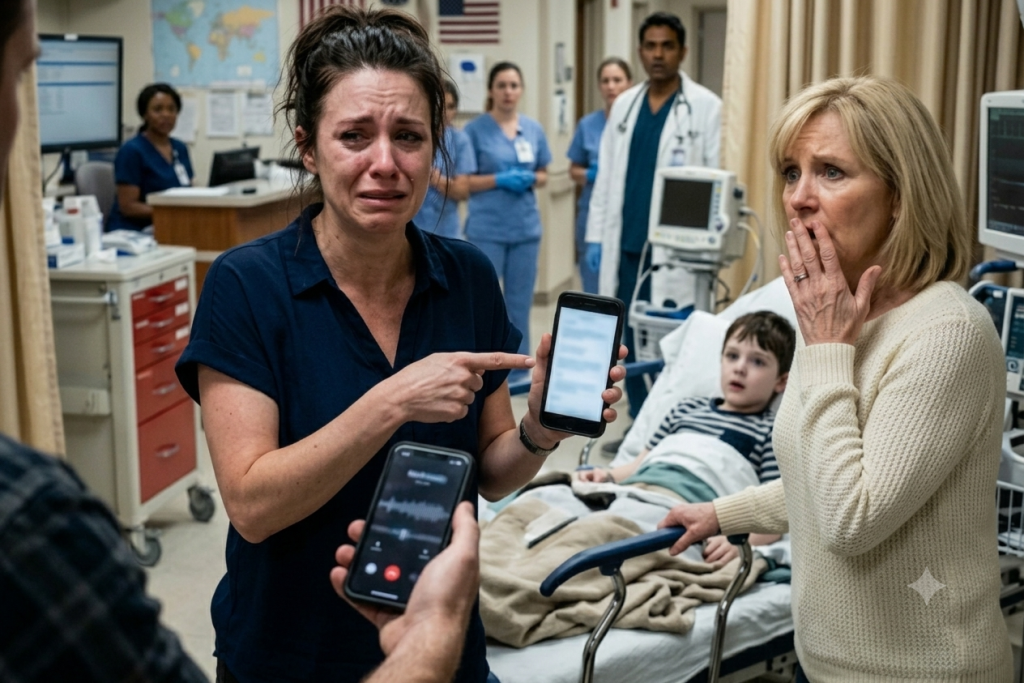
My son was found barefoot and barely conscious almost a mile from my mother-in-law’s apartment.
When she finally showed up at the ER, she smiled like nothing happened.
That was her first mistake.The ER smelled like sanitizer, wet clothes, and burnt coffee from the vending machine near the waiting room.
Every chair was full.
Every face looked like it was waiting for bad news.
Somewhere behind a curtain, a machine was beeping too fast, and every beep seemed to hit the center of my chest.
A nurse grabbed my shoulders with both hands.
“Ma’am, I need you to breathe,” she said. “Your son is alive, but we’re not out of danger yet.”
I heard the words.
I understood them in pieces.
Alive.
Danger.
Not out.
Then my knees gave way, and I hit the hospital floor before I even realized I was falling.
The nurse caught one of my arms.
Someone else pulled a chair toward me.
I could not sit.
I could not stand.
All I could do was stare at the beige curtain where my five-year-old son was lying behind strangers, machines, and the kind of fear a mother never fully recovers from.
Noah had been found behind Cedar Pines Apartments near the drainage canal.
Barefoot.
Soaked.
Barely conscious.
Almost a mile from Diane’s apartment.
Diane was my mother-in-law.
Diane was supposed to be watching him.
Just three hours.
That was all.
Our regular sitter had the flu, and I had a mandatory meeting at work I had already been warned not to miss.
I had hated asking Diane.
I had stood in my kitchen that morning with Noah’s little dinosaur backpack on the counter, watching Ethan scroll through his phone, trying to convince myself I was being unfair.
“She’s his grandmother,” Ethan said.
I wanted to say that being a grandmother was not the same thing as being safe.
Instead, I said, “Please make sure she understands. No errands. No leaving him with anyone else. Just cartoons, snacks, and three hours.”
Ethan kissed my forehead.
“Emily, it’s my mom,” he said. “She knows.”
That was the sentence I kept hearing later under the hospital lights.
She knows.
Diane had pulled into our driveway at 2:12 p.m. in her clean SUV, wearing lipstick and a cream cardigan, looking like she was doing us a favor large enough to be remembered at Thanksgiving.
Noah ran to her with his little sneakers squeaking on the floor.
She bent down and kissed the top of his head.
“Don’t worry, sweetheart,” she told me. “Grandma knows what she’s doing.”
I should have trusted the tightness in my stomach.
Instead, I packed his snack cup, his hoodie, and the blue blanket he still pretended he did not need.
I let my son climb into her back seat.
I waved from the porch.
That was the trust signal.
I let her call herself Grandma, and I let that word stand between my child and my instincts.
At 4:58 p.m., my meeting ran long.
At 5:11 p.m., I put my phone face down because my manager was standing beside the conference room screen.
At 5:26 p.m., a man I did not know found my son near the drainage canal behind Cedar Pines Apartments.
At 5:34 p.m., an unfamiliar number started calling me.
Sixteen missed calls appeared on my screen when I finally stepped into the office lobby.
I was holding a paper coffee cup that had gone cold in my hand.
The seventeenth call came through before I could even unlock my phone.
I answered because something in me had already started shaking.
“Are you Noah’s mother?” a man asked.
My mouth went dry.
“Yes,” I said. “Who is this?”
“Your child was found near the drainage canal behind Cedar Pines Apartments.”
For one second, I thought it was a scam.
A terrible prank.
The kind of thing that happens to other people on the news.
Then I heard Noah crying in the background.
Not whining.
Not fussing.
Crying like an animal that had run out of strength.
I dropped the coffee cup.
It burst across the lobby floor, brown liquid running under the security desk while the man kept talking.
I remember saying, “I’m coming.”
I remember calling Ethan over and over until he picked up.
I remember screaming, “Where is your mother?”
He did not answer right away.
That silence told me more than words.
“She’s not picking up,” he said.
I do not remember the drive to the hospital clearly.
I remember red lights smearing across my windshield.
I remember gripping the steering wheel so hard my fingers hurt.
I remember praying out loud, badly and desperately, without finishing a single sentence.
By the time I reached the ER, Noah was already behind a curtain.
A hospital intake worker pushed a clipboard toward me.
I signed where she told me to sign.
My name looked like it belonged to someone else.
A nurse asked me his full name.
“Noah Carter.”
His birthday.
His allergies.
His pediatrician.
His grandmother’s name.
When she asked that, my throat closed.
“Diane Carter,” I said.
The nurse wrote it down.
Process verbs make a nightmare feel official.
They documented his temperature.
They logged the time he arrived.
They bagged his wet clothes.
They clipped a hospital wristband around his tiny wrist.
They asked how long he had been alone.
Alone.
That word cracked something open inside me.
Ethan arrived twenty minutes after I did.
His face was gray, and his hair looked like he had been running his hands through it for the entire drive.
He reached for me.
I stepped back.
Not because I did not love him.
Because our son was behind a curtain fighting to stay warm, and Ethan’s mother had vanished.
“I called her,” he said. “She’s not answering.”
“You said she knew,” I whispered.
His eyes filled.
“Emily.”
“No,” I said. “You said she knew.”
He looked toward the curtain, and whatever defense he had been preparing died before it reached his mouth.
For nearly two hours, Diane did not answer.
The nurse came in and out.
A doctor told us Noah’s body temperature had dropped too low.
His blood sugar was unstable.
They were giving him fluids.
They were watching him closely.
They were not ready to say he was out of danger.
At 7:43 p.m., Diane walked through the sliding ER doors.
Lipstick perfect.
Pearl earrings on.
Same cream cardigan she wore to church.
She did not look scared.
She did not look guilty.
She looked annoyed.
“Oh, thank God,” Ethan said, rushing toward her. “Mom, where were you?”
Diane sighed like we had inconvenienced her.
“I went to lunch with Carol,” she said. “Noah was watching cartoons. He was fine.”
The words did not make sense.
They entered the hallway and changed the temperature of it.
The nurse at the intake desk stopped typing.
A man holding a plastic pharmacy bag looked over.
A woman with a toddler on her lap pulled the child closer.
I stared at Diane.
“You left him alone?”
Her eyes flicked to me.
Cold.
Flat.
Almost bored.
“He’s five, Emily,” she said. “Not a baby.”
There are people who apologize because they are sorry.
There are people who apologize because they are caught.
Diane did not even think she was caught yet.
The curtain opened behind us.
A nurse stepped out.
“Mom?” she said gently. “He’s asking for you.”
I walked past Diane without touching her.
Noah was awake, barely.
His face was too pale.
His hair was damp at the temples.
A heated blanket covered him almost to his chin, and his hand came out from underneath it, reaching for me.
“Mommy,” he whispered.
I bent over him.
“I’m here, baby.”
His fingers closed around mine.
They were cold even under the blanket.
“Grandma locked the door,” he said.
The room went still.
Ethan was behind me.
I felt him stop breathing.
Diane stepped into the doorway and gave a small laugh.
“Oh, he’s confused,” she said. “Children exaggerate.”
Noah started crying.
The monitor jumped.
The nurse put a hand on his shoulder.
“She said I ruined her day,” he sobbed. “She said if I wanted Mommy, I could go find her.”
Ethan turned toward his mother slowly.
Not angrily at first.
Like his body was refusing to let his mind reach the conclusion.
“Mom,” he said.
Diane’s mouth tightened.
“You’re going to take the word of a tired child over me?”
I looked at her then.
Really looked.
At the clean lipstick.
At the pearls.
At the cardigan that did not have a single wet mark on it while my son’s clothes were sealed in a hospital bag.
I saw what I had ignored for years.
The little corrections.
The comments about my parenting.
The way she called Noah “dramatic” when he cried and “spoiled” when he wanted me.
The way Ethan always said, “That’s just how she is.”
A family can teach you to doubt the warning bell in your own chest.
They call it peacekeeping when what they really mean is obedience.
Diane looked at me, smiled just enough for only me to see, and said, “Well, we had such a great time without him.”
Ethan gasped.
“Mom.”
For one ugly second, I wanted to scream.
I wanted to grab that cream cardigan and shake her until every person in that ER understood what she had done.
I wanted her to feel one ounce of the fear Noah had carried barefoot through the cold.
I did not.
I did not slap her.
I did not scream.
I did not give her the reaction she was waiting for.
Instead, I stepped back.
I lifted my phone.
And I pressed play.
The recording had started the moment Diane walked in.
Her voice filled the ER hallway.
“I went to lunch with Carol. Noah was watching cartoons. He was fine.”
Then mine.
“You left him alone?”
Then hers.
“He’s five, Emily. Not a baby.”
The hallway froze.
The nurse at the desk reached for the phone.
Ethan stared at his mother like someone had pulled the floor out from under him.
Diane’s smile disappeared so fast it almost made her look human.
“Emily,” she said. “Turn that off.”
I kept holding it.
The nurse beside Noah’s bed looked at me, then at Diane, then at the chart in her hand.
Her face changed.
Not shock.
Recognition.
That scared me more.
“Mrs. Carter,” she said quietly, “there’s something else you need to know.”
I looked at her.
She lowered her voice, but not enough to spare Diane.
“Someone called before you arrived.”
Ethan blinked.
“What?”
The nurse checked the notes clipped to the hospital intake form.
“The call came in at 6:12 p.m. A woman claimed to be Noah’s grandmother.”
Diane went very still.
The nurse continued.
“She said he wandered for attention. She said he was dramatic. She said his parents did not want unnecessary treatment.”
My blood went cold.
Diane whispered, “That is not what happened.”
The nurse looked at her.
“We keep call logs.”
Noah’s hand tightened around mine.
His eyes were fixed on Diane’s purse.
“She said Daddy would believe her,” he whispered.
Ethan made a sound I had never heard from him before.
Small.
Broken.
Ashamed.
He put one hand on the wall like his legs might give out.
“Noah,” he said. “What else did Grandma say?”
Diane stepped forward.
“That’s enough. He’s exhausted.”
The nurse moved between Diane and the bed.
“No,” she said. “You need to step back.”
Diane looked offended.
Offended.
As if boundaries were something only other people had to respect.
Noah’s lower lip trembled.
I leaned close.
“You can tell me, baby.”
He lifted one shaking finger toward Diane’s purse.
“She put my shoes in there,” he said.
Every adult in the room froze.
Diane’s hand moved toward the purse.
The nurse saw it.
“Do not touch that,” she said.
Ethan looked from the purse to his mother.
His face drained of the last bit of denial.
“Mom,” he whispered. “Open it.”
Diane lifted her chin.
“I will not be treated like a criminal.”
Nobody had used that word.
That was the thing about guilt.
Sometimes it introduces itself.
Security was called.
Not with sirens.
Not with drama.
Just a quiet call from the desk, a process verb spoken into a phone, another line added to the night.
The nurse documented Noah’s statement.
The intake desk preserved the call record.
A hospital social worker was asked to come down.
Ethan stood beside the wall, staring at his mother’s purse like it was a live wire.
When security arrived, Diane tried to turn soft.
She put one hand over her chest.
“I made a mistake,” she said. “I was overwhelmed. I thought he was old enough to sit for a little while.”
I looked at her.
“You locked him out.”
Her eyes sharpened.
“I did not.”
Noah cried harder.
The nurse said, “Enough.”
Then Diane made her second mistake.
She looked at Ethan instead of me.
“Tell them,” she said. “Tell them your wife has always hated me.”
Ethan flinched.
For years, that sentence would have worked.
Not because Ethan was cruel.
Because he was trained.
Diane had raised him to hear her discomfort as an emergency.
If she cried, he apologized.
If she pouted, he explained.
If she crossed a line, he asked everyone else to step back from it.
But that night, our son was in a hospital bed.
And there are some lines a man cannot step back from without losing himself.
Ethan bent down, picked up his phone from the hallway floor, and looked at his mother.
“No,” he said.
It was one word.
It sounded like a door locking.
Diane stared at him.
“What did you say?”
“I said no.”
He turned to the nurse.
“I want everything documented. The call. What Noah said. What she said when she walked in.”
Diane’s face twisted.
“Ethan.”
He did not look at her.
“And I want to know who I need to speak to about making sure she does not come near him again.”
I closed my eyes.
Not from relief exactly.
Relief was too clean a word for what I felt.
It was more like the first breath after being underwater too long.
The hospital social worker arrived with a folder and a calm face.
She asked questions in a voice that made room for answers.
Noah told her what he could.
Not everything at once.
Children do not give trauma in neat paragraphs.
They hand it over in pieces.
A locked door.
Wet grass.
Cold feet.
A car driving away.
Grandma saying, “Then go find her.”
Each piece went into the notes.
Each piece made Diane smaller.
Not physically.
She still stood there in her church cardigan, pearls shining under the ER lights.
But the authority she had carried into every room of our marriage began to drain out of her.
When security asked her to sit in the family waiting area, she refused.
When the nurse told her she could not approach Noah, she tried to push past.
When Ethan stepped in front of her, she slapped him across the face.
Not hard enough to injure him.
Hard enough to reveal herself.
The sound cracked down the hallway.
Nobody spoke for a second.
Then Ethan touched his cheek and looked at her with a grief so old it did not seem to belong only to that night.
“You’ve been doing this my whole life,” he said.
Diane’s mouth opened.
No excuse came out.
The security guard moved closer.
The social worker wrote something down.
I held Noah’s hand and felt his fingers finally warming under mine.
Later, after Diane was escorted out of the ER, Ethan sat beside our son’s bed and cried without sound.
He did not ask me to comfort him.
He did not defend her.
He did not say she meant well.
He said, “I am sorry.”
I believed him.
But believing an apology does not erase the damage that made it necessary.
Noah slept in short bursts that night.
Every time the monitor beeped differently, my body jolted.
Every time someone walked past the curtain, I looked up.
The nurse brought me a blanket I never used.
Ethan filled out forms with shaking hands.
At 11:18 p.m., the social worker returned with copies of the hospital notes and instructions for the next steps.
There would be reports.
There would be follow-up calls.
There would be statements.
There would be family consequences Diane could not smile her way through.
By morning, Noah’s temperature had stabilized.
He ate two bites of toast and asked for his blue blanket.
The one I had packed for Diane’s apartment.
The one she had left behind.
Ethan drove home first to get it.
He came back with the blanket, Noah’s favorite dinosaur pajamas, and a face that told me he had seen his mother’s apartment.
“What?” I asked.
He sat down heavily in the chair beside me.
“There were cartoons still playing,” he said. “His cup was on the coffee table. His shoes weren’t there.”
I looked at him.
He swallowed.
“They were in her purse.”
I turned toward Noah.
He was sleeping.
His little hand rested open on top of the blanket.
For a long time, neither of us spoke.
That silence was not like the hallway silence.
This one had weight, but it also had direction.
A line had been crossed.
A door had closed.
And finally, Ethan was standing on the right side of it.
Weeks later, people would ask why I recorded her.
They would ask it with curiosity, judgment, or that careful tone people use when they want a mother to be reasonable about the unreasonable.
The answer was simple.
I had spent years being told Diane did not mean it that way.
That she was old-fashioned.
That she was blunt.
That she loved Noah in her own way.
That night, I decided her own way needed witnesses.
The recording did not save my son.
The stranger who found him did.
The ER staff did.
Noah’s own brave little voice did.
But the recording stopped Diane from rewriting the room.
It stopped her from turning neglect into misunderstanding.
It stopped her from making me look hysterical while she stood there in pearls.
Carelessness has a sound.
So does truth.
Truth sounded like Diane’s voice coming out of my phone while every adult in that hallway finally heard what my son had survived.
Noah came home the next day.
He was tired.
He was clingy.
He cried when doors closed too loudly.
For weeks, he asked me if I knew where his shoes were.
Every time, I answered the same way.
“Yes, baby. I know. You’re safe.”
Ethan changed too.
Not perfectly.
People do not unlearn a lifetime in one hospital night.
But he stopped asking me to smooth things over.
He stopped answering Diane’s calls.
He started therapy.
He sat on the floor with Noah and let him be angry, scared, quiet, or five years old without correcting him into politeness.
One afternoon, months later, Noah stood at the front door in his sneakers and looked back at me.
“Mommy,” he said, “you won’t let me get lost?”
I crouched in front of him.
I could smell laundry soap on his hoodie.
I could hear Ethan in the kitchen packing snacks into a paper bag for the park.
Outside, the mailbox flag was up, and the small American flag our neighbor had stuck near the sidewalk moved in the breeze.
“No,” I said. “I won’t.”
He studied my face.
Then he nodded like he had decided to believe me.
That trust felt heavier than any apology.
Diane had taken a word that should have meant safety and tried to hide behind it.
Grandma.
But that night in the ER taught me something I will never forget.
A title does not protect a child.
A smile does not prove innocence.
And when someone shows you they are willing to risk your child to punish you, you do not argue with their image anymore.
You protect the child.
You document the truth.
You press play.
