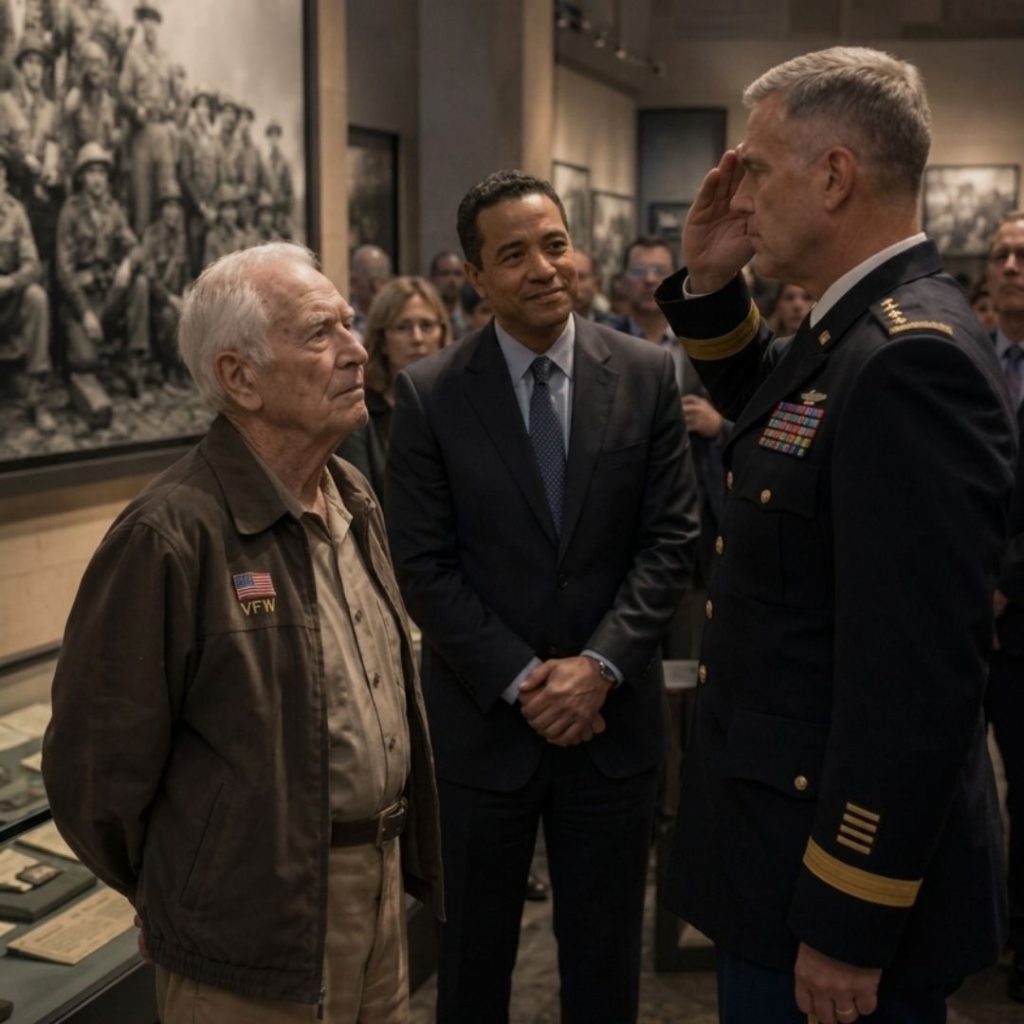
A Museum Curator Publicly Dismissed a Frail Old Veteran for Claiming He Could Identify Every Soldier in a “Lost” World War II Photograph—But When a Celebrated General Suddenly Recognized the Man, Saluted Him in Front of the Entire Gallery, and Revealed Who He Really Was, the Room Fell Into Stunned Silence…
“This photograph is of an unidentified unit,” the young curator announced, his voice echoing with polished confidence through the hushed gallery. “Historical records are incomplete, unfortunately. A casualty of the chaos of war.”
He gestured toward the massive wall-sized photograph behind him.
It showed a group of exhausted soldiers standing in a snow-covered forest, their faces hollow with cold, hunger, and the kind of fatigue that does not end when a man sleeps. Their uniforms were torn. Their helmets sat low. Frost clung to their sleeves and packs. Some of them stared directly into the camera. Others seemed to be looking past it, toward something only they could still hear.
The curator, Julian Croft, smiled at the small tour group as if he had just delivered something profound.
A few visitors nodded. A woman in a camel coat lifted her phone to take a picture of the plaque. A man near the back adjusted his scarf and whispered something about “anonymous sacrifice” to his wife.
Then an old man in a worn tweed coat stepped forward.
He leaned heavily on a simple wooden cane. His movements were slow, deliberate, and painful in the way of a body that had endured too much and then been asked to keep going for decades anyway. His coat was clean but threadbare at the cuffs. His trousers had seen better years. His shoes were polished, though the leather had cracked along the sides.
“Unidentified?” he asked.
His voice was a dry whisper that barely carried.
Julian turned with a practiced, patronizing smile.
“Sir?”
The old man’s pale blue eyes never left the photograph.
“I can name every single one of them.”
A small, uncomfortable silence moved through the group.
Julian’s smile remained, but it tightened around the edges.
“Sir, with all due respect, that’s simply impossible. This image has stumped historians for decades.”
The old man did not look away from the frozen faces.
“I should hope not,” he said.
A deep sadness colored the words.
“They were my boys.”
His name was Arthur Vance.
He had taken two buses to get to the city’s new Military Heritage Museum, a journey that left his old bones aching and his knees stiff enough that he had needed to sit on a bench outside the entrance for nearly ten minutes before stepping inside. He had not come for the gleaming tanks in the atrium or the restored fighter planes suspended from the ceiling. He had not come for the interactive maps, donor plaques, or polished glass cases full of weapons made safe by distance and lighting.
He had come for this photograph.
He had seen a small version of it in a newspaper article announcing the museum’s new winter exhibit. The image was grainy and poorly printed, but even in newsprint Arthur had recognized the slant of Captain Hayes’s shoulders, the way Danny Miller held his rifle too low, and the stubborn tilt of Russo’s chin.
The picture had pulled him from his quiet, solitary life like a ghost’s summons.
Arthur lived alone in a small apartment three neighborhoods away from anyone who remembered his younger name. His days were simple: tea, toast, library books, the same chair by the window, the same short walk when the weather allowed, the same evening news he watched without really hearing. Medals, commendations, faded letters, and a few photographs were packed away in a dusty footlocker beneath his bed, silent testimony to a life he rarely discussed.
Not because he was ashamed.
Because speaking of the dead requires strength, and some days strength is needed simply to stand.
That morning, however, silence had not been an option.
He had dressed in his best coat, straightened his tie twice in the mirror, tucked a handkerchief into his pocket, and left early enough to make both buses. He had carried no documents. No medals. No proof except the one thing no museum display could manufacture.
Memory.
Now he stood before the photograph.
It was larger than he had imagined. Each face was rendered in stark, grainy detail. The exhaustion was there. The fear. The defiant grit. The frost on their collars. The haunted steadiness of boys trying to look like men because men behind them had already fallen.
The official plaque mounted beside it was brief and clinical.
Unidentified platoon, 101st Airborne Division, presumed taken near Bastogne, Belgium, December 1944. A poignant reminder of the anonymous sacrifices of war.
Anonymous.
The word struck Arthur like a physical blow.
These men were anything but anonymous to him.
They were the sound of laughter in a freezing foxhole. The sharing of a last cigarette. The smell of wet wool and cordite. The weight of a promise made in the dark. They were voices calling through snow. Hands gripping sleeves. Jokes told through chattering teeth. Letters read and reread until the paper softened at the folds.
Julian Croft continued leading his small tour group, his voice confident and academic as he spoke of supply lines, strategic importance, and the brutal winter campaign.
“The tragedy here,” Julian said, “is that we will likely never know who these brave men were. Their identities are lost to history, making their sacrifice a purely symbolic one.”
Arthur felt a tremor in his hand.
He stepped closer to the glass barrier.
His gnarled finger rose.
“Danny,” he murmured, voice cracking. “Danny Miller from Ohio. He was scared of mice.”
Julian’s lecture faltered.
He had noticed the old man staring intensely at the photograph, but now the man had spoken. The curator moved toward him, his smile shifting into a mask of professional concern.
“Excuse me, sir. Are you all right? It’s a very powerful exhibit. I understand it can bring up a lot of emotions.”
Arthur did not look at him.
His eyes moved from one face to the next.
“And that’s PFC Russo. We called him Romeo because he got more letters than the rest of us combined. Next to him, Doc Peterson. He wasn’t even a medic, just a farm boy who was good at patching people up.”
Julian’s smile tightened.
The old man was becoming a distraction.
“Sir, that’s a lovely thought,” he said gently, “but as I said, there’s no way to verify any of that. Memory can be a tricky thing after so many years.”
His tone was careful, the kind one might use with a confused child or a customer in need of quiet removal.
“We appreciate your personal connection, but here at the museum we must rely on documented, verifiable facts.”
The small crowd shifted uncomfortably.
Some looked at Arthur with pity. Others with mild irritation. They had paid for a guided tour, not for an old man’s trembling interruption.
At the edge of the group, a young museum intern named Chloe watched with a troubled expression. She had been shadowing Julian for two weeks and had learned when to stand still, when to smile, and when to say nothing. But she saw the old man’s face. Not confusion. Not performance. Conviction so deep it looked painful.
Arthur seemed not to hear Julian’s dismissal.
He was lost in that frozen forest, walking among his men.
“Captain Hayes,” he continued, his voice gaining a fragile strength. “Always chewed an unlit cigar. Said it kept his teeth from chattering. Over there, that’s Private First Class Chen from San Francisco. Only eighteen. Lied about his age to enlist with his older brother. Corporal Evans beside him. Always writing letters to his girl back in Tennessee with a pencil so small you could barely see it.”
He named a dozen men.
Each name carried a detail.
A hometown.
A habit.
A joke.
A fear.
A small truth no history book could contain.
“Sergeant Miller,” Arthur whispered, pointing to a broad-faced soldier near the left edge. “He sang hymns when the shelling got close. Couldn’t carry a tune in a bucket, but nobody told him because it helped the new boys breathe.”
The word Sergeant stopped someone near the entrance.
A side door had opened, and a small group entered the gallery. At their lead was a tall, broad-shouldered man in a dark tailored suit, his posture ramrod straight and his face weathered by age, command, and the kind of memories that never entirely leave military men.
General Marcus Thorne, retired.
A celebrated figure in the military community and one of the museum’s major patrons, he had arrived for a private tour before a fundraising dinner. The museum director hurried at his side, eager and deferential.
Thorne paused.
His sharp eyes took in the scene: the flustered curator, the approaching security guard, the uncomfortable visitors, and the old man with his back to them, speaking softly to the photograph.
Then Thorne heard Arthur say the name.
Sergeant Miller.
The general froze.
Something moved across his face.
Disbelief.
Then recognition.
Julian’s patience snapped before Thorne reached them.
“Sir, I am going to have to ask you to stop,” Julian said, voice sharp now, stripped of its museum softness. “You are disrupting the tour and, frankly, spreading misinformation. This is a place of historical accuracy.”
He glanced over his shoulder, discreetly signaling the security guard to move closer.
Arthur lowered his hand.
Not because he agreed.
Because the old body is sometimes slower than the heart that lives inside it.
The security guard reached the edge of the group, uncertain but obedient.
Before he could speak, General Thorne waved off the museum director, who had started toward him with a nervous smile. The general’s focus was entirely on Arthur.
He walked forward.
His expensive shoes made almost no sound on the polished floor.
He stopped just behind the old man and listened for another moment as Arthur quietly spoke another name.
Then, in a voice unexpectedly gentle, the general said, “Arthur? Arthur Vance?”
Arthur flinched.
The voice pulled him from the winter.
He turned slowly, body stiff, cane trembling slightly beneath his hand. He looked up at the powerful man before him, and for a moment his cloudy eyes searched the face the way old minds sometimes search across decades.
Then they cleared with a spark of memory.
“Marcus,” he breathed. “Marcus Thorne. You were just a fresh-faced lieutenant then. Always tripping over your own feet in the snow.”
A rare, sad smile touched Arthur’s mouth.
General Thorne’s stern expression softened completely, replaced by profound and undisguised respect.
He turned toward the stunned curator and the silent crowd.
When he spoke again, his voice was no longer gentle.
It was command.
“This man is not spreading misinformation.”
The words cracked through the gallery like a rifle shot.
“He is providing historical testimony.”
Julian’s face reddened.
“General, I was only—”
Thorne lifted one hand.
Julian stopped.
The general looked back at Arthur, then pointed to a face in the photograph—a young, determined soldier in the back row, helmet low over his eyes, jaw set against cold and fear.
“And how do you know all their names so well, Arthur?”
Arthur followed his gaze.
He looked at the young man in the picture.
A boy of twenty.
Then he slowly raised a trembling hand to his own chest.
“Because that one,” he said, voice thick with unshed tears, “that one’s me.”
A collective gasp rippled through the onlookers.
Julian Croft’s face, which had been red with irritation moments earlier, drained of color. He looked from the old man to the young soldier in the photograph, and the resemblance across seventy-five years of hardship struck him like a physical blow.
The same eyes.
The same brow.
The same stubborn set of the mouth beneath the collapse of age.
General Thorne’s gaze fixed on Julian, cold and unforgiving as a winter battlefield.
“This is not an unidentified platoon,” the general declared. “This is Third Platoon, Able Company, 506th Parachute Infantry Regiment. And this man is their platoon sergeant, First Sergeant Arthur Vance.”
The gallery had gone still.
“The man who held the line near Noville when command had written them off for dead. The man who led these soldiers—his soldiers—through a frozen hell I would not wish on my worst enemy.”
Thorne took a step toward Julian, who involuntarily shrank back.
“You talk about documented facts. Let me give you one, Mr. Croft. The reason the records for this platoon are incomplete is because their position was overrun. The paperwork, the after-action reports, the casualty lists—most were burned, lost, or buried in the attack. The only complete record that survived was the one men like Sergeant Vance carried in their heads and their hearts.”
The general’s voice lowered into a dangerous growl.
“This man’s memory is a living archive, more precious than any document you have in your climate-controlled vaults. You didn’t just dismiss an old man today. You dismissed a hero. You dismissed the very history this museum is sworn to protect.”
He pointed toward Arthur, but his eyes never left Julian.
“You looked at him and saw a nuisance. I look at him and see a man to whom I, and this country, owe an unpayable debt.”
Julian stammered.
“General, sir, I had no idea. Our protocols, the verification process—”
“Your protocols failed,” Thorne roared, cutting him off. “Your arrogance failed. You saw a worn coat and a cane, and you judged him. You didn’t see the soldier.”
Then Thorne turned his back on the disgraced curator and faced Arthur once more.
The fury vanished from his face.
In its place came deep, unwavering respect.
He drew himself to his full height, back ramrod straight, and executed a slow, perfect salute.
“First Sergeant Vance,” he said, “it is an honor to stand in your presence again.”
For a moment, there was only silence.
Then the young security guard, an Iraq War veteran with a small American flag tattoo near his wrist, snapped to attention and rendered his own salute.
A few visitors began to applaud, softly at first, wiping tears from their eyes. The sound grew carefully, respectfully, until it filled the gallery not like noise, but like a promise arriving late.
Arthur looked overwhelmed by the sudden turn of events.
He gave a small, tired nod, accepting the salute with the same quiet grace he had carried all day.
Then he turned back to the photograph.
His family of ghosts.
“They were good boys,” he whispered to General Thorne. “Every last one of them.”
The museum director rushed to Arthur’s side, mortified and apologizing so quickly his words nearly tripped over one another. He promised the plaque would be corrected before the museum closed that day. He offered Arthur a lifetime honorary membership, a private car home, and access to the museum’s archival team. His voice was humbled when he asked whether Arthur might be willing to sit down with their historians and document the stories of the men in the photograph.
Arthur did not answer immediately.
His eyes remained on the soldiers.
Finally, he said, “If it means their names go up, I’ll talk.”
The director swallowed.
“They will.”
Julian Croft was quietly escorted from the gallery by a senior board member. His face had become a canvas of shame and professional ruin. Chloe, the intern, watched him go. Then she looked back at Arthur and understood, perhaps for the first time, that history was not only what lived in files and archives.
Sometimes it arrived on two buses, wearing a threadbare coat, leaning on a wooden cane.
A week later, Arthur sat in a comfortable chair in a quiet archival room at the museum. The massive photograph had been temporarily moved there for him. Under softer light, the faces looked less like symbols and more like men interrupted.
Across from him sat Chloe and the museum’s lead historian. A tape recorder ran between them. On the table lay notebooks, sharpened pencils, archival gloves, and a stack of forms that suddenly seemed less important than Arthur’s breathing.
He pointed to the first face.
“That’s Captain Hayes,” he said. “He had a wife named Margaret and a little girl he called Bee because she never sat still. He chewed that cigar right up until Christmas Eve. Never lit it. Said if he ever got home, he’d smoke it on his porch. He didn’t get home.”
Chloe wrote carefully.
Arthur moved to the next face.
“Danny Miller. Ohio boy. Scared of mice, like I said. Brave under fire, but if a mouse ran through a barn, he’d climb the wall like a cat. He had a brother named Paul. Worked in a tire shop.”
Next.
“Russo. Anthony Russo, from Brooklyn. We called him Romeo. He got letters from three girls and swore he was going to marry all of them if the Army would let him.”
The historian smiled despite himself.
Arthur did not.
“Romeo froze to death on the twenty-second. Gave his gloves to Chen. Said he had warm hands.”
The smile disappeared.
Hour after hour, Arthur gave them names.
Hometowns.
Habits.
Fears.
Promises.
Who snored.
Who prayed.
Who lied about his age.
Who cried quietly when mail came late.
Who made coffee from melted snow so bitter it could have stripped paint.
Who sang.
Who stole extra socks.
Who carried a photograph until it fell apart.
Who died quickly.
Who did not.
The tape recorder turned.
Chloe’s hand cramped.
The historian removed his glasses twice to wipe his eyes.
Arthur spoke until his voice rasped.
When they asked whether he needed to rest, he shook his head.
“I’ve rested enough,” he said. “They’ve waited long enough.”
In the main gallery, where the photograph would soon return, a new brass plaque was already being engraved.
The Heroes of Third Platoon.
Below the title, in solemn rows, were the names Arthur had refused to forget.
First Sergeant Arthur Vance.
Captain Robert Hayes.
Sergeant Daniel Miller.
Private First Class Anthony Russo.
Private First Class William Chen.
Corporal James Evans.
And the others.
Not anonymous.
Never anonymous.
When the exhibit reopened the following month, Arthur attended in the same tweed coat. This time, a car brought him. General Thorne stood beside him. Chloe, now promoted to assistant archivist, held the corrected program in both hands like something sacred.
The crowd was larger than before.
Veterans. Families. Donors. Students. Reporters. Museum staff. People who came because they had read about the mistake and the correction, the old man and the photograph, the curator who dismissed him, the general who recognized him.
Arthur did not care for the attention.
But he stood through it.
The museum director approached the podium and apologized publicly. Not in the careful, defensive language institutions often use, but plainly. He said the museum had failed. He said history had been standing in the room and they had almost escorted it out. He said the corrected exhibit would become the foundation of a new oral-history initiative dedicated to capturing veteran testimony before it was lost.
Arthur listened without expression.
Then General Thorne was invited to speak.
He stepped to the podium, looked out across the gallery, and said, “We use the word sacrifice too easily when the people who sacrificed are no longer in the room to correct us.”
The gallery quieted.
“This photograph was once labeled anonymous. That word was not just inaccurate. It was an injury. These men had names. They had mothers, brothers, wives, sweethearts, bad habits, jokes, fears, and dreams. Their lives did not become symbolic because paperwork burned.”
He turned toward Arthur.
“And one man carried them for seventy-five years.”
Arthur looked down at his cane.
Thorne’s voice softened.
“We are late, First Sergeant. But today, we finally say their names.”
One by one, the names were read aloud.
For each name, Arthur closed his eyes.
Not every time.
Only when the voice hit a place inside him that had stayed frozen since 1944.
At the end, the room stood.
No one told them to.
They simply stood.
Applause rose slowly, then faded into silence as the photograph was unveiled with its new plaque beneath it. Arthur stepped forward and touched the glass lightly, not over his own younger face, but over the row of men beside him.
“See there,” he whispered. “Told you I’d get you home.”
No one near him spoke.
No one had the right.
In the months that followed, Arthur returned to the museum every Thursday. Sometimes he spoke to historians. Sometimes to school groups. Sometimes he sat quietly in front of the photograph and said nothing at all.
Children asked him whether he had been scared.
“Yes,” he told them.
Every time.
They asked how he became brave.
“I didn’t,” he said. “I just had men counting on me.”
Adults asked more complicated questions and often understood less.
One afternoon, Chloe found him alone in the archival room, looking at a newly digitized copy of the photograph.
“Do you ever wish you hadn’t come that day?” she asked.
Arthur looked surprised.
“To the museum?”
“Yes.”
He considered it.
“No.”
“Even after how Mr. Croft spoke to you?”
Arthur’s mouth twitched.
“He was young.”
“He wasn’t that young.”
“Younger than me.”
“That’s almost everyone.”
This time Arthur did smile.
Then he looked back at the photograph.
“I almost didn’t come,” he said. “Saw the picture in the paper. Thought maybe I should let it be. Thought maybe old ghosts don’t need waking.”
“What changed your mind?”
Arthur tapped his cane gently against the floor.
“Anonymous,” he said. “That word.”
Chloe nodded.
“I couldn’t leave them under it,” he continued. “A man can bear being forgotten himself. That’s easy enough if he lives long enough. But carrying men all those years and then seeing them called anonymous? No. That I couldn’t bear.”
Chloe looked at the digitized faces.
“Do you remember all of them clearly?”
Arthur was quiet.
“Not always. Some days their faces are sharp. Some days the names come first. Some days I remember a laugh and have to wait for the face to follow. Memory isn’t a file cabinet, Miss Chloe. It’s more like weather. Comes clear. Goes foggy. But love remembers what it can.”
She wrote that down later.
Not for a label.
For herself.
Julian Croft resigned before the review board could remove him. Months later, he wrote Arthur a letter. It was stiff at first, then less so. He apologized for his arrogance, for hiding behind verification when humility was required, and for mistaking education for wisdom.
Arthur read it twice.
Then he folded it and placed it in the footlocker beneath his bed.
He did not write back immediately.
A week later, he sent three sentences.
Mr. Croft,
History is not embarrassed by correction. Only pride is.
Do better with the next old man.
Arthur Vance
The letter became famous inside the museum, though Arthur never knew that. Chloe copied the second sentence onto a card and kept it taped inside her desk drawer.
Years passed.
Arthur’s visits became less frequent as his legs weakened. Then one winter, he stopped coming altogether. Chloe visited him in his apartment with a recorder, tea, and a stack of printed photographs. The footlocker sat open beside his bed now. Medals, letters, and old newspaper clippings had been sorted into careful piles.
“You finally opened it,” Chloe said.
Arthur looked toward the locker.
“Figured it was time.”
Inside, she found a letter still wrapped in wax paper.
It was addressed to Danny Miller’s brother in Ohio but had never been mailed.
Arthur saw her looking at it.
“I wrote that in 1945,” he said. “Never sent it. Didn’t know how to tell a man his brother died singing off-key in the snow.”
Chloe’s eyes filled.
“Do you want me to help you find the family?”
Arthur closed his eyes.
“Yes.”
They found them.
Not all at once.
But one by one, families of Third Platoon began to come to the museum.
A granddaughter from Tennessee brought Corporal Evans’s letters. A nephew of Russo arrived from Brooklyn with a photograph of Anthony in a borrowed suit. The Chen family came from California and stood for a long time beneath the plaque, reading the name of a boy who had lied about his age and lived long enough in Arthur’s memory to be found again.
Danny Miller’s great-nephew came last.
He brought a small wooden cross that had belonged to Danny’s mother.
Arthur held it in both hands and cried without sound.
The museum changed around the photograph.
What had once been a brief anonymous display became one of its most visited exhibits. Not because of strategy maps or military hardware, but because people stood before those faces and read the names. They listened to Arthur’s recorded voice describing who laughed, who prayed, who carried extra socks, who shared gloves, who never made it home.
History had become personal again.
The way it should have been from the beginning.
When Arthur Vance died, the museum closed the gallery for one day.
General Thorne attended the funeral in uniform. Chloe sat in the second row. The young security guard who had saluted Arthur that first day stood near the back. Families of Third Platoon sent flowers from states Arthur had never visited but had carried in his heart for most of his life.
At the service, General Thorne spoke briefly.
“Arthur Vance did not ask to be remembered,” he said. “He asked us to remember his men. That is why we will remember him too.”
Afterward, Chloe returned to the museum alone.
She stood before the photograph.
The plaque had been updated once more.
The Heroes of Third Platoon
Identified through the testimony of First Sergeant Arthur Vance, Able Company, 506th Parachute Infantry Regiment, who carried their names for seventy-five years and returned them to history.
Chloe read the words twice.
Then she looked up at the faces.
No longer anonymous.
No longer symbolic.
Men.
Young. Cold. Frightened. Brave.
Remembered.
And in the back row, helmet low over his eyes, stood Arthur Vance at twenty years old, unaware that one day he would become the last witness, the living archive, the old man in a worn tweed coat who would take two buses across the city because love had not allowed him to stay home.
THE END
