Luke had been twenty-two then.
Tom had tried to be both parents after that, and failed in ways only a quiet son would notice but never name.
The barn door slid open behind him.
Tom turned.
Luke Walker stepped into the yard carrying a stack of feed records under one arm.
He was tall and lean, just over six feet, with dark brown hair that constantly fell across his forehead no matter how often he pushed it back. He had his mother’s narrow face and Tom’s eyes, though Luke’s were steadier, quieter, as if the world entered him through observation rather than argument. Neighbors often mistook that silence for shyness. Tom knew better. Luke rarely spoke unless he had thought through what he meant to say, and when he did speak, he had the irritating habit of making other people feel too loud.
“You talked to the buyer today?” Luke asked.
Tom nodded.
“They’ll be here Friday.”
Luke said nothing.
Tom hated that silence.
Not because it was angry. Anger would have been easier. It was thoughtful, and thoughtful people were difficult to argue with because they did not simply throw words back at you. They examined them, weighed them, and sometimes handed them back sharper than before.
“The offer is fair,” Tom said. “It clears every debt, gives us a clean start.”
Luke set the records on the workbench just inside the barn.
“And after that?”
Tom frowned. “What do you mean?”
“What happens after that?”
Tom let out a tired breath.
“You leave this town.”
Luke looked away toward the north pasture.
“You’ve said that before.”
“Because it’s true.” Tom stepped closer, his boots grinding dry dirt. “Luke, I don’t want you spending the next thirty years fighting the same battles I fought. You deserve better.”
For a moment, neither man spoke.
From the far pen came the sound of cattle shifting, one animal lowing softly as dust moved through the lot. The ranch seemed to be holding its breath with them.
Finally, Luke said, “Maybe you’re looking at the wrong thing.”
Tom stared at him.
“The wrong thing?”
“The ranch isn’t the problem.”
Tom almost laughed, but he was too tired.
“Then what is?”
Luke hesitated. Not with uncertainty, exactly, but as if he knew how ridiculous the answer would sound before he said it.
Then he pointed toward the far pasture, toward a single black Angus bull grazing alone near the water trough.
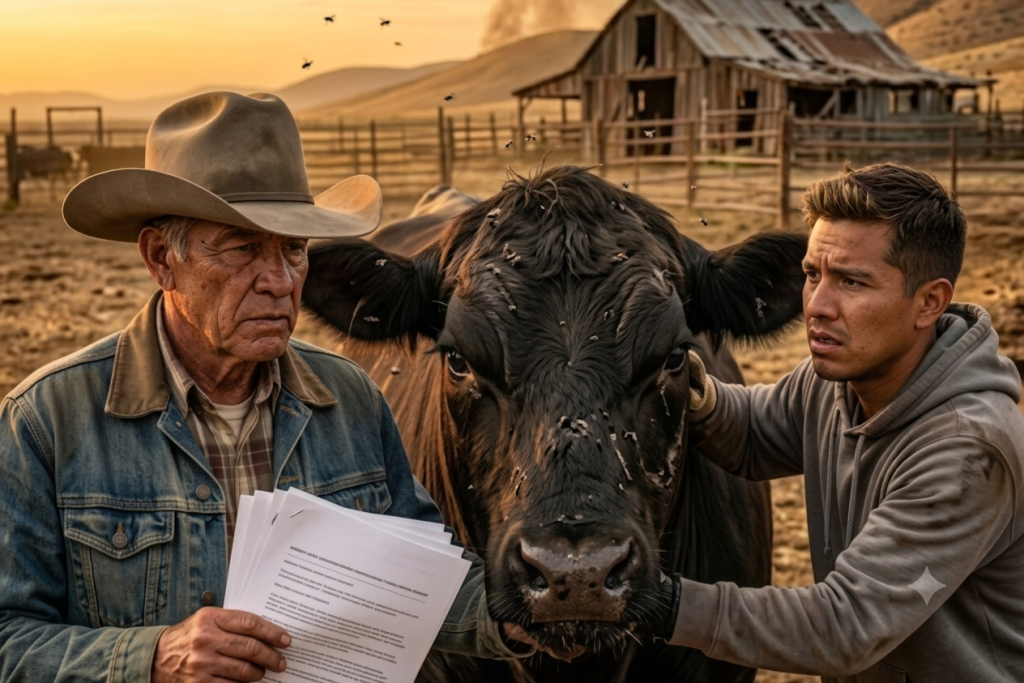
The bull was old now. His black coat had begun to fade around the shoulders and muzzle, sun-burnished in patches where age had softened the shine. Scars marked his neck from years of testing younger bulls and being tested in return. His back was not as straight as it once had been. His head carried heavier now, not from weakness, but from time. Most ranchers would have sold him years earlier.
His name was Duke.
Tom looked at the bull, then back at his son.
“Luke,” he said carefully, “don’t tell me this is about Duke.”
“It is.”
Tom rubbed his forehead.
The bank was coming. The buyer was coming. Every debt they owed had gathered around the ranch like coyotes. Everything they owned was hanging by a thread, and somehow his son was talking about an aging bull that most men in the county would have already turned into hamburger.
But Luke’s expression never changed.
There was no embarrassment in it. No childish pleading. No sentimental attachment. Only conviction.
That unsettled Tom more than any argument could have.
Because Luke rarely believed in anything without a reason.
And for the first time that afternoon, Tom wondered if his son knew something he did not.
The following morning, Luke was in the calving pasture before sunrise.
The air had that bitter early-spring edge Nebraska keeps even when the calendar promises warmth. A thin line of orange pressed against the east, but the prairie remained mostly dark, the cattle still shapes moving slowly through the half-light. Luke walked with a flashlight in one hand and a small notebook in the other, his boots making soft sounds in the dry grass.
Most ranchers in the county judged their herds by appearance first. They looked for frame, muscling, depth, bone, coat, fertility, easy movement, an animal’s way of carrying itself. Luke looked at those things too. He had learned from Tom, and Tom had learned from his father. But Luke had spent nearly ten years studying something else.
Numbers.
Patterns.
Results.
Back in the small office attached to the barn, dozens of notebooks filled an old wooden bookshelf. Every notebook was labeled by year. Every page held handwritten observations in Luke’s careful print: birth weights, weaning weights, feed consumption, veterinary treatments, winter survival, breeding dates, pasture rotation, illness, recovery time, rainfall, supplemental hay, and notes about temperament, mothering ability, and how quickly calves found their feet after birth.
The habit had started when Luke was sixteen.
Most teenagers in western Nebraska spent weekends hunting, playing football, chasing girls, fixing trucks, or finding ways to be wherever adults were not. Luke spent evenings weighing calves, checking tag numbers, and writing down things other people trusted themselves to remember.
Neighbors laughed about it.
Some called him “the professor.”
A few meant it kindly.
Most did not.
Luke never cared. He trusted data more than opinions, including his own. Especially his own.
That morning, he opened a notebook from six years earlier and placed it beside several newer records. Then he began comparing again, though he had done it so many times he already knew what he would find.
The same pattern appeared.
Calves descended from Duke consistently outperformed the others.
Not dramatically. Not in the kind of way a casual buyer would spot across a sale ring. A few pounds heavier at birth without being too large. Faster to stand. Slightly better condition during drought. Lower veterinary costs. Stronger survival through winter storms. Daughters that bred back sooner. Sons that converted feed more efficiently.
Small differences.
But small differences across one year become noticeable across three.
Across ten, they become impossible to ignore.
Around midmorning, Tom entered the office carrying a cup of black coffee. He looked as if he had not slept. The dark circles beneath his eyes had deepened since the meeting with Prairie Star’s representative. His beard was uncombed. His shoulders seemed lower than usual.
“You’ve been staring at those books all night again, haven’t you?” Tom asked.
Luke nodded.
Tom sat heavily in the chair near the desk.
For several moments, neither spoke.
Finally, Luke slid three notebooks across the desk.
“Look at these.”
Tom sighed, but opened the first one.
Rows of numbers filled the pages.
To Luke, the records told a story.
To Tom, at first, they looked like homework.
“What am I supposed to see?”
Luke pointed to a series of columns.
“Compare Duke’s calves to the others.”
Tom studied the pages.
Slowly, his expression changed.
Not because he fully understood, not yet, but because the consistency surprised him. The same advantage appeared again and again, across different years, different cows, different weather.
Still, he shook his head.
“Even if you’re right, Luke, what does it change?”
“It changes everything.”
“No.” Tom closed the notebook. “It doesn’t change the bank.”
The words landed heavily.
Neither man needed to say more.
The ranch owed more than it could repay. Good calves would not solve that problem overnight. Good records did not stop foreclosure. A bull’s bloodline, however promising, could not call the banker and ask for patience.
That afternoon, another visitor arrived.
Carl Benton’s pickup came through the ranch gate in a plume of dust.
Carl was fifty-two, tall and heavily built, with a thick neck, weathered skin, a sandy mustache going gray, and a scar across his chin from a rodeo accident he had somehow turned into three different stories depending on his audience. He owned one of the largest ranches in the county and rarely visited neighbors without a reason.
When his truck rolled into the yard, Tom knew the visit was not social.
Carl stepped out and removed his hat.
“Heard about the sale,” he said.
Tom nodded.
“News travels fast.”
“News like that does.”
Carl glanced toward the pasture where Duke grazed alone.
“You planning to sell the old bull too?”
Luke appeared from the barn before Tom could answer.
“No.”
Carl turned.
“That thing is still alive?”
Luke did not smile.
Carl noticed and chuckled.
“You serious?”
“I’m keeping him.”
Carl laughed harder this time.
“Son, that bull should’ve been hamburger five years ago.”
The comment irritated Tom more than he expected. Not because he disagreed completely, but because Luke’s reaction was strangely calm. Almost confident. Carl eventually left, shaking his head, but the visit confirmed something important.
Everyone saw Duke as nearly worthless.
Everyone except Luke.
Over the following weeks, another concern emerged.
Prairie Star Livestock, the company buying the ranch, was not just interested in land. They wanted the entire operation: buildings, water systems, equipment, grazing leases, cattle, and bloodlines. Everything.
Prairie Star was one of the fastest-growing cattle corporations in the Midwest, buying distressed family operations at prices large enough to feel generous and small enough to make shareholders happy. According to rumor, they were willing to pay more than market value for the Walker place.
Much more.
One evening, Luke sat at the kitchen table reviewing records when Tom came in with a letter.
He opened it, read two lines, and his face tightened.
“What is it?” Luke asked.
Tom handed over the document.
Prairie Star wanted to inspect the ranch before finalizing the offer.
The inspection would take place in less than two weeks.
Luke read the letter twice.
Then he looked out the window.
Across the dark pasture, Duke stood beneath a fading sunset. The old bull seemed ordinary. Nothing about him suggested value. Nothing about him suggested importance. He was just an aging black Angus bull in a dry pasture on a ranch everyone believed was finished.
But Luke could not shake the feeling that everyone was missing something.
And if he could not prove it before the inspection arrived, the Walker ranch would be gone forever.
Spring arrived slowly across western Nebraska in 2005.
Patches of green returned to the prairie, but the scars left by three years of drought remained visible everywhere. Bare slopes still showed where grass had thinned too far. Ponds held low rings around their banks like dirty collars. Fence corners trapped tumbleweeds and dust. The Walker Ranch looked better than it had the previous summer, but better was not the same as saved.
Grass could grow back.
Debt rarely disappeared so easily.
The Prairie Star inspection team arrived on a Wednesday morning.
Three pickup trucks rolled through the ranch gate shortly after sunrise. Men in pressed work shirts stepped out carrying clipboards, tablets, and folders. They were not ranchers in the old sense, though some had grown up near cattle and knew enough not to wear city shoes. They were businessmen studying numbers, assets, liabilities, projections.
Leading them was Grant Mercer.
Grant was forty-eight, tall, and sharply dressed even on dusty ground. His dark hair was neatly combed. A trimmed beard framed a face that rarely revealed emotion. Years earlier, he had grown up on a small cattle operation in Kansas, but after his family lost their ranch during the agricultural downturn of the 1980s, he had dedicated himself to corporate agriculture.
Losing his family’s land had not made him sentimental.
It had made him efficient.
Grant trusted spreadsheets more than memory and margins more than tradition. He shook Tom’s hand firmly.
“You’ve built a beautiful operation here,” he said.
Tom appreciated the compliment, but both men understood why Grant had come.
To buy it.
For hours, inspectors examined everything: fences, equipment, water systems, pastures, herd inventories, calving records, feed storage, liability risks, road access, sale history, and the structural condition of every building that still stood. Luke followed quietly behind them.
Several times, he noticed inspectors stop near Duke.
Each time, they made notes.
Each time, they moved on.
No one seemed particularly interested in the old bull.
By late afternoon, Grant Mercer sat across from Tom at the kitchen table. Luke stood near the counter with his arms folded. The offer was placed between them.
The number was larger than Tom had expected.
Large enough to erase every loan.
Large enough to repair every mistake.
Large enough to guarantee Luke would never have to worry about money again if he chose a life somewhere else.
For several minutes, Tom simply stared at the paper.
His hand rested beside the contract.
One signature.
That was all it would take.
That evening, after the inspectors left, Luke entered the house carrying a heavy cardboard box.
Without speaking, he placed it on the kitchen table.
Tom looked inside.
Dozens of notebooks.
“Luke,” Tom began.
“Just look.”
The sun had already disappeared beyond the horizon. The old kitchen clock ticked quietly as father and son sat together under the yellow kitchen light.
At first, Tom flipped through the notebooks reluctantly.
Then more carefully.
Then with complete attention.
Page after page revealed the same pattern.
Duke’s descendants consistently performed better.
Not once.
Not twice.
Every year.
The record stretched back over a decade: birth weights, growth rates, veterinary expenses, winter survival percentages, feed efficiency, breeding success, mothering ability, drought condition scores.
Tom noticed something he had not understood before.
Luke had not only recorded the successful animals.
He had recorded every animal.
Good and bad.
Strong and weak.
The data was not selective.
It was complete.
Around midnight, Luke unfolded several large charts he had spent months preparing. For the first time, the numbers became impossible to ignore. The differences were not dramatic in a single season, but over ten years, they became enormous.
A ranch producing slightly healthier cattle every generation eventually produced a significantly stronger herd.
Tom leaned back.
Silence filled the room.
He felt something unfamiliar.
Doubt.
Not doubt about Luke.
Doubt about himself.
For months, Tom had believed selling was the responsible choice. Now he was not so sure.
“What if you’re wrong?” Tom finally asked.
Luke looked directly at him.
“What if I’m right?”
The question lingered long after neither man spoke.
Tom barely slept that night.
Before sunrise, he walked the property alone. Past the barns. Past the water tanks. Past the calving shed where he had slept on hay bales during storms. Past the fields his father once managed. Eventually, he reached the pasture where Duke stood grazing.
The old bull lifted his head briefly before returning to the grass.
Nothing about him looked extraordinary.
No trophies.
No famous show-ring record.
No glossy catalog page.
Just an aging black Angus bull with scars on his neck and gray around his muzzle.
Yet somehow the future of the ranch seemed connected to him.
Tom stayed there nearly an hour, thinking, remembering, questioning.
When the sun finally rose above the prairie, he knew what he had to do.
Later that morning, Grant Mercer returned carrying the final contract. Everything had been prepared: legal documents, transfer schedules, payment arrangements.
Grant placed a pen on the table.
Tom looked at it.
Then at Luke.
Then back at the contract.
The room felt unusually quiet.
Finally, Tom pushed the paperwork away.
“I’m sorry,” he said.
Grant frowned.
“For what?”
Tom took a slow breath.
“We’re not selling.”
For several seconds, nobody moved.
Grant stared at him in disbelief.
Luke closed his eyes briefly, not in celebration, but relief.
Because for the first time since the drought began, the future of the Walker Ranch would not be decided by a corporation.
It would be decided by whatever truth was hidden inside the records of one aging black Angus bull.
The weeks following Tom’s decision were some of the most uncomfortable of his life.
Across western Nebraska, news traveled faster than wind. At coffee shops, livestock auctions, feed stores, and church parking lots, ranchers discussed the Walker family with disbelief and amusement. Many believed Tom had let his son talk him out of the only sensible decision available.
Tom heard the comments.
So did Luke.
Neither responded.
Privately, the pressure grew.
The bank still expected payments. The drought had not magically ended. Every day the ranch remained unsold carried financial risk. A good idea would not matter if foreclosure arrived before proof did.
Luke knew he needed something stronger than notebooks.
He needed outside verification.
That realization led him to a livestock genetics research center affiliated with a university several hours away. Genetic testing was becoming more common in the cattle industry, especially among breeders seeking measurable value in bloodlines beyond appearance. Luke selected DNA samples from Duke and several descendants, packaged them exactly according to protocol, and shipped them for analysis.
Then he waited.
The waiting was harder than expected.
Nearly three months passed. Spring turned into summer. Grass slowly returned to the prairie. Meanwhile, Duke continued living exactly as he always had. The old bull spent his days grazing quietly and avoiding younger animals. His movements slowed. Gray appeared around his muzzle. To anyone visiting the ranch, he looked like an ordinary aging bull near retirement.
One hot afternoon, a white university vehicle pulled into the yard.
Luke recognized immediately that something unusual was happening.
The visitor was Dr. Nathan Keller.
Dr. Keller was fifty-five, lean and slightly stooped from years spent in laboratories and livestock facilities. He had short silver hair, wire-rimmed glasses, and sharp blue eyes that missed very little. Unlike many academics, he had grown up on a cattle ranch in eastern Colorado. His family lost much of their herd during a devastating drought when he was a teenager, an experience that eventually pushed him toward livestock genetics.
Those years taught him that survival traits could be worth far more than appearance.
Inside the ranch office, Dr. Keller opened a folder.
“I’ve reviewed hundreds of cattle reports,” he said. “Very few look like this.”
Tom sat silently.
Luke leaned forward.
Dr. Keller placed several charts on the desk.
The explanation took nearly an hour. Most involved technical language: genetic markers, inheritance probabilities, feed conversion traits, adaptation indicators, fertility-linked markers. But one conclusion became clear.
Duke carried an unusually rare combination of genetic traits associated with feed efficiency, drought resilience, and long-term fertility.
In simple terms, Duke’s offspring required less feed to achieve comparable growth. They maintained body condition more effectively during dry periods. Females descended from the bloodline showed stronger reproductive performance. Calves showed lower veterinary intervention rates across harsh seasons.
For ranchers operating in increasingly difficult environmental conditions, those traits were incredibly valuable.
Tom struggled to process it.
For years, he had viewed Duke as a stubborn old bull. Good enough, yes. Useful, yes. But not extraordinary.
Now a respected geneticist was describing him as one of the most valuable animals he had ever tested.
“This kind of resilience is not something you manufacture quickly,” Dr. Keller said. “It usually comes from long adaptation under pressure, combined with careful, even accidental selection.”
Luke looked toward Tom.
Tom looked down at his hands.
Accidental selection.
That phrase hit him strangely.
His father had always kept cattle that survived hard years. Tom had done the same, often without thinking about it as a breeding philosophy. He kept daughters from cows that bred back after bad winters. He gave second chances to animals other ranchers would have culled if they showed grit under pressure. He disliked flashy bulls with thin feet and high maintenance needs. He favored animals that stayed sound, bred naturally, ate rough feed, and did not require pampering.
He had not called it genetics.
He had called it common sense.
The report spread quickly.
At first, only a few neighboring ranchers became interested. Several asked whether Luke would sell breeding calves. Others requested access to historical performance records. Then interest expanded beyond the county. A regional cattle association contacted the Walkers. Shortly afterward, ranchers from South Dakota, Kansas, and Wyoming began calling.
Many wanted to purchase offspring from Duke’s bloodline.
Others wanted to visit the ranch and inspect the herd themselves.
Tom watched the transformation with disbelief.
Only months earlier, people had mocked Luke’s notebooks.
Now some of those same people were asking for copies.
Even Carl Benton returned.
The large rancher who once joked that Duke should have been hamburger stood beside the fence staring at the herd. For several moments, he said nothing.
Finally, he looked at Luke.
“I guess I owe you an apology.”
Luke smiled politely.
“You don’t owe me anything.”
Carl shook his head.
“No. I do.”
For the first time, Tom heard genuine respect in the man’s voice.
The months that followed brought more visitors than the ranch had seen in decades. Some came seeking genetics. Some came seeking answers. Others came because they could not believe the story was true.
Meanwhile, drought conditions continued affecting much of the region. Feed costs rose. Profit margins shrank. Many ranchers struggled to remain afloat.
Yet the Walker cattle consistently performed better than expected under the same conditions.
Every new season confirmed what Luke had suspected years earlier.
The old bull everyone had ignored was quietly changing the future of the herd.
By the end of the year, the waiting list for Duke’s descendants was longer than anyone on the Walker Ranch had imagined.
The first real money came not as a windfall, but as deposits.
Breeding contracts.
Calf reservations.
Semen collection agreements.
Consulting visits.
Luke handled the records. Tom handled the cattle. Together, they negotiated carefully, protecting the bloodline from being scattered carelessly or marketed as a miracle cure. Luke insisted every buyer understand what made the line valuable: not size alone, not fast gain alone, not beauty in a catalog photograph.
Resilience.
Efficiency.
Fertility under stress.
Traits only visible when conditions were hard enough to reveal them.
Some buyers did not like that language.
They wanted a product that promised easy success.
Luke refused to sell that way.
“If the land is failing and management is poor, no bull fixes that,” he told one impatient rancher from Kansas. “This bloodline helps cattle survive pressure. It doesn’t excuse bad stewardship.”
Tom heard him say it and almost smiled.
The boy had become harder than people realized.
Not cruel.
Precise.
That first year did not save everything.
But it bought time.
The bank received a payment larger than expected. Then another. The ranch refinanced on better terms after Dr. Keller’s report and the breeding contracts established asset value no bank officer had been able to see before. Prairie Star Livestock sent one more offer, higher than the first, clearly hoping regret had set in.
Tom burned it in the shop stove without telling Luke.
He slept better that night than he had in years.
Duke died two winters later.
He went down in a sheltered pasture after a mild cold front, not violently, not dramatically, just old and finished. Luke found him at sunrise near the draw where snow had collected in shallow drifts. The old bull lay on his side, black coat silvered with frost, head turned slightly toward the open grass.
Luke stood beside him for a long time.
Tom came after, slower, knowing from Luke’s posture before he reached him.
Neither man spoke at first.
Tom removed his hat.
Luke crouched and placed one hand on the bull’s shoulder.
The body beneath his palm was still warm.
“He did enough,” Tom said quietly.
Luke nodded.
They buried Duke on a ridge overlooking the calving pasture.
No marker at first.
Just stone.
Later, Luke placed a simple iron plate there.
DUKE 1993–2007
What he left behind mattered more than what he looked like.
Fifteen years passed faster than either Tom or Luke imagined.
The Nebraska prairie changed. Markets changed. Weather patterns changed. Some years brought drought, others hail, others grasshoppers, others prices that seemed designed by people who had never met a cow. Ranches disappeared. Others consolidated. Corporations bought what families could no longer hold. But the Walker Ranch continued growing.
What had once been a struggling sixteen-hundred-acre operation expanded into more than forty-five hundred acres of productive grazing land spread across multiple properties. Some parcels were purchased from retiring owners. Others were saved from foreclosure during difficult years and gradually restored under Luke’s management.
The Duke bloodline moved into herds across Nebraska, Kansas, South Dakota, Wyoming, and parts of Colorado.
Duke himself was gone, but his influence remained everywhere.
Every spring, trucks arrived carrying ranchers from across the Midwest. Some came to purchase breeding stock. Some came to study records. Some came simply to learn how Luke built a herd that could hold condition when grass was thin and winter came mean.
The Walker Ranch became far more than a cattle operation.
It became a reputation.
On a warm September afternoon in 2020, eighty-two-year-old Tom Walker stood on a hill overlooking one of the largest pastures on the property.
Age had changed him. His shoulders had narrowed. His beard was completely white. Arthritis stiffened his hands in cold weather, and his steps were slower than he liked. But his eyes remained sharp.
Beside him stood Luke, now forty-three.
Time had changed him too. The quiet young man who once filled notebooks with cattle records had become one of the most respected cattle breeders in the region. His dark hair showed gray near the temples. Years outdoors had added lines around his eyes.
Father and son stood silently watching hundreds of black Angus cattle move through distant grass.
The herd seemed almost endless.
Tom smiled.
“Funny, isn’t it?”
Luke glanced toward him.
“What is?”
“There was a time I thought we’d lose all this.”
Luke nodded.
“I remember.”
Tom studied the cattle.
Then he asked a question he had never asked before.
“What made you so sure?”
Luke looked confused.
“About what?”
“Duke.” Tom’s voice softened. “What made you willing to risk everything because of that bull?”
For a moment, Luke did not answer.
Wind moved across the prairie. Somewhere in the distance, a gate rattled gently against a fence post.
Finally, Luke walked toward a nearby utility vehicle parked beneath a cottonwood tree. When he returned, he carried an old leather notebook. The cover was worn. The edges faded. Years of use had left cracks in the binding.
Tom recognized it immediately.
His expression changed.
“I haven’t seen that in years.”
Luke handed it to him.
Tom opened the notebook carefully.
Inside were handwritten entries dating back more than twenty-five years. Records, observations, thoughts, ideas, memories. Pages written long before Luke became an adult. Long before Duke became famous. Long before drought nearly destroyed the ranch.
Tom turned the pages slowly.
Then he stopped.
A particular entry caught his attention.
The handwriting was unmistakably his own.
He remembered writing it one winter evening after spending hours evaluating replacement bulls. At the time, he had forgotten about it almost as soon as he wrote it. Now the words stared back at him.
Never judge a bull by what he’s worth today. Judge him by what he leaves behind for the next generation.
Tom read the sentence again.
And again.
The realization arrived quietly.
Not like lightning.
More like a truth returning home.
For years, he had believed Luke saw something special nobody else could see. But that was not entirely true. Luke had learned it somewhere. From someone.
From him.
The lesson had never disappeared.
Only Tom had forgotten it.
The old rancher lowered the notebook.
Emotion filled his eyes.
He remembered the debt. The drought. The sleepless nights. The contract he almost signed. The future he had nearly sold away. Everything had happened because fear convinced him to abandon the very principles he had once taught his son.
Luke had simply remembered them.
Tom laughed softly.
A quiet laugh, full of relief rather than amusement.
“You know,” he said, “I spent years thinking I saved this ranch.”
Luke smiled.
“No, you didn’t.”
Tom nodded.
“I know.”
For several moments, neither man spoke.
They watched cattle moving across rolling hills.
The descendants of Duke.
The descendants of decisions made decades earlier.
The descendants of patience.
Finally, Tom placed a hand on his son’s shoulder.
There were no speeches. No grand declarations. Only a simple truth standing between them.
Tom had once been willing to sell the ranch to protect Luke’s future.
In the end, Luke protected the future of the entire family by remembering something his father had forgotten.
The Walker Ranch was never really saved by a bull.
Duke was part of the story, yes. Without him, the numbers would not have lined up. Without his genetics, the herd would not have performed the way it did. But the real miracle was easier to miss.
It was a father who spent a lifetime teaching wisdom without realizing how deeply those lessons had taken root.
It was a son who trusted records when fear made everyone else trust panic.
It was a ranching family that had unknowingly selected for survival across generations, not because a consultant told them to, but because hard country punishes animals that cannot endure and rewards people who pay attention.
Sometimes the greatest value on a ranch is not the animal that brings the highest price today.
Sometimes it is the trait quietly moving through the herd, unseen by everyone except the person patient enough to measure what others overlook.
The following spring, Tom walked with Luke to Duke’s grave on the ridge.
The grass was just beginning to green. Calves bawled in the lower pasture. A cold wind moved over the hills, but it carried moisture this time, the smell of thawing soil and a season not yet decided.
Tom stood before the iron plate and removed his hat.
“I was ready to sell you for nothing,” he said to the empty ridge, and Luke did not interrupt him.
Then Tom looked toward the herd.
“Not nothing,” he corrected himself. “I was ready to sell what I didn’t understand.”
That was the sentence that stayed with Luke long after.
What I didn’t understand.
Because that, more than debt or drought, was what had nearly ended the Walker Ranch. Not stupidity. Not weakness. Not even desperation, though desperation had sharpened the blade.
Misunderstanding.
Tom had looked at Duke and seen an old bull.
Luke had looked at Duke’s descendants and seen a pattern.
The bank had looked at the ranch and seen a distressed asset.
Prairie Star had looked at the ranch and seen an acquisition.
The neighbors had looked at Luke’s notebooks and seen a young man avoiding reality.
Only the records told the truth before anyone else was willing to hear it.
Years later, when people traveled across three states to see what Duke left behind, they often asked Luke what the secret was.
He would take them into the ranch office and point to the shelves.
Not to awards.
Not to framed articles.
Not to the genetic report, though that mattered.
To the notebooks.
“The secret,” he would say, “is writing down what actually happens, not what you wish happened.”
Some people understood immediately.
Others nodded politely and asked about semen prices.
Luke learned not to expect everyone to hear the same lesson.
That was all right.
Land teaches differently depending on who is listening.
Tom lived long enough to see the Walker Ranch become secure in a way he had never imagined during those drought years. He saw Luke hire young ranch hands and teach them to keep records before teaching them to sort cattle. He saw struggling ranchers buy Duke-line bulls and come back three years later with calves that held through bad grass. He saw his son become not rich in the flashy way, but respected in the old way—by being right often enough, humble enough, and useful enough that people who had once laughed eventually came back with questions.
He also saw the old fear leave the house.
Not all at once.
Fear leaves slowly when it has lived somewhere long.
But the ranch house changed. The kitchen table no longer held unpaid notices stacked beneath coffee cups. The office no longer smelled of dread and unopened envelopes. The pastures still demanded work. Weather still made no promises. Markets still behaved like storms with paperwork. But the ranch was not hanging by one signature anymore.
It had roots again.
One evening near the end of summer, Tom sat on the porch while Luke worked late in the office.
A calf bawled somewhere near the south lot. Crickets started in the grass. The prairie rolled dark and wide under a sky beginning to fill with stars. Tom closed his eyes and could almost hear his father’s voice, then his grandfather’s, then his own younger voice telling a little boy beside a fence to watch what the cows did in a dry year.
They will tell you more than a catalog, he had said once.
Luke had listened.
That had been the difference.
Tom had spent so long believing wisdom was something a father handed down in big moments that he nearly missed the truth. Most of it had been handed down in fragments. A sentence in a notebook. A comment beside a sale pen. A habit of keeping daughters from cows that bred back after hard years. A preference for animals that stayed sound without pampering. A distrust of shine when durability mattered more.
Luke had gathered those fragments.
Then, when the ranch stood at the edge of being sold, he had brought them back whole.
The next morning, Luke found Tom asleep in the porch chair with an old notebook open on his lap.
On the page, in Tom’s shaky handwriting, was one final entry.
Sept. 18. Good grass in north pasture after late rain. Luke was right about Duke. More important, he remembered what I forgot. Ranching is not what you can sell today. It is what you leave alive for tomorrow.
Luke stood there a long time before carefully closing the notebook.
He did not cry then.
That came later, years later, when Tom was gone and the ranch still stood, and Luke found himself reading the entry to a new hired hand who thought recordkeeping was a waste of time.
The boy was seventeen, restless, and certain he already understood cattle because he had watched videos online and owned a good pair of boots.
Luke handed him a scale sheet and a pencil.
“Write down the calf weights,” Luke said.
The boy sighed.
“Every one?”
“Every one.”
“Why?”
Luke looked across the pasture where Duke’s descendants grazed under a hard blue Nebraska sky.
“Because someday,” he said, “the thing that saves this place might be hidden in a number everybody else was too busy to write down.”
The boy rolled his eyes, but he wrote.
Luke smiled to himself.
That was how it started.
It had always been how it started.
One observation.
One record.
One lesson kept longer than the fear that tried to bury it.
And somewhere in the herd, moving quietly through black hides, strong calves, drought years, hard winters, and generations still unseen, Duke kept leaving something behind.
THE END
