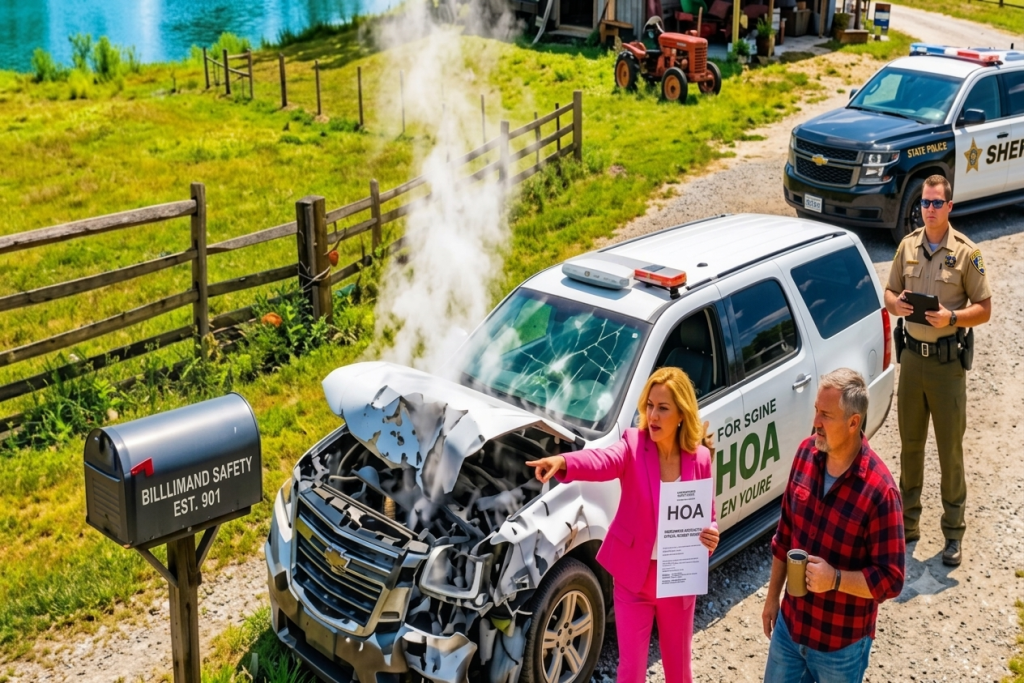
She tore the page off the clipboard and held it out to me on the flat of her palm, the way someone hands a leash to a dog.
I took the citation.
I looked at the badge on her chest.
I looked at the VIN on the dash of the Explorer.
I looked at the embroidered name tag over her left breast pocket.
CALDWELL, B.
Then I took out my phone.
Her hand flinched toward the pepper spray on her belt.
I did not dial 911.
I photographed the badge. I photographed the VIN. I photographed the name tag. I photographed the mailbox, the bollard, the bumper, the deployed airbag, the broken headlight, the skid marks in the gravel, and the position of the patrol vehicle relative to the centerline of County Road 14.
In that order.
I had done this kind of documentation in roughly that order 417 times over the course of a previous career.
She watched me do it.
She did not understand what she was watching.
She had no idea the man writing down her badge number had spent twenty-six years writing down badge numbers for the federal government.
She mistook my silence for fear.
People in tactical polos with thirty-dollar badges almost always do.
She squared her shoulders, raised her voice so Hector Vargas across the road could hear her clearly, and threw out the line that would eventually end her career.
“We own this road,” she said. “We own this whole stretch of frontage. You are squatting on Pine Ridge Estates property, and we will have you removed by Monday morning.”
I slipped the phone back into my jacket pocket.
I picked up my coffee from the fence post.
It was cold now.
Six months earlier, none of this would have made sense to anyone watching.
By the next night, it would land on the desk of a federal investigator.
I just had not told her yet that the federal investigator used to be me.
To understand what was sitting in my gravel that morning with its airbag in its lap, you have to go back a few months.
Back before the crash, before the bollard, before the cameras, before the bullhorn, before Karen Caldwell stood at the end of my driveway trying to order a real deputy to arrest a man standing on his own deeded land.
Back to a morning when County Road 14 was quiet except for my truck idling at the cattle gate at 5:40 and a black Angus heifer complaining about the hour.
My name is Frank Holloway.
I own 240 acres outside Pinewood County, Texas.
My great-grandfather bought the first eighty in 1923 with money he made shoeing horses in a railroad town that does not exist anymore. My grandfather added the next eighty in 1951 with a VA loan and a handshake. My father added the last eighty in 1979, and he did one more thing that year nobody in Pine Ridge Estates bothered to read before they started swinging.
He recorded the easement.
County Road 14, where it ran along the front of our property—the stretch with my mailbox on it—was a private easement in fee to the Holloway Ranch. Recorded at the Pinewood County Courthouse on March 14, 1979. Instrument number 79-04412.
The county graded the road.
The county did not own it.
I did.
I knew that the morning I walked the pasture in the dark.
The HOA, as it turned out, did not.
Pine Ridge Estates went up in 2018 on eighty acres of pasture the Halverson family sold to a developer the year after old man Halverson had his stroke. Ninety-six homes. Cul-de-sacs with names like Sterling Oak Court and Bridal Path Lane. A clubhouse with a pool. Fake limestone monument signs at the entrance. Uniform mailboxes. Streetlights designed to look rustic without being useful. A homeowners association formed before half the sod had rooted.
And one problem the developer had not bothered to solve before pouring the slabs.
Pine Ridge had one way in and one way out.
A single road that fed onto State Highway 290 at a light that backed up half a mile every afternoon. The fire marshal had signed off on the development with a written note that secondary egress would be required within five years for continued occupancy certification.
The developer nodded, built the homes anyway, sold the lots, handed the problem to the homeowners, and walked away with his check.
Five years was up in 2023.
The only land that could give Pine Ridge a second exit onto the highway was the strip of road frontage in front of my ranch.
My easement.
My family’s easement.
Recorded in 1979, instrument number 79-04412, on file at the courthouse where anyone with twelve dollars and an afternoon could go look it up.
The first letter arrived in January 2024.
It was polite.
The Pine Ridge Estates Homeowners Association offered to buy the frontage easement for twelve thousand dollars and called it “a neighborly arrangement that benefits both communities.”
I wrote back, also politely, and declined.
I am not a community.
I am a ranch.
My grandfather did not haul that road in by hand so ninety-six homeowners could shave six minutes off their commute.
The second letter arrived in March.
It was less polite.
It offered eighteen thousand dollars and mentioned “alternative legal remedies.”
In April, my mailbox got hit for the first time.
I want you to understand the shape of what happened next because it was not random and it was not stupid in the way people imagine HOA stupidity.
It was patient.
It was patterned.
It was, in its own small and ugly way, professional.
After every letter I declined, my mailbox went down within seventy-two hours.
Letter.
Hit.
Letter.
Hit.
Letter.
Hit.
By August, I had six bent mailbox posts stacked behind my workshop like firewood. And I had six certified letters in a folder. Each one dated within three days of a hit.
I did not call the sheriff.
I had already learned what the sheriff’s office did with calls about the Pine Ridge HOA. I had heard about it from Hector Vargas, who ran cattle on the 180 acres directly south of me, and from Amina Emboya, who kept horses on the 160 acres directly north.
They had been getting their own letters.
They had been getting their own hits.
And every time one of them called the sheriff, the answer came back the same way.
Private property dispute.
HOA matter.
Not law enforcement jurisdiction.
It was the wrong answer.
I knew it was the wrong answer.
But I was not ready to say so yet.
Instead, I started to read.
Pine Ridge HOA had a board of five.
Karen Caldwell, president, three years running. The kind of woman who pronounced the word community the way other people pronounce the word kingdom. There was also a vice president, treasurer, secretary, and at-large member, all reliable, all handpicked, all afraid of her.
The patrol unit—which the HOA called the Pine Ridge Community Safety Division—had been Karen’s idea.
Six tactical polos.
Two white Ford Explorers marked with light bars.
A “chief of patrol” position she created for her thirty-one-year-old daughter, Brenda Caldwell, who had failed the state police academy twice on the physical and twice on the written and had been working at a tanning salon when her mother appointed her.
Brenda was the one who hit the mailboxes.
Same driver.
Same vehicle.
Same time of day.
I had her on camera.
I had her on six different cameras.
I had her plate, face, uniform, route, and the timestamp on every single hit.
I did not act on any of it.
People who have not done this kind of work do not understand the temptation. You see the evidence. You watch it pile up. Every instinct in your body wants to walk into a courthouse on Tuesday morning and have it over with by Friday.
I did not do that.
I had been trained for twenty-six years not to do that.
You let the pattern complete.
You let the actor commit to the pattern.
You let the paper trail get long enough to become undeniable.
Then you bring it all to one place at one time and you do it once.
In October, I drove into town and pulled the HOA’s expansion proposal out of the public planning file at the county. There was a map attached. The map showed Pine Ridge Estates in pale green, the highway in gray, and a thin red corridor running across the front of three properties.
Vargas.
Holloway.
Emboya.
Labeled in twelve-point Arial:
PROPOSED PINE RIDGE SECONDARY EGRESS.
They had drawn a road across our easements on a map and submitted it to the county like it was already theirs.
I put the map in my workbench drawer on top of the six bent mailbox posts, next to the file folder with the six certified letters, beneath the old USPS Postal Inspection Service training manuals I had pulled from the workshop shelf the week before.
The manuals I had not opened in nine years.
There is a leather wallet I keep in the bottom drawer of the workbench.
Inside that wallet is a piece of metal I had no reason to carry after the day I retired.
The night I filed the expansion map in my drawer, I ran my thumb across the outside of that wallet.
I did not open it.
Not yet.
The seventh letter arrived three days before the seventh hit.
It did not offer money.
It offered, in language a real attorney clearly had not reviewed, “immediate annexation under HOA emergency egress authority pursuant to community safety statutes.”
There was no such statute.
There was no such authority.
There was no such thing.
I poured the concrete for the bollard the next morning.
The certified letter came on a Tuesday in November. I signed for it at the gate. The carrier, a regular USPS letter carrier on a regular USPS route—the kind of detail that would matter later in ways the HOA never thought about—handed me the green card and a manila envelope with the Pine Ridge seal embossed in dark green ink.
I thanked her by name.
She drove on.
I opened the envelope in the workshop.
The letter was four pages.
The first three were a recitation of HOA bylaws I had never signed, never voted on, and was not bound by.
The fourth was a bill.
Total outstanding fines: $4,800.
Eight hundred dollars for failure to maintain HOA aesthetic frontage standards.
Eight hundred for unapproved roadway-adjacent structure.
Eight hundred for non-compliance with monthly inspection request.
Eight hundred for obstruction of community access.
Eight hundred for refusal to acknowledge HOA jurisdictional authority.
And eight hundred, listed last and underlined, for administrative processing of repeated violations.
They were fining me for the cost of fining me.
At the bottom of the page, in a different font and bold type, it said failure to remit within thirty days would result in escalation to lien proceedings against the named property.
I read it twice.
I put it in the folder with the other six letters.
I made a fresh cup of coffee.
Then I sat at the workbench and did the one thing I had been refusing to do for fourteen months.
I called Hector Vargas.
Then I called Amina Emboya.
I told them I was going to the next Pine Ridge HOA board meeting.
Hector laughed once, short and dry.
“They won’t let you in, Frank.”
“I know.”
“That’s the point.”
The meeting was on the second Thursday of the month in the Pine Ridge clubhouse, the one with fake limestone columns and a pool rules sign listing fourteen prohibited activities.
I parked at the curb, walked through the front door with the manila envelope under my arm, and carried a small audio recorder in the breast pocket of my Carhartt jacket. The kind a journalist would carry. The kind that runs nine hours on a charge and produces a clean MP3 with a date stamp embedded in the metadata.
I had not bought it for this.
I had owned it for nineteen years.
It had testified in transcript form in three federal trials.
The room held about sixty residents in folding chairs and a five-person board at a long table on a low stage. Karen Caldwell sat in the center wearing a cream blazer and a small enamel pin shaped like the Pine Ridge monument sign. Behind her, against the back wall, Lieutenant Brenda Caldwell stood in full tactical polo with her hands clasped at the small of her back.
Parade rest.
As if she had ever in her life been in a military.
I took a seat in the third row.
Heads turned.
Karen looked up from her notes, found me, and held my gaze for exactly one second before looking down and making a small note with her pen.
The meeting opened with the Pledge of Allegiance, then the treasurer’s report, then a discussion of the upcoming holiday decoration contest, which lasted, by my watch, twenty-two minutes.
I sat.
I listened.
I waited.
When the chair asked for community comments, I stood.
“Mr. Holloway,” Karen Caldwell said before I opened my mouth. “You are not in our database.”
“I know.”
“I came to talk about the letters.”
“You don’t get a voice in this community,” she said, “because you are not part of this community. If you would like to be part of this community, you may submit an application to the membership committee, pay the initiation fee, and accept the bylaws. Until that time, please sit down.”
A man in the back row said quietly, “Just let him talk.”
Karen did not look at him.
She spoke into the microphone.
“Lieutenant Caldwell, please escort Mr. Holloway out.”
Brenda crossed the room in eight steps.
She put her hand on my elbow.
I want to be clear about what that was.
It was not a guiding hand.
It was a grip.
Thumb on the inside of my upper arm. Four fingers wrapped to the bone. The way a bouncer moves a drunk who has overstayed his welcome.
I am sixty-one years old.
I have been touched in anger by professionals.
This was not professional.
This was a woman who had failed the academy twice using her mother’s microphone to teach an old rancher a lesson in front of his neighbors.
I let her walk me to the door.
I did not resist.
The recorder in my breast pocket continued to run.
At the door, I turned.
In a conversational voice, I said, “Madam President, for the record, under what authority is Pine Ridge HOA assessing fines against a non-member property owner whose land was deeded in 1979 and lies outside the HOA’s recorded plat?”
The room went quiet.
Karen Caldwell leaned toward the microphone.
“Mr. Holloway,” she said, “this board will use every legal mechanism available to make your property untenable until you accept our fair market offer for the front easement. Daily fines, weekly inspections, code violation reports to the county—we have the resources and we have the patience. You do not.”
She said it on the record.
She said it into a live microphone in front of sixty residents with my recorder running in my pocket.
She said the quiet part out loud because she had spent three years saying the quiet part out loud in that room and nobody had ever told her to stop.
I said, “Thank you, Madam President.”
Then I walked out.
In the parking lot under the sodium light, Hector Vargas was leaning against the tailgate of my truck with his arms crossed. Amina Emboya stood beside him in a wool coat with her hands in her pockets.
Neither said anything for a moment.
Then Hector said, “Did you get it?”
I patted the breast pocket of my jacket.
“All of it.”
Amina asked, “What now?”
“Now,” I said, “I order a mailbox.”
I drove home that night, sat at the workbench, opened my laptop, and placed three orders.
One Salsbury Industries USPS-approved heavy-duty steel mailbox.
One crash-rated security bollard rated to stop a heavy vehicle at speed.
Four Reolink 4K outdoor cameras with infrared and local storage.
I paid for overnight shipping on all of it.
Total cost: $3,411.
I emailed the receipts to myself.
I printed the receipts and put them in the folder with the seven certified letters and the expansion map.
I set the recorder on the workbench beside the leather wallet I had not yet opened.
The patrol got their seventh hit anyway.
But this time, the bollard was already in the ground.
The morning after the board meeting, three coffee mugs sat on my workbench.
Hector took his black.
Amina took hers with milk, no sugar.
Mine had gone cold while I queued up the file on the laptop. The workshop smelled like sawdust, motor oil, and the particular smell of a kerosene heater that had been running since five in the morning.
I had been up since four.
I had spent the night cutting fourteen months of footage into a single eighteen-minute file.
Six prior mailbox hits.
Date stamps in the lower right corner.
Timestamps in the upper right.
License plate of the Pine Ridge patrol Explorer from three different angles.
Brenda Caldwell’s face, clear, lit, unobscured, at the wheel of every single one.
I turned the laptop so they could see the screen and pressed play.
Hector watched the first hit without expression.
He watched the second and rubbed his jaw.
By the third, he had stopped rubbing his jaw and leaned forward with both elbows on the workbench.
By the fourth, Amina had placed her hand flat on the surface of the wood and left it there.
I let the file run all the way through.
When it ended, Hector exhaled through his nose.
“Twenty-two months,” he said.
“What?”
“Mine,” he said. “Twenty-two months. Not fourteen. I have it on dash cam.”
He pulled his phone from his shirt pocket and slid it across the bench.
Two video files.
He had labeled them in his careful block-letter way.
MAILBOX ONE.
MAILBOX TWO.
Dates and times typed underneath.
Amina did not have video.
Amina had paper.
She placed a manila folder on the workbench, the same color as the envelope Pine Ridge had used for my $4,800 fine, and opened it. Inside were six sheriff’s department complaint forms filled out by hand, signed and dated over eleven months. Each described an incident: a destroyed mailbox, a damaged fence post, a Pine Ridge patrol Explorer photographed near the property line.
Each one had a routing stamp from the Pinewood County Sheriff’s Office at the bottom.
The stamps all said the same thing.
Private property dispute.
HOA matter.
Not law enforcement jurisdiction.
No further action.
“Six times,” Amina said quietly. “I stopped calling after the sixth one.”
I looked at the stamps for a long time.
Then I said, “That answer is wrong.”
Hector looked at me.
“A mailbox approved by the United States Postal Service and installed at a federally recognized delivery address is protected under federal law,” I said. “The sheriff doesn’t get to treat its destruction as a private HOA matter just because a private HOA did it. The sheriff is wrong.”
Amina asked, “Then why hasn’t anyone done anything, Frank?”
“Because no one filed it with the right office.”
I paused.
“Yet.”
I let that sit in the room a moment.
Then I pulled a legal pad toward me and started building the timeline.
Across the top of the page, I wrote three columns.
VARGAS.
HOLLOWAY.
EMBOYA.
Down the left side, I wrote the months January through November 2024.
Then I began filling in boxes.
Letter dates from each of us.
Hit dates from each of us.
Dollar amounts on fine letters.
Dates of sheriff complaints.
Dates of each refusal.
The pattern rose off the page like a photograph in developer fluid.
Every declined letter was followed by a hit within seventy-two hours.
Every hit was followed by a refusal from the sheriff’s office.
Every refusal was followed by another HOA letter, slightly more aggressive, slightly more expensive, slightly more legal-sounding.
Hector looked at the chart.
“It’s a campaign.”
“Yes.”
Amina said, “How long have you known?”
“Since April.”
“And you didn’t say anything?”
“I needed them to do it enough times that no jury could call it an accident.”
She looked at me for a long second.
Then she nodded once.
People who run ranches tend to understand patience in a way people who live in cul-de-sacs do not.
I poured fresh coffee. We sat with the timeline between us.
After a while, Hector asked, “What do we do?”
“We keep documenting,” I said. “We don’t confront. We let the HOA hang itself on the next hit. I’m installing a new mailbox today. It’s not a trap. It’s a mailbox that meets federal spec and stands up. When they hit it—and they will hit it—the patrol vehicle is going to take the damage instead of the mailbox.”
“That’s not entrapment,” Amina said.
“No,” I said. “That’s physics.”
“And then?” Hector asked.
“Then I file the complaint with the right office.”
I did not say which office.
I did not say with whom.
I said it the way I had said everything for fourteen months.
Flat.
Quiet.
Without flourish.
Hector looked at me a little longer than usual. I think he was beginning to put something together.
He did not ask.
People who run cattle do not ask about things you have not yet said.
The three of us walked outside.
The bollard had arrived the night before. The mailbox sat in its shipping crate on the gravel. The cameras were lined up on the tailgate of my truck in their boxes, SD cards loaded, settings configured.
We poured the concrete that morning.
Hector mixed.
Amina held the level.
I set the bollard to forty-two inches deep and backfilled, tamped, and let it cure beneath a tarp. In the afternoon, I installed the Salsbury mailbox on the bollard sleeve. Exact USPS height. Exact USPS offset. Reflective marking on the side facing oncoming traffic, the way the spec required.
I bolted on the small American flag because my father had bolted one to the original mailbox in 1979, and I had never asked his permission to stop.
The cameras went in at sundown.
Two in fence posts on either side of the mailbox.
One in the live oak across the road angled to catch plate numbers.
One at the workshop gate pointed at the mailbox from 120 feet away, in case the others got knocked out.
All four ran local SD storage and pushed encrypted copies to a cloud account I had registered under an LLC the HOA had no way to find.
When the sun went down, the three of us stood on the gravel looking at it.
Hector said, “It looks like a regular mailbox.”
“It is a regular mailbox.”
Amina asked, “Will they hit it?”
“They’ve hit it six times,” I said. “They’ll hit it a seventh.”
“And you’re sure?”
“I’m sure.”
I picked up my coffee from the fence post.
It had gone cold again.
I had stopped minding cold coffee in 1998, somewhere in the middle of a stakeout in a parking garage in San Antonio, and I had never gone back to caring.
Hector finally asked, “Frank, who exactly are we calling when they hit it?”
“I’ll handle the call.”
He looked at me.
“I have the number.”
The seventh hit came three weeks later.
That was the morning Brenda Caldwell drove the white Explorer into the bollard at thirty-eight miles an hour and learned, all at once, that the mailbox did not fold anymore.
The crash completed the pattern.
But Pine Ridge was not done making mistakes.
The next letter arrived three days after the new mailbox survived.
It was not certified this time.
It was hand-delivered.
I watched it happen on camera three. Brenda Caldwell pulled up in a white Ford Explorer I had not seen before, this one a rental with a dealer plate and no light bar. She got out in civilian clothes, walked up to the new mailbox, lifted the flag, dropped the envelope in, and photographed it inside the box with her phone before driving away.
I watched her do it from my workshop on a thirty-two-inch monitor in real time.
She did not know the cameras were live.
Twenty minutes later, I walked down to the gate, opened the mailbox, removed the envelope, and carried it back to the workbench without opening it.
Then I slit the seal.
NOTICE OF LIEN INTENT.
That was the header in bold, in a font two sizes too large, the way amateurs format documents copied off the internet.
Underneath came three pages of recitation. HOA bylaws I had never signed. References to “community jurisdictional authority” that did not exist. And at the bottom:
TOTAL CUMULATIVE FINES AND ASSESSMENTS: $11,400.
Failure to remit within thirty days would result in filing of a lien against the property with foreclosure proceedings to begin within ninety days thereafter.
I read it twice.
Slowly.
You need to understand what was wrong with that document because the wrongness of it is the reason I let it land in my mailbox before doing anything about it.
A homeowners association cannot file a lien against property outside its association.
That is not a technicality.
That is the entire concept.
An HOA is a private contractual entity between the association and its members. If you are not a member, the association has no more legal authority over your land than the bowling league across town.
Pine Ridge HOA was not just wrong.
They were wrong in writing, on letterhead, with a date, delivered by their chief of patrol on camera.
They had committed attempted lien fraud and recorded themselves doing it.
I put the letter in the folder.
I made a fresh cup of coffee.
Then I waited.
The tow truck came the next morning at 9:40.
It was a flatbed commercial unit with the name of a towing company from the next county painted on the door. The driver was a man in his late thirties wearing a high-visibility vest and carrying a clipboard. He had the expression of someone who had been told this would be routine.
Behind him, in the rental Explorer, Brenda Caldwell sat in the passenger seat with a copy of the lien notice in her hand and a faint bandage visible above her left eyebrow.
I let them get out.
I let them walk up to the mailbox.
I let the tow driver loop a strap around the bollard sleeve.
I let him climb back into the cab.
I let the winch take up slack.
The strap creaked.
The bollard did not move.
The strap creaked louder.
The truck’s rear suspension squatted.
The driver eased the winch up another notch.
The strap pulled tight as cable.
The bollard did not move.
Then the strap snapped.
It came back at the cab with a sound like a rifle shot and laid a six-inch welt across the hood of the tow truck.
The driver flinched.
He looked at the bollard.
He looked at the strap.
He looked at Brenda Caldwell through the windshield.
Then he climbed out, walked around to her side, and stood at her window with one hand on his hip.
That was when I walked down the driveway.
Same Carhartt jacket.
Same coffee mug.
The morning was cold enough that steam lifted from the rim.
I said to the driver, “Son, what’s your name?”
“Donnie.”
“Donnie, what does the paperwork say is being removed today?”
He looked at his clipboard.
“Obstruction. HOA removal order. Lady said it’s a roadway hazard.”
“Donnie, look at me for a second.”
He did.
“That mailbox is a federally protected mail receptacle installed at federal spec at a federally recognized delivery address. The lady in the passenger seat is wearing a thirty-dollar badge and works for a homeowners association that has no jurisdiction over this property. If you put your truck back on that bollard, you’re going to be a federal witness by the end of the week. I’d unhook now.”
Donnie stood there about four seconds.
Then he walked to the front of the truck, climbed onto the bumper, undid the strap from his end, dropped it in the gravel, got back in the cab, and drove away.
He did not look at Brenda Caldwell.
That was the first time anyone in Pine Ridge’s orbit had broken ranks.
Brenda got out of the rental.
She had been on her phone first, then off it. She walked up to me with shoulders forward and chin out.
“You can’t intimidate my contractor,” she said. “That was tampering with a removal order. You’re going to lose this ranch, old man. I’m going to make sure of it personally.”
“Ma’am,” I said, “I’d step back.”
She did not step back.
She closed the last two feet and put both hands flat on my chest.
Then she shoved me.
I am not a large man anymore, but I have been shoved by professionals, and I know how to take a shove. I rocked back on my heels and caught my balance on the fence post behind me. The coffee sloshed in the mug but did not spill.
Brenda stood there with her hands still half raised and a look on her face suggesting she had not quite decided, in the half second after her palms left my jacket, whether she had meant to do that.
The cameras decided for her.
Camera one had her face.
Camera two had the shove from the side.
Camera three had audio of her threat to “make sure of it personally.”
Camera four, from 120 feet away, had the wide shot: Brenda, me, the bollard, the mailbox, the small American flag, and Amina Emboya’s silver Tacoma parked at her own gate across the road with her phone visibly raised over the steering wheel.
Amina had recorded the whole thing.
Brenda saw the Tacoma.
She saw the phone.
Something behind her eyes recalculated.
She walked back to the rental Explorer without speaking, got in, slammed the door hard enough that the dealer sticker peeled an inch, and drove off.
I stood on the gravel a moment longer.
Then I walked back to the workshop.
I sat at the workbench.
I opened the bottom drawer.
I took out the leather wallet I had not opened in nine years.
Inside was a gold five-point shield with a banner above and a banner below.
The top banner read:
U.S. POSTAL INSPECTION SERVICE.
The bottom banner read:
INSPECTOR.
The number stamped under the seal was a five-digit credential number issued to me on a Tuesday in 1989 and retained in retirement under agency policy. Retired inspectors do not walk around making arrests. They do not pretend to be active-duty agents. But in matters personally observed and reported through proper channels, especially those involving federal mail infrastructure, a retired inspector with twenty-six years of service knows exactly where evidence belongs.
The badge was not a weapon.
It was memory.
And a phone number.
I set it on the workbench beside the yellow legal pad.
I did not put it on.
I picked up the phone and dialed a number I had not dialed in nine years.
It rang twice.
A man’s voice answered.
“Houston Field Office, Postal Inspection Service, duty desk. How can I help you?”
“This is retired inspector Frank Holloway, credential 55812, San Antonio Division,” I said. “I’m reporting an ongoing pattern of destruction of federally protected mail receptacles. Seven incidents. Fourteen months. Same actor. Full documentary evidence on file. I’d like a field inspector at my property tomorrow morning.”
There was a pause.
Then the man said, “Stand by, Inspector. I’m patching you to a supervisor.”
I waited.
The coffee in my mug had gone cold.
I knew exactly which office to call.
I had worked with it for twenty-six years.
But I had waited.
I wanted them to do one more stupid thing first.
The HOA arrived at 1:15 the next afternoon.
I had been expecting them since the moment I hung up with the Houston supervisor the night before.
What I had not expected was the bullhorn.
Karen Caldwell stood at the head of my driveway in a charcoal pantsuit and the same enamel pin from the board meeting, holding a battery-powered bullhorn in her left hand and a stapled stack of papers in her right. Behind her, arranged in two semicircles on the gravel shoulder of County Road 14, stood roughly thirty Pine Ridge residents holding signs printed on white poster board.
MAINTAIN OUR PROPERTY VALUES.
REMOVE THE EYESORE.
HONOR YOUR HOA.
Brenda Caldwell stood at her mother’s right shoulder in full tactical polo, two-inch badge, mirrored sunglasses, and sidearm on her hip, directing sign placement with small, impatient gestures.
Parked behind the crowd was a Pinewood County sheriff’s cruiser.
Real plate.
Real light bar.
Real deputy.
The deputy stood beside his cruiser in a dark green uniform, body camera clipped to the center of his chest, one hand resting on the open driver’s door. He looked uncomfortable in the way a man looks when he has been called to a scene by people who told him one story and he arrived to find a different one.
I walked down the driveway with a manila folder under my arm.
I did not bring coffee.
Karen lifted the bullhorn as soon as I came within earshot.
“Mr. Holloway,” she said, the bullhorn distorting her vowels, “the residents of Pine Ridge Estates are gathered here today to demand the immediate removal of the dangerous structure you have installed in violation of HOA aesthetic and safety standards. We have a petition of thirty signatures. We have requested the assistance of the Pinewood County Sheriff’s Office. We are giving you one final opportunity to comply voluntarily.”
The deputy did not move.
He was watching me.
I stopped at the edge of my gravel ten feet from Karen and addressed him.
“Sir, what’s your name?”
“Deputy Lawson. Pinewood County.”
“Deputy Lawson, I’d like to hand you two documents. May I approach?”
He nodded.
I walked past Karen. She lowered the bullhorn but did not step aside. I handed the folder to Deputy Lawson.
He opened it on the hood of his cruiser.
On top was a photocopy of the 1979 easement deed, instrument number 79-04412, recorded at the Pinewood County Courthouse on March 14, 1979, with two county clerk stamps and the original surveyor’s signature. The deed described in fee simple the road frontage along County Road 14, granted to my grandfather and his heirs.
Under that was a one-page printout of 18 U.S.C. § 1705, plain text, no commentary, regarding destruction of letter boxes or mail.
Deputy Lawson read the deed.
He read the statute.
He took a long breath through his nose.
Then he looked up at Karen Caldwell.
“Ma’am, may I see Pine Ridge HOA’s documented jurisdiction over the property described in this deed?”
Karen said, “We have a petition of thirty signatures.”
“Ma’am,” he said, “a petition is not jurisdiction. Do you have a recorded document showing HOA authority over this specific parcel?”
“We have community standards.”
“Ma’am, yes or no. Recorded document. Property authority over this parcel.”
She did not answer.
Brenda stepped forward and spoke into the air more than to the deputy.
“This man’s mailbox is a roadway hazard. It injured an officer. It damaged a patrol vehicle. He installed it as a deliberate trap.”
Deputy Lawson turned to her.
“Ma’am, your injury report from that incident, please.”
“I—we don’t file every—”
“Your patrol vehicle’s accident report filed with the state of Texas.”
“It’s being processed.”
“Under what authority do you operate a marked vehicle with emergency lights on a Texas county road?”
“Pine Ridge HOA authority.”
Something in Deputy Lawson’s face changed.
Not anger.
Recognition.
The look of a professional who has just understood that the situation in front of him is not the one he was dispatched to handle.
He took half a step away from Brenda, just enough to put himself square with the cruiser instead of with her, then keyed his shoulder mic and murmured something into it.
Karen saw the shift.
People in her position always do the same thing when they feel a room tilt away from them.
They double down.
She lifted the bullhorn again.
“Deputy Lawson,” she said, the bullhorn cutting through her own composure, “I am formally requesting that you arrest this man for trespassing on Pine Ridge Estates roadway frontage and for deliberate creation of a hazardous structure causing injury to a duly authorized community safety officer.”
She was telling a real deputy to arrest a man on his own deeded property at the request of a private homeowners association.
The crowd shifted but did not move.
Deputy Lawson looked at me.
Then at the folder on his hood.
He had not yet seen what was behind the deed and statute.
I walked to the cruiser, opened the folder, lifted the deed and statute aside.
Underneath was the leather wallet, open.
Inside was the gold five-point shield.
Deputy Lawson looked at the badge.
Then he looked at me.
He did not speak.
He was waiting.
Behind us, Karen raised the bullhorn one more time.
“Deputy,” she said. “I am ordering you to arrest this trespasser.”
She did not see what was on the hood of the cruiser.
She stood thirty feet behind us, on the wrong side of Deputy Lawson’s body, with the bullhorn against her cheek and her chin lifted at the angle she had perfected across three years of board meetings.
She thought she was issuing a command.
She was, in fact, dictating the audio that would later be transcribed as Exhibit C.
Deputy Lawson looked down at the badge in the open wallet.
Then at Karen.
Then at me.
I lifted the badge so he could read it clearly in the sunlight.
“Frank Holloway,” I said at conversational volume. “Retired inspector. Twenty-six years, San Antonio Division. I am reporting a federal crime in progress.”
Deputy Lawson straightened.
It was a small motion. A man who had been leaning on the door of his cruiser put his weight back on his own two feet. But the crowd saw it. Every sign holder in the front row saw it.
Karen Caldwell saw it last.
She lowered the bullhorn.
She did not understand yet.
She only understood something had changed.
Brenda Caldwell took one step backward.
I do not think she knew she did it.
People who have worn a costume for a long time, when they encounter the real thing, take one involuntary step backward before remembering to compose their face.
Brenda’s foot moved on its own.
The gravel crunched under her boot.
She glanced down as if her own body had betrayed her.
I turned to Deputy Lawson.
“Deputy, I am formally invoking federal jurisdiction on destruction of United States Postal Service-approved mail receptacles. Seven confirmed incidents in fourteen months. Full documentary evidence on file. The Houston field office has been notified. A field inspector is arriving at this property at 0900 tomorrow.”
Deputy Lawson said, “What do you need from me, Inspector?”
He said the word inspector clearly.
Loud enough for the front row of sign holders to hear.
The shift in the gravel was small and physical.
A woman in a navy windbreaker holding a sign that read MAINTAIN OUR PROPERTY VALUES lowered her sign six inches.
The man beside her in a Pine Ridge polo did not lower his sign, but he stopped holding it up.
Karen finally registered the word.
“What did he just say?”
Deputy Lawson did not look at her.
“Inspector,” he said, “walk me through it.”
I said, “On camera, Deputy.”
He tapped the body camera clipped to his chest.
“Always.”
“Then for the record,” I said.
And I laid it out.
I did not lecture.
I named the counts.
Seven destructions of a USPS-approved mail receptacle on my property between January and November.
All seven incidents on camera.
Same driver.
I nodded toward Brenda.
Operating a marked vehicle with active emergency lights on a Texas county road without state authority.
I nodded toward the rental Explorer.
Assault on a retired federal inspector reporting a mail-related federal crime, captured on four cameras and one independent cellphone recording.
Brenda’s mouth opened a quarter inch.
I did not look at her.
Attempted lien fraud and abuse of process. Pine Ridge HOA, under Karen Caldwell’s signature, issued a lien intent notice against a non-member parcel. The notice was hand-delivered by the chief of patrol on camera.
I did not raise my voice.
I named each issue and stopped.
The legal pad in the folder had every incident numbered and every supporting exhibit paginated.
I had built it the way I had built 417 complaints before this one.
I did not need to read from it.
Deputy Lawson said, “Anything else, Inspector?”
“One more thing. There is a pattern across three properties. Mine, the Vargas Ranch to the south, and the Emboya Ranch to the north. Same conduct. Same actor. Same documentary trail. Whether that rises to coordinated extortion or a broader fraud question is for the proper investigators to determine. I’m not naming it as a count today. I’m naming it as a question.”
Deputy Lawson nodded slowly.
He keyed his shoulder mic.
“Dispatch, I’m going to need a second unit at County Road 14, mile marker 18. Non-emergency detention assist.”
Dispatch acknowledged.
That was when Karen Caldwell came forward.
She walked thirty feet from the head of the crowd to the cruiser with the bullhorn at her side. Her face had gone the color of putty. The enamel pin on her lapel caught the sun.
She stopped four feet from Deputy Lawson.
“This is…” She swallowed. “There has been a misunderstanding.”
I said quietly, “Madam President, for the record, would you like to repeat the statement you made at the November board meeting? The one where you said the board would use every legal mechanism available to make my property untenable? I have it on a nineteen-year-old recorder that has testified in three federal trials. I’d be happy to play it now.”
She did not answer.
Behind her, the woman in the navy windbreaker put her sign down in the gravel.
“I want to say something,” she said.
Deputy Lawson turned to her.
She spoke loud enough to carry.
“I signed that petition because Karen Caldwell told me my landscaping fines would double if I didn’t. I have the email.”
Another voice from the second row said, “She told me the same thing.”
A third voice followed.
“She told all of us.”
A fourth voice, a man in a barn jacket who had not been holding a sign at all, said, “I want a copy of that statute, Deputy. The one Inspector Holloway just cited. I’m going to read it carefully tonight.”
The petition unraveled on its own gravel.
Karen turned around.
She looked at her residents.
She looked at her daughter.
Then she lifted the phone in her left hand as if to call someone.
She got as far as starting to dial.
“Madam President,” I said, “if you’re calling the HOA’s attorney, you should know the Postal Inspection Service has federal court practice. You may want him to bring a colleague who has appeared in the Southern District of Texas.”
She lowered the phone.
Brenda Caldwell finally moved.
She turned toward the rental Explorer and began to walk.
Deputy Lawson said, “Ma’am, stop, please.”
Brenda stopped.
“Stay where you are,” he said. “The state’s going to want to talk to you about your light bar. The federal inspector is going to want to talk to you about everything else.”
Brenda stood on the gravel with her hands at her sides, her thirty-dollar badge on her chest, the bandage above her eyebrow visible to thirty witnesses, one body camera, and four of my cameras still recording from the fence posts, live oak, and workshop gate.
I closed the wallet around the gold badge.
I looked at the mailbox.
The small American flag had caught the afternoon light and thrown a long, thin shadow across the gravel toward Karen Caldwell’s feet.
I had waited fourteen months for this.
It took six minutes.
The field inspector arrived at nine the next morning.
His name was Reyes. He came out of the Houston office in a dark suit with a tie clip shaped like the same five-point shield I had placed on my workbench the night before.
He spent four hours at my property.
He took copies of the camera footage, the manila folder, the recorder, the timeline page, the eight letters, and sworn statements from me, Hector Vargas, and Amina Emboya.
He shook our hands at the gate.
Then he drove off at 1:15.
Six weeks later, the indictments came down.
Brenda Caldwell was charged with seven counts related to destruction of protected mail receptacles and additional charges connected to the shove, the unauthorized vehicle lights, and the patrol operation.
Karen Caldwell faced separate charges through the Pinewood County District Attorney’s Office, coordinated with federal prosecutors, involving conspiracy to commit fraud, the lien notice, and abuse of process.
On top of everything else, Pine Ridge HOA’s insurance carrier dropped the association midcase in a one-page letter citing willful conduct outside the scope of covered activities.
That was the legal payoff.
The financial payoff arrived in two parts.
The first was the easement fund.
Pine Ridge had collected $214,000 from ninety-six homeowners over three years in a line item called Secondary Access Reserve, supposedly for the purpose of buying—or, as it turned out, taking—the frontage in front of my ranch.
The fund was frozen by court order within ten days of the indictment.
The homeowners filed a class action against the board for misuse of association dues.
The settlement dissolved the patrol unit, stripped the board of authority, and distributed recovered funds back to residents.
The second part was personal.
The Pinewood County District Court issued a written order voiding every fake fine against my property: the $11,400 lien notice, the $1,200 citation from the morning of the seventh hit, and every invented administrative fee that had accumulated along the way.
The Pinewood County Sheriff’s Office sent a letter—actual paper, actual letterhead—apologizing to Amina Emboya for eleven months of misrouted complaints and committing to internal jurisdictional training.
Amina framed the letter and hung it in her tack room.
The social payoff came faster than I expected.
The ninety-six homeowners of Pine Ridge Estates voted out the entire board in an emergency election six weeks after Inspector Reyes’s visit. The new board, three women and two men, none of whom had ever held HOA office before, ran on a single-sentence platform:
We are a homeowners association. We are not a government.
They won by margins no one needed to count twice.
Karen Caldwell put her house on the market within thirty days.
It sold in eleven.
The sign came down on a Wednesday in February.
The two white Ford Explorers were auctioned off at the Pinewood County impound lot in March. Both had their light bars removed first by court order.
I drove past the auction on my way back from the feed store. The vehicles sat in a row with three repossessed pickups and a salvage-title Camry, looking smaller than they had ever looked on County Road 14.
Hector Vargas hosted a dinner at the property line in April.
He set up two long folding tables on the gravel where his easement met mine, covered them with checkered tablecloths, and ran two brisket smokers starting at four in the morning. Amina brought a flat of tomatoes. I brought coffee. Good coffee. The kind people actually drink.
Six former Pine Ridge residents came, including Don Patton, the retired structural engineer who had asked Deputy Lawson for a copy of 18 U.S.C. § 1705, and the woman in the navy windbreaker, whose name turned out to be Margaret and who had been the first to put down her sign.
We ate at sundown.
Nobody made speeches.
Halfway through the meal, Margaret asked me what I had done before I retired.
I told her.
She said, “I should have guessed.”
And that was the end of it.
The emotional payoff, the one that mattered, did not arrive in a courtroom or settlement.
It arrived on a Tuesday morning in May.
I walked down to the gate at 5:40 with a mug of black coffee in my hand. The sky had that Central Texas color it gets about twenty minutes before the sun clears the live oaks. The cattle were quiet. The mailbox stood at the end of the driveway, the small American flag still bolted to its side, the bollard still set forty-two inches deep in concrete, the cameras still in the fence posts, live oak, and workshop gate.
I set the mug on the fence post.
Then I stood there awhile.
Nobody came down the road.
No white Explorer.
No bullhorn.
No clipboard.
No tow truck.
No tactical polo.
The county graded the road later that morning the way the county had always graded the road. The grader operator waved through the cab window. I waved back.
Then I walked to the workshop.
I opened the bottom drawer of the workbench.
I took out the leather wallet.
I climbed the small step ladder and put the wallet back in the shadow box on the shelf where it had been the morning of the seventh hit. The shadow box held the badge, my old credentials, a photograph of my academy class from 1989, and a folded letter of commendation from a Houston supervisor who had been three weeks from retirement when I started.
I closed the workshop door.
That afternoon, I rebuilt the section of fence the tow truck had clipped on its way out. I bolted the rail, set the post, tamped the dirt. Took about an hour.
When I walked back up the driveway, the coffee mug was still on the fence post where I had left it at sunrise.
The flag on the mailbox had caught the afternoon light the same way it had caught the morning light. The way it had caught the light when the white Explorer hit it at thirty-eight miles an hour. The way it had caught the light when Deputy Lawson said the word inspector in front of thirty witnesses.
The mailbox was the same mailbox.
The road was the same road.
The flag was the same flag.
I had not built a trap.
I had built a mailbox that stood up.
The federal government agreed.
I picked up the cold coffee from the fence post and carried it back to the workshop the way I had carried coffee around working land for forty years.
Then I sat down at the workbench and started on the paperwork for the spring cattle vaccinations.
They thought they were the cops.
The mailbox knew better.
THE END
