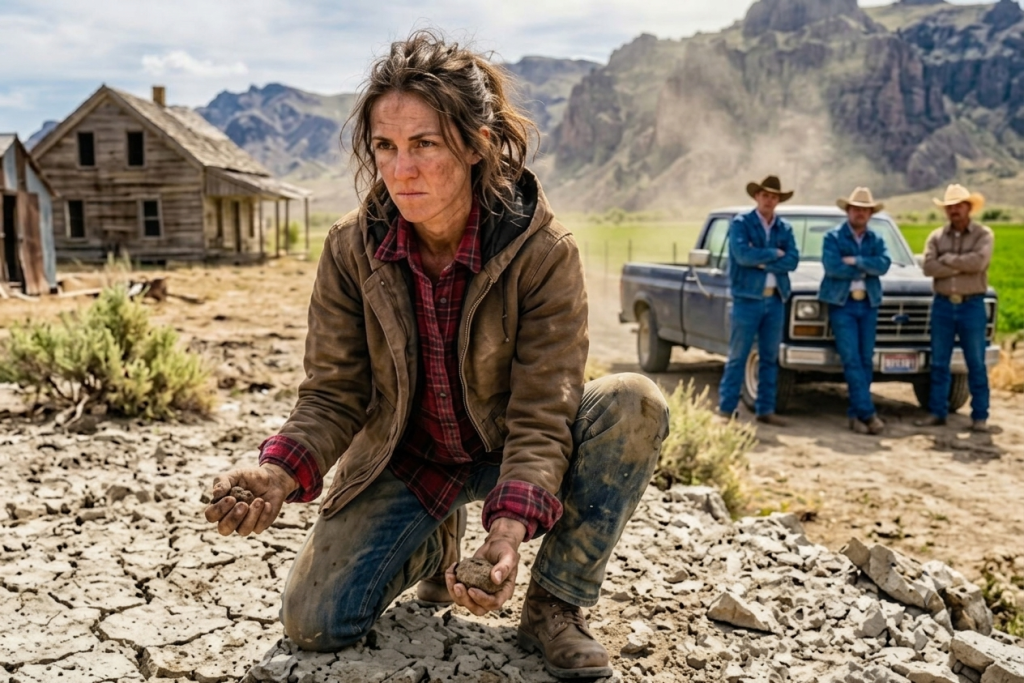
When everything settled, Clara had a maxed-out credit card, a bruised pride, and a letter from a probate court in Idaho informing her that a dead uncle she had barely known had left her land.
“I appreciate the warning, Mr. Henderson,” Clara had said, hearing how steady her voice sounded while her hands trembled in her lap. “But I don’t exactly have a backup plan. I’ll take the keys.”
The drive to Oak Haven took four hours and seemed to carry her backward out of one life and into something harsher. Green pastures faded into yellowing scrub. The scrub surrendered to baked earth, low sage, dry gullies, and sun-struck ridges. By the time she pulled her battered Honda Civic onto the gravel shoulder of County Road 9, the world around her felt scraped clean of softness.
Now, standing at the fence line of her inheritance, Clara understood why the lawyer had sounded sorry.
The property was a tragedy in three acts.
In the foreground stood the farmhouse, weather-beaten and warped, its porch boards bowed and splintered, its windows filmed with dust. Behind it stood the barn, rusted and leaning, with one sliding door hanging crooked from its rail. And beyond all of that lay the land: cracked gray earth, fractured limestone, and not a single blade of green daring to raise its head.
The silence was so complete that when heavy tires crunched onto the gravel behind her, Clara turned sharply.
A pristine midnight-blue King Ranch pickup rolled to a stop behind her Civic. The truck looked freshly washed, absurdly polished against the dust. The door swung open, and a man stepped out wearing custom-tooled leather boots, a crisp shirt, and sunglasses that remained on his face though the sun was already at his back.
He was broad through the shoulders, sun-leathered, and rich in the particular rural way that did not need to shout because everyone nearby already knew.
“You must be Arthur’s niece,” he said.
Clara kept her posture straight.
“Clara Higgins.”
“Thomas Griggs.” He leaned one elbow on a fence post and tilted his chin toward the lush green fields beyond the southern boundary. “I own the green side of the fence.”
She glanced past him.
His land looked impossible from where she stood: wide irrigated fields, dark soil, uniform crops, pivot sprinklers, straight roads, shining equipment, and wealth arranged in long, orderly rows. Three thousand acres of commercial farming pressed against her dead twenty like a humiliation.
Griggs smiled at her, though there was no warmth in it.
“Listen, Clara. Your uncle was a dreamer. This land broke him. It’s nothing but a dust trap. Every time the wind blows, your alkaline dirt coats my soybeans.”
He pulled a silver money clip from his pocket and flipped it open.
“I’m not a sentimental man, but I hate seeing a young woman in over her head. I’ll give you five hundred an acre. Ten thousand dollars cash. You can get back in that little car of yours and head back to civilization.”
Ten thousand dollars.
The number landed harder than Clara wanted it to. It would clear her credit card debt. It would give her enough for a security deposit on a new apartment, maybe a few months to find another logistics job. It was not generous, not really, but it was escape.
The logical part of her recognized that.
Then she looked at Thomas Griggs’s face.
She saw the same expression Daniel had worn when she failed to secure the promotion he had silently counted on. The same polished pity. The same lazy confidence of a man looking at a woman and seeing weakness before he saw a person.
Something hot and unfamiliar stirred in her chest.
“The county assesses it at eight hundred an acre, Mr. Griggs,” she said.
Griggs chuckled. It was a dry sound, unpleasant as dead weeds scraping tin.
“The county assessor hasn’t tried to grow a weed in this chalk. Ten grand is a gift, sweetheart.”
Clara looked back at the Boneyard.
“The price is fifty thousand,” she said, turning to face him fully. “Or it’s not for sale.”
His smile disappeared.
For a few seconds, the only sound was the wind moving dust against the fence wire.
“You have no equipment,” Griggs said. “No capital. No water rights to the main reservoir. You’ll be starved out in six months, and the bank will auction this place to me for pennies. I was trying to do you a favor.”
“I’ll take my chances.”
The words sounded foolish even as she said them.
Griggs pushed himself off the fence post.
“Enjoy the dust, Miss Higgins. Don’t say I didn’t warn you.”
His truck sprayed gravel as he pulled away.
Clara watched him go, then turned toward the farmhouse. The front door was swollen in its frame and resisted her shoulder. When it finally gave, it opened into stale air, dust, old newspapers, mouse droppings, cracked plaster, and the lingering atmosphere of a man who had spent his last years arguing with the world and losing.
She stepped inside anyway.
She had no money.
No farming experience.
No equipment.
No friends in Oak Haven.
And now she had an enemy who owned half the county.
But as she stood in Arthur Higgins’s ruined front room with Idaho dust in her hair, Clara made a vow to the ghost of an uncle she had barely known.
She was going to make that land bleed green, even if it killed her.
The first three months nearly did.
Clara learned quickly that determination was a poor substitute for topsoil. She spent the last of her severance pay on a rusted 1982 John Deere tractor bought from a retiring farmer two towns over. The tractor groaned every time she turned the key, coughed black smoke into the sky, and shook so badly that after two hours in the seat, Clara’s teeth seemed to buzz inside her head.
She dragged a heavy disc harrow behind it for fourteen-hour days, trying to break open the earth.
The earth resisted.
The limestone pan beneath the surface was not soil in any meaningful sense. It was a shield. Blades chipped. Shear pins snapped. The tractor overheated twice. Clara learned to keep spare bolts, rags, water, and bandages in the tool box. Her hands became a landscape of blisters and split skin. Her shoulders ached so badly some mornings she had to grip the edge of the sink and breathe through the pain before she could lift a coffee cup.
By late May, she had managed to seed five acres of drought-resistant sorghum.
She prayed for rain.
The sky remained a hard, mocking blue.
Oak Haven watched with open curiosity and private pleasure.
Every Wednesday, Clara drove into town for groceries, fuel, and coffee, and every Wednesday she endured the local diner. It sat on Main Street between the bank and a farm supply shop, with faded booths, pie under glass, old men in seed caps, and one corner booth ruled by Abigail Fenton, the town’s undisputed queen of gossip.
Abigail had narrow eyes, white hair sprayed into place, and the terrible confidence of a person who had never confused kindness with entertainment.
“I saw the dust clouds yesterday, dear,” Abigail said one afternoon as Clara waited at the counter for coffee. “Are you trying to signal the space station, or are you actually trying to farm that chalk?”
A low chuckle moved through the diner.
Clara felt her face heat, but she forced a smile.
“Just aerating the soil, Abigail. Have a good day.”
The laughter followed her out.
But the diner was nothing compared to the farm.
By July, the sorghum had sprouted, then withered into brittle brown husks. The soil was too compacted to hold moisture, too dead to protect seed, too alkaline to support life. Clara walked the rows one morning and heard each dead stalk crack under her boots like tiny bones.
Then she found the water line cut.
She had spent two thousand dollars—money she needed for winter heating oil—to install a small drip-tape system from her unreliable well to a half-acre vegetable patch near the farmhouse. It was supposed to be her survival garden: tomatoes, beans, squash, peppers, anything she could eat and maybe sell.
She went out at dawn and found the thick black plastic severed in three places.
Not torn.
Cut.
Cleanly.
With a knife.
Clara knelt in the dust and touched the edge of one cut with her thumb.
Her eyes went immediately to the southern horizon, where Thomas Griggs’s irrigated fields began.
She had no proof.
Sheriff Miller, a weary man who played poker with Griggs on Friday nights, would laugh her out of the station if she tried to file a complaint. The town would call her paranoid. Griggs would smile behind his sunglasses.
She was on her own.
Defeated, filthy, and shaking with exhaustion, Clara retreated into the farmhouse. Arthur had left it full of hoarded junk: old newspapers stacked in towers, broken chairs, coffee cans filled with nails, buckets of rusted hardware, cracked dishes, books with mouse-chewed covers, boxes of boots, tools, rags, and unlabeled parts.
In a fit of frustrated rage, she kicked a heavy wooden crate in the parlor.
The crate overturned, spilling boots and tools across the floor.
The kick also dislodged a loose floorboard beneath it.
Clara froze.
For a moment, she thought she had imagined it. Then she knelt, pushed the crate aside, and worked her fingers under the edge of the board. It came up with a dry creak.
Hidden between the joists lay a heavy canvas bag sealed with wax.
Her heart began pounding.
She dragged it onto the rug and cut the seal with a kitchen knife.
Inside was no money.
No gold.
No miracle inheritance.
Only a leather-bound journal, several rolled-up topographic maps, and a thick, heavily annotated textbook titled Regenerative Earthworks and Hydrological Topography.
Clara opened the journal.
The handwriting was erratic, urgent, driven by a kind of fever. It was Arthur’s.
April 14. They think the land is dead. They’re fools. The water isn’t gone. It’s just moving too fast. The limestone creates an impermeable pan, and the slope rushes every drop of rain straight off my property and down into Griggs’s basin. I’ve been farming it wrong. We all have. You don’t break the soil. You catch the water.
Clara read until the room went dark.
Then she lit a lamp and kept reading.
For forty-eight hours, she lived inside Arthur’s maps and notes. She drank coffee, ate crackers, forgot to sleep, and began to understand that her uncle had not failed because the land was cursed. He had failed because he had been trying to force a conventional industrial farming system onto a fragile, unique piece of ground that needed something entirely different.
Arthur had spent years taking core samples, mapping slight changes in elevation, tracking runoff after storms, and studying how the limestone pan behaved beneath the surface. His conclusion was radical but simple.
The land did not need to be plowed.
It needed to be carved.
He had designed contour swales: long, level trenches dug across the slope, six feet wide and three feet deep, filled with organic matter and backed by berms. They would catch rainfall before it could flash off the hardpan. They would stop erosion. They would hold water in place long enough for it to sink deep through cracks in the limestone and hydrate the land from below.
Arthur had mapped the entire twenty acres.
Every swale.
Every berm.
Every overflow.
Every planting zone.
He had the blueprint.
He had simply run out of money and time.
Clara looked at her bank account.
Three hundred dollars remained.
It would not rent a backhoe for a day.
It certainly would not rent an excavator for two weeks.
But she had one asset left: the farmhouse itself.
The next morning, she called the only bank in Oak Haven and arranged a high-interest mortgage against the house Arthur had left her. It was financial madness. If she failed, she would not merely lose the land. She would owe more money than she had ever owed in her life.
That afternoon, she stood on the porch looking out at the cut water lines and the dead sorghum.
“You wanted me gone,” she whispered toward Griggs’s green fields. “Now I’m digging in.”
Ben Caldwell arrived four days later with a massive yellow Caterpillar excavator on a lowboy trailer, a cigarette behind one ear, tobacco in his cheek, and no visible interest in judging what people paid him to do.
“You want me to do what?” he shouted down from the cab after Clara unrolled Arthur’s map across the hood of the Civic.
“I want you to dig a ditch,” Clara yelled over the diesel. “Six feet wide, three feet deep, following this exact contour line across the property. Dead level. If it’s off by an inch, it won’t work.”
Ben spat tobacco juice into the dust.
“Lady, you’re paying me a hundred fifty bucks an hour. If you want me to carve your initials into bedrock, I’ll do it. But I got to warn you, this is going to look like a war zone.”
Clara picked up the laser level.
“Start digging.”
For two weeks, the peace of Oak Haven shattered under the thump and roar of excavation. Clara walked ahead of the machine marking contour lines with orange paint while Ben’s bucket tore into gray earth. They were not plowing. They were carving the land into giant serpentine terraces, trench after trench bending across the slope in long, level ribbons. The soil from each trench was piled downhill, forming rough berms.
The town went wild.
The local Facebook group filled with theories. Clara was strip mining. Clara was burying toxic waste. Clara was building a moat. Clara had finally lost her mind in the Boneyard.
Thomas Griggs did not post online.
He acted.
On a sweltering Tuesday, a white SUV with the county seal pulled up to Clara’s property line, escorted by Griggs’s midnight-blue truck. Clara wiped grease from her hands and walked over.
Inspector Davies climbed out of the county vehicle. He had the gray face and deep frown of a man who had not smiled since the late 1990s.
“Ms. Higgins,” he said, “I’ve received multiple complaints regarding unpermitted strip mining and unauthorized earthworks on this parcel.”
Griggs stood behind him with his arms crossed, satisfaction shining through his sunglasses.
“You’re destroying the valley’s watershed, Clara. I told you to take the money.”
Clara held out her agricultural zoning permits.
“I’m not mining, Inspector. I’m preparing agricultural beds. This property is zoned A1. I’m allowed to manipulate topography for water retention. There are no county ordinances against digging ditches on private farmland.”
Davies took the papers.
He read them slowly, as if hoping they would become wrong if he frowned hard enough. Then he walked to the nearest trench, looked at the raw scar of earth, and sighed.
“Technically, she’s correct, Mr. Griggs. Agricultural zoning. As long as she isn’t damming a designated creek, which she isn’t because there is no creek, she can dig.”
Griggs’s face flushed dark.
He stepped closer to Clara, his voice dropping.
“You’re making a mess, little girl. Those loose piles of dirt will blow straight into my winter wheat. If a single grain of your dust damages my crop, I’ll sue you into oblivion.”
Clara looked him straight in the face.
“Stay off my land, Thomas.”
By late August, the excavation was finished.
Clara’s money was gone.
The land looked horrific. Deep dry trenches and raw berms wound across the twenty acres like enormous wounds. But according to Arthur’s plan, the digging was only the first part.
The land needed carbon.
It needed biology.
It needed rot.
Clara called the county dump and every tree trimming service within eighty miles. She offered her place as a free dumping ground for organic waste. Over the next week, trucks rolled in with rotting wood chips, grass clippings, dead leaves, chipped limbs, and spoiled hay. Clara shoveled and dragged and raked until her back spasmed. She filled the trenches halfway with organic matter and seeded the berms with a cheap mix of daikon radish, clover, and vetch—cover crops, not cash crops, chosen for roots that could break hard ground, feed microbes, and hold the loose soil in place.
Then she waited.
September came with dark clouds building over the Owyhee Mountains.
The valley had prayed for rain all summer.
When it finally arrived, it did not fall.
It crashed.
The weather station issued a flash flood warning. Wind slammed rain against the farmhouse windows. Clara stood on the porch in a yellow raincoat, hair whipping across her face, watching the deluge hit the land.
Normally, rain on the Boneyard moved like panic. The baked hardpan repelled it. Water sheeted across the surface, carrying dust, ash, and whatever little topsoil existed toward lower ground.
This time, the runoff raced down the slope and struck the first swale.
The trench caught it.
The wood chips drank it.
Instead of flying off the property in a destructive sheet, the water slowed into a long, level ribbon. When the first swale filled, it overflowed gently into the next, then the next. The entire landscape became a linked system of quiet basins, holding hundreds of thousands of gallons in place and forcing it to sink slowly downward into the fractured limestone pan.
Not a single drop left Clara’s property.
The next morning, after the storm broke, Clara walked to the fence line.
Down below, Thomas Griggs’s flat fields were torn open by gullies. The runoff from the upper ridge had ripped through sections of his soybean crop, carrying expensive topsoil away in muddy streams. His synthetic green had been gashed and stripped.
Clara looked back at her own land.
The trenches were still full, slowly draining. The berms were damp. The wood chips had already begun to soften and darken. She crouched and pulled a tiny daikon radish sprout from the moist mound.
Arthur had been right.
The land was not dead.
It was waiting to be awakened.
Winter did not come gently to Owyhee County. It came with hard wind, sleet, ice, and cold that moved through the farmhouse walls like a living thing. Clara’s breath fogged in the kitchen most mornings because she rationed heating oil. Her bank account was overdrawn by forty-two dollars. Her pantry held bulk rice, dried beans, canned tomatoes from the guarded summer patch, and whatever eggs she could barter from a neighbor.
Thomas Griggs was not content to let winter freeze her out naturally.
Her success in the autumn storm had gotten under his skin.
The week before Christmas, Richard Gable, branch manager of the local bank, called.
“Clara,” he said, voice coated with false sympathy, “I’ve been reviewing your file. You’ve made your monthly payments, but the board is expressing concern about alterations to the property’s topography. They feel it may have drastically reduced the resale value of the collateral.”
Clara gripped the phone harder.
“It’s agricultural land, Mr. Gable. I’ve implemented water-retention earthworks. The value has gone up.”
“That’s highly subjective. We require an independent appraisal. If the appraiser determines the land has been damaged, the bank may have to call the loan due.”
She closed her eyes.
“When?”
“Friday.”
The appraiser arrived in a sleet storm. His name was Higgins too, no relation, which he pointed out with immediate irritation. He walked the property in a parka, boots slipping on frozen berms, clipboard held beneath one arm.
The land looked terrible under winter. The swales were filled with snow. The berms rose like burial mounds. The daikon, clover, and vetch had been killed by frost. Everything appeared desolate.
“It’s a mess, Miss Higgins,” the appraiser muttered. “No commercial farm equipment could safely navigate this terrain. You’ve essentially rendered the acreage useless for modern combines or tractors.”
“I’m not running modern combines,” Clara said through chattering teeth. “Look at the radishes.”
She grabbed a shovel from the barn, marched to the nearest berm, and drove the blade into frozen earth. She pried up a chunk and pointed to the rotting foot-long daikon roots.
“They’re biological tillers. They drove deep through the limestone crust. Now they’re rotting in place, leaving channels full of organic matter. Water and oxygen can move into the subsoil. I’m building topsoil from the inside out.”
The appraiser stared at her without interest.
“The bank doesn’t lend on rotting radishes, Miss Higgins. It lends on yield history and arable acreage.”
For two weeks, Clara waited for foreclosure.
Then Arthur saved her again.
Years earlier, her uncle had filed a small historic conservation easement on a rocky corner of the property where native plants had once been documented. The legal red tape surrounding that easement prevented the bank from moving quickly on any claim that topographical changes had degraded collateral value. Foreclosure stalled.
Clara had bought herself three months.
When spring thaw came in late March, the transformation was invisible from the road. The Boneyard still looked raw. But when Clara walked across the berms, something had changed beneath her boots.
The swales had captured snowmelt all winter. Instead of running off, the water had seeped into the ground. The limestone beneath the property was hydrated. The berm soil was darker, crumbly, softer than anything she had touched there before.
Then she saw it.
One earthworm.
Tiny.
Pink.
Wriggling in the loose darkening soil between her fingers.
Clara dropped to her knees and began to cry.
It was only one worm.
To her, it was a biological gold medal.
Life was returning.
The second phase of Arthur’s plan demanded animals.
Plants alone could not rebuild the system quickly enough. The land needed manure, hooves, disturbance, fertility, movement. Cows were impossible. Clara had no money. So she drove to the Oak Haven livestock auction and walked not to the padded bleachers with the commercial ranchers, but to the muddy back pens where the culls were kept.
The old.
The sick.
The unwanted.
There she met Wyatt, a grizzled, chain-smoking man trying to unload thirty ragged Katahdin sheep and fifty laying hens past their prime.
“They’re bound for the dog food plant, lady,” Wyatt said. “They ain’t worth the hay it’d take to fatten them.”
“I don’t have cash,” Clara said, “but I have a 1950s Ford truck in the barn. Antique. Engine block is cracked, but the body is clean. Chrome alone is worth two grand. Trade me the sheep, the chickens, and that roll of portable electric fence in your truck bed.”
Wyatt squinted at her.
Then spat.
“Deal.”
The animals changed everything.
Clara did not let them roam. Following Arthur’s textbook, she practiced intensive rotational grazing. Every morning before sunrise, she moved portable electric fence, packing the sheep into a tiny section of grassy berm for just twenty-four hours. They ate the cover crops down hard, trampled dead weeds, and covered the ground in nitrogen-rich manure.
The next day, she moved the sheep forward and brought the chickens behind them. The hens scratched through the manure, spreading it, eating parasite larvae, and adding their own hot fertilizer.
The work was relentless.
But the response was explosive.
By June of her second year, sections the animals had grazed erupted in dense green. Native grasses that had not appeared on the property in fifty years emerged from seed long buried in the soil. Clover spread. Vetch climbed. Earthworms multiplied. Clara began selling dark-yolked pasture-raised eggs to an organic grocery store in Boise, two hours away. It was not a fortune, but it kept the lights on and the bank away.
Two local teenagers, siblings named Jess and Cody, started hanging around after school, offering to mend fence and carry feed in exchange for learning what Clara was doing.
For the first time since arriving, she was not entirely alone.
Thomas Griggs watched from his side of the fence.
His fields relied on expensive synthetic fertilizers, deep wells, and massive irrigation. That year, a strange fungal blight moved through several low sections of his soybeans. Meanwhile, Clara’s Boneyard was turning green.
The insult of it ate at him.
The fire came on a moonless night in mid-August.
Clara woke to terrified bleating and the frantic barking of the stray dog she had adopted that spring. She grabbed the heavy Maglite from her nightstand and ran onto the porch.
To the south, near the Griggs property line, orange flame licked up into the dark.
Someone had set fire to the dead brush at the edge of her property, and the wind was pushing it straight toward the swales and the temporary pen holding her sheep.
Clara ran.
Smoke burned her throat. Heat struck her face. When she reached the pasture, she saw the electric fence slashed in three places. The sheep were trapped, huddled against a dense scrub oak thicket while flames moved toward them.
She did not think.
She dove into the smoke, tearing at thorny scrub oak with her bare hands to create a gap.
“Go! Go! Get out!”
She slapped the animals, shoved them, screamed until her voice broke. The last lamb staggered through the gap just as flames swallowed the thicket. Clara collapsed on the damp earth of a swale, coughing, hands burned and bleeding.
Through the smoke, she heard a heavy diesel engine fading down County Road 9.
A truck that sounded exactly like a King Ranch pickup.
The fire department arrived thirty minutes later and stopped the blaze before it reached the farmhouse.
The next morning, Sheriff Miller stood in the blackened field, kicking ash with one boot.
“Looks like lightning,” he said.
“There was no lightning.”
“Maybe a cigarette. Brush is dry this time of year.”
“The fence was cut. I heard a truck.”
“I can’t launch an arson investigation based on a phantom truck, Clara.” He avoided her eyes. “You’re playing a dangerous game out here alone. Maybe it’s time to cash out.”
Clara stood with her hands wrapped in gauze.
In that moment, she understood that law in Oak Haven stopped at the edge of Thomas Griggs’s bank account.
She looked across the burned ground.
The fire had taken grass and brush.
It had not touched the deep wet swales.
It had not burned the water stored underground.
“I’m not leaving, Sheriff,” she whispered. “I’m planting trees.”
Years three and four became a marathon of labor.
The fire had an unintended consequence. It outraged the quiet edges of Oak Haven—the people Griggs had bullied, undercut, bought out, or humiliated over decades. Wyatt showed up with a truckload of salvaged timber to help rebuild her barn. Jess and Cody recruited classmates to plant. A retired nursery owner sent fruit tree cuttings. A tree service from Boise delivered chipped wood for free after seeing a photo of the burned fence.
Using insurance money from the fire and every dollar she could earn from eggs, Clara executed the final phase of Arthur’s plan.
A food forest.
Along the swales and berms, Clara and her ragtag army planted over two thousand trees and shrubs. Not in straight monoculture rows. In guilds. Apple, plum, and pear underplanted with nitrogen-fixing Siberian pea shrub. Blackberries, raspberries, currants, and elderberries woven through the understory. Comfrey, yarrow, clover, mint, and wildflowers seeded around trunks to pull minerals and feed pollinators.
The soil below had become a hidden reservoir.
The trees grew with terrifying speed.
In two years, the old chalky Boneyard turned into a dense, layered green landscape. Sheep grazed the understory. Chickens followed. Bees returned. Birds nested in the new growth. Earthworms worked the berms. Fungal threads spread through the darkening soil like underground lightning.
Then came year five.
The year the sky turned off.
It was the worst drought Idaho had seen in eighty years. From April to September, not one meaningful rain fell on Owyhee County. The sun baked the earth into cracked pottery. The county’s main agricultural reservoir dropped to catastrophic levels. Emergency water rationing followed. Pivot sprinklers were shut down to conserve drinking water.
Thomas Griggs had been caught unprepared.
His empire depended on surface irrigation. When regulators shut off his water, his three thousand acres began to die. Clara watched from her porch as his fields turned from synthetic green to yellow, then brittle brown. Dust storms lifted his chemically treated topsoil into the air and carried it toward the highway.
But Clara’s farm did not blow away.
Her property stood as an emerald oasis in a desert of failure. The swales had stored winter rain and snowmelt deep in the limestone. The tree canopy shaded soil and stopped evaporation. Deep roots tapped water beyond the reach of drought. Apple branches bent under fruit. Plum trees turned purple with harvest. Berry canes were heavy. Sheep grew fat in the cool understory grass.
In late August, news vans arrived.
A regional crew from Boise had come to cover Owyhee County’s agricultural collapse and intended to interview Griggs. But on the drive past Clara’s property, their cameras caught the impossible sight of lush green trees beyond the fence line while everything else lay brown.
The reporter, Sarah Jenkins, approached Clara with a microphone and wide eyes.
“Ma’am, we’re doing a piece on the historic drought,” Sarah said. “How are you irrigating this? County water was shut off two months ago.”
Clara wiped dirt from her jeans.
“I don’t use county water,” she said, looking directly into the camera. “I haven’t turned on an irrigation pump in three years. I don’t buy synthetic fertilizer, and I don’t use pesticides.”
“Then how is this possible?”
“Commercial farming treats soil like an empty sponge that has to be constantly filled with pumped water and expensive chemicals,” Clara said. “Five years ago, this land was considered unfarmable. They called it the Boneyard. We stopped fighting the earth. We dug swales on contour to catch rain. We used livestock to build biology. We built an ecosystem that waters itself. What you’re looking at isn’t a miracle. It’s biology.”
The segment aired that night across the Pacific Northwest.
The headline read:
THE UNFARMABLE OASIS: HOW ONE WOMAN BEAT THE HISTORIC DROUGHT.
The phone began ringing the next morning and did not stop.
Universities in Oregon and Washington wanted to bring graduate students. Organic distributors from Seattle offered triple market rates for the fruit harvest. Environmental groups wanted tours. Farm magazines wanted photographs.
But the most satisfying moment came two days later.
Clara was standing by the mailbox when the midnight-blue truck pulled up.
Thomas Griggs stepped out looking ten years older.
No sunglasses.
No swagger.
His face had the hollow look of a man watching his legacy turn to dust.
He walked to the fence and stared into the shade of Clara’s food forest.
“The bank is threatening to call my operating loans,” he said. “My crop is gone. The topsoil blew away yesterday.”
Clara said nothing.
“I have three thousand acres of dead dirt.” His voice barely carried. “I spent my whole life trying to force this land to do what I wanted.” He swallowed. “You listened to it.”
His pride cracked in front of her.
“I need you to show me how you did it. I need you to teach me how to dig the trenches.”
Clara looked at the man who had mocked her, sabotaged her, and tried to run her out of town. She looked past him at the vast dead expanse of his farm. If Griggs’s land died completely, Oak Haven would suffer with it.
“My consulting rate is two hundred dollars an hour, Thomas,” she said. “And you’re going to have to sell your tractors. You’ll need a bigger excavator.”
Griggs’s jaw tightened.
The old arrogance flickered and died.
“When do we start?”
“Tomorrow at dawn. Bring a shovel. A manual one.”
The transformation of Thomas Griggs began with manure.
At 5:00 a.m., he arrived wearing expensive work gloves. Clara handed him a rusted spade and pointed at steaming compost windrows behind the barn: sheep manure, wood chips, leaves, spoiled hay, and old bedding.
“Before we move dirt,” she said, “you need to understand what makes dirt live. Turn the pile. All of it. If it doesn’t breathe, the aerobic bacteria die and it becomes sludge.”
For two weeks, the wealthiest man in Oak Haven shoveled manure.
People slowed on County Road 9 to stare.
Then they watched his equipment sell.
The combine. The fertilizer sprayers. The deep-well pumps. Much of the oversized conventional machinery that had defined Griggs’s empire went to auction to cover immediate debt. In its place came Ben Caldwell’s yellow excavator, crossing the property line into Griggs’s dead fields.
Clara stood on the hood of her battered Civic with a surveyor’s transit, shouting coordinates while Griggs trudged through dust with a wooden grading rod.
“You’re off by three inches, Thomas. If the swale isn’t dead level, water will pool and blow out the berm. Do it again.”
Griggs wiped sweat and dirt from his face.
He did not argue.
Then the black Escalades came.
They belonged to Apex Agricultural Partners, a multibillion-dollar corporate farming syndicate based in Chicago. Apex thrived on climate disasters. Its model was simple: wait for historic drought to bankrupt independent farmers, buy defaulted loans from local banks for pennies on the dollar, foreclose, consolidate land, and install automated mega-farms powered by deep aquifer mining.
Richard Gable at the local bank had quietly sold Griggs’s mortgage to Apex.
The hammer fell on a Tuesday in late October.
Clara and Griggs were sitting on his tailgate mapping winter cover crops when a black Escalade stopped beside them. A man stepped out in a charcoal suit that looked absurd against the dusty Idaho plain.
“Harrison Cole,” he said, extending a manicured hand. “Apex Agricultural Partners. Mr. Griggs, I believe you received our notice of default.”
Griggs ignored the hand.
“I have a ninety-day grace period.”
Cole smiled without warmth.
“Apex has accelerated the debt due to extreme depreciation of the asset. You’ve destroyed tillable acreage with this ditch-digging. Four point two million dollars due in thirty days, or we seize the land.”
Then he turned to Clara.
“And you must be the local miracle worker.”
“Get off my property line.”
“I’m not on your property, Ms. Higgins. I’m on Apex property.”
His smile sharpened.
“When we install industrial wells, we’ll pull from the deep Owyhee aquifer. The same aquifer your little puddles rely on. We’ll see how long your fruit trees last when we drop the water table by two hundred feet.”
He drove away.
Griggs dropped his head into his hands.
“It’s over. I can’t generate four million in thirty days. They’ll take it. Once they drill, they’ll suck the whole valley dry. Your farm dies with mine.”
Clara looked at the unfinished swales stretching across Griggs’s land.
She thought of Arthur dying penniless while trying to save twenty acres. She thought of burned hands, sheep in smoke, winter hunger, laughter in the diner, and water sinking into stone.
Then she turned toward the farmhouse.
“Where are you going?” Griggs called.
“To the barn. I need my uncle’s maps.”
She cleared the kitchen table, unrolled Arthur’s largest yellowed map, and stared.
For five years, she had believed Arthur mapped only his own land.
She had been wrong.
The blue lines crossed beyond her twenty acres, beyond Griggs’s fields, all the way to the county highway and the ridgeline above the valley.
“He mapped the entire Oak Haven watershed,” Clara whispered.
Griggs leaned closer.
“That’s my north ridge.”
“And this is the slope to the highway.” Clara ran one finger along the contours. “He knew. Arthur knew twenty acres was not enough. If we fix one farm, we get an oasis. But if Apex drains the aquifer next door, the oasis dies. The only way to protect the water cycle is to catch rain across the entire valley slope.”
“Beautiful theory,” Griggs said. “But I have thirty days.”
“Not if the valley fights back.”
That night, Clara did not sleep.
By the next evening, she walked into the Oak Haven diner on Friday at its busiest hour. Sheriff Miller was eating a burger in the corner. Abigail Fenton held court with the gossips. Wyatt sat at the counter drinking black coffee. The room went silent when Clara entered.
She walked to the center.
“I need your attention.”
Then she told them everything.
Apex had bought Griggs’s debt. Apex would foreclose. Apex would take the high ground. Apex would drill deep industrial wells and drain the aquifer beneath the entire town. Wells would fail. Property values would collapse. Apex would buy the rest cheap.
“They aren’t just coming for Thomas,” Clara said. “They’re coming for the water under your homes.”
Wyatt leaned forward.
“What do we do, Clara? They’ve got billions. We’ve got dirt.”
“We form a cooperative,” Clara said, slapping a stack of papers onto the counter. “An agricultural trust. We pool land equity, leverage it, and buy Thomas’s debt back from Apex. Then we implement Arthur’s water system across the whole watershed. We trap rainfall. We rebuild the local water table. We make the land drought-resistant.”
The diner erupted.
“You want us to risk our homes to save Thomas Griggs?” Abigail snapped. “After what he’s done to half this town?”
“I’m not asking you to save Thomas,” Clara said. “I’m asking you to save yourselves. If Griggs falls, Apex controls the watershed. If Apex controls the watershed, Oak Haven dries out. But if we join together, we control the high ground. We control the water cycle. We control our future.”
The door chimed.
Thomas Griggs walked in.
He looked nothing like the king of Oak Haven. He was dirty, bandaged, and tired. He crossed to the counter, picked up a pen, and signed the first page of the cooperative trust agreement.
“I was a fool for thirty years,” he said, voice echoing through the diner. “I fought the land and I fought all of you. Clara beat me by listening to the earth. If we don’t listen now, we die in the dust.”
Wyatt stood next.
“I ain’t got much but fifty acres of scree and a bad back,” he said, taking the pen. “But it’s yours, Clara.”
By midnight, twenty-two families had signed.
The Oak Haven Regenerative Cooperative was born.
The next four weeks were warfare.
Using combined land equity, a regional credit union issued a commercial loan. On day twenty-nine, Clara and Griggs walked into Apex’s temporary Boise office and dropped a certified check for $4.2 million on Harrison Cole’s desk.
Cole stared at it, a vein pulsing at his temple.
“You’ve saddled dirt-poor farmers with massive debt. You can’t pay interest growing boutique radishes.”
“We won’t be growing radishes, Harrison,” Clara said. “We’re growing a monopoly.”
Apex pivoted to legal sabotage.
As excavators carved miles of contour swales across the valley, Apex filed suit and secured a temporary injunction claiming Clara’s cooperative was illegally trapping surface runoff meant to feed the county reservoir. They called it water theft.
Sheriff Miller delivered the injunction on a gray November morning.
“I’m sorry, Clara,” he said, looking genuinely ashamed. “Machines shut down. If you dig another inch, you’re in contempt.”
The excavators went silent.
The hearing in Boise took place in a sterile courtroom paneled in mahogany. Apex lawyers presented polished charts showing surface water capture and projected reservoir impact.
Clara brought no lawyer.
She brought Arthur’s journal, two transparent boxes of soil, and two pitchers of water.
“Objection,” Apex’s lead counsel said. “Is this a science fair project?”
The judge sighed.
“Overruled. Proceed, Ms. Higgins.”
Clara placed the first box on the stand. It held gray hardpan limestone soil.
“Apex claims I’m stealing surface water,” she said. “But in degraded Owyhee soil, rainfall does not soak in. It flashes. It runs off, erodes, floods, and evaporates before it benefits anyone.”
She poured water onto the gray dirt. It pooled, ran off the sides, and carried dust with it.
Then she lifted the second box.
Dark soil.
Root-filled.
Spongy.
Alive.
“This is from my farm. Built with swales, cover crops, compost, and rotational grazing.”
She poured the second pitcher.
The water vanished into the soil.
“I am not damming water, Your Honor. I am injecting it. The swales force rainfall into subterranean limestone and recharge the aquifer. Apex isn’t angry that I’m stealing water. They’re angry I’m putting it back underground where they can’t meter it, control it, or sell it back to us.”
She placed Arthur’s data on the bench.
“Five years of well measurements. Since I built my swales, the local water table under my land has risen fourteen feet. We’re saving the watershed.”
The courtroom went silent.
The judge looked at the wet dark soil.
Then at the data.
Then at the Apex lawyers.
“Injunction lifted. Case dismissed.” He struck the gavel. “Let the woman dig.”
It took three years to finish the Oak Haven Valley project.
Under Clara’s relentless leadership, the cooperative transformed fifty square miles of dying alkaline ground into the largest continuous regenerative food system in North America. Miles of contour swales wound across slopes, stopping runoff. Berms were planted with chestnuts, walnuts, apples, cherries, nitrogen-fixing shrubs, berries, wildflowers, and deep-rooted perennials. Between swales, synchronized herds of cattle and sheep moved through strict rotational grazing cycles, trampling cover crops, spreading manure, feeding soil, and moving before roots were damaged.
The biological explosion was staggering.
The true test came in year eight.
Another severe drought struck the Pacific Northwest. Corporate mega-farms around the region were devastated. Deep industrial wells began pulling saline water, poisoning synthetic crops. Wind stripped dead topsoil from flat fields and darkened the sky.
But inside Oak Haven, the air remained cool and damp.
The entire valley had become a sponge. Winter snowmelt sat deep in the underground limestone reservoir. Tree roots pulled moisture upward. Canopies broke the wind. Pastures remained green under clover and shade.
While food prices soared and surrounding counties failed, the Oak Haven Cooperative reported a record harvest.
By then, they were no longer selling raw commodities to brokers. They had processing facilities. They sold premium grass-finished beef, organic fruit, artisanal honey, nuts, berries, and value-added products directly to national distributors.
Gross revenue crossed $100 million in one season.
Apex closed its Boise office and retreated east.
Oak Haven was reborn.
The diner renovated. The local school, once close to closing, filled with children of families moving back for cooperative jobs. Wyatt ran the livestock division with Cody. Jess managed orchard crews and later became operations director. Thomas Griggs served as chief logistics officer, with less personal money than he once had and more peace than he knew what to do with. He wore muddy boots now and smiled easily.
On a crisp October evening, Clara walked to the highest ridge of her original twenty acres.
The old farmhouse was gone, replaced by an off-grid timber-frame home she had built with help from the town. Beside her walked a massive sheep dog descended from the stray that had saved her flock from fire. Below her, the first swale she had ever dug was invisible beneath plum trees, comfrey, wild mint, blackberries, and shade.
She knelt and plunged her bare hands into the earth.
No hardpan.
No dry chalk.
No dead gray dust.
Her fingers sank into rich black topsoil, sweet-smelling, damp, alive with earthworms and fungal threads.
They had called it cursed.
They had called it unfarmable.
They had laughed when she refused Thomas Griggs’s pity buyout.
They had called her crazy when she stopped planting and started tearing the land apart.
Clara smiled, wiped dark soil across her jeans, and looked over a valley that bled green from ridge to road.
Arthur had been right.
The earth was not dead.
It had only been waiting for someone brave enough to listen.
THE END
