The front door was unlocked when Captain Carter came home.
That was the first wrong thing.
Tessa never left the front door unlocked.
Not when she walked to the mailbox.
Not when she carried grocery bags in from the SUV.
Not when she stepped onto the porch to water the two planters she treated like a personal responsibility.
He stood in the entryway with his duffel strap cutting into his shoulder, waiting for the ordinary sounds of home to rise around him.
Nothing came.
No music from the kitchen.
No television from the living room.
No soft rush of Tessa’s slippers against the hallway floor.
The air smelled like bleach.
Too much bleach.
The kind of sharp, chemical smell that burned through the nose and made everything feel scrubbed of life.
Underneath it, faint but unmistakable, was another smell.
Blood.
Carter did not shout right away.
His body changed first.
His breathing slowed.
His eyes moved over the room the way they had been trained to move over places where danger had recently passed through.
A dining chair lay on its side.
A lamp was broken near the kitchen wall.
One of their anniversary photos was facedown on the hardwood, the glass cracked across Tessa’s smile.
There were drag marks near the stairs.
Then he saw the small dark streak on the baseboard.
Dried blood.
“Tessa?” he called.
The house gave him nothing back.
At 9:18 p.m., he called 911 from the driveway because he did not trust himself to stand inside that house and listen to a dispatcher ask routine questions.
At 9:47 p.m., an officer told him there had been “an incident.”
At 10:26 p.m., a hospital intake clerk handed him a visitor sticker and asked him to confirm Tessa’s date of birth.
He answered because procedure still existed even when a person’s life had split open.
A doctor met him outside the ICU.
The man looked exhausted.
His mask was pulled under his chin, and the lines around his eyes told Carter more than his words did.
“Captain Carter,” the doctor said quietly, “your wife is alive, but barely.”
Alive.
Carter held on to that word.
He had held on to worse things in worse places, but nothing had ever weighed as much as that one word outside a hospital room.
Then he saw her.
Tessa lay beneath white sheets, still in a way she had never been still in life.
Machines beeped beside her bed.
Tubes ran into her arms.
Her face was swollen and bruised, one eye sealed shut, her lips split and dry.
A hospital wristband circled her wrist.
Her wedding ring remained on her finger.
That detail almost broke him.
He reached for her hand and stopped himself from holding it too tightly.
The doctor stood beside him with the quiet discomfort of a man who had seen the damage but still had to name it.
“Thirty-one fractures,” he said.
Carter did not turn his head.
“Say that again.”
“Thirty-one fractures. Severe blunt force trauma. Repeated strikes.”
The room seemed to narrow around the words.
“Repeated?” Carter asked.
The doctor nodded.
“It wasn’t random violence.”
Carter looked at the chart clipped near the foot of the bed.
The top page had the clean, official look of institutional horror.
INCIDENT REPORT.
Hospital intake form.
CT notes.
Every line translated pain into language that could be filed.
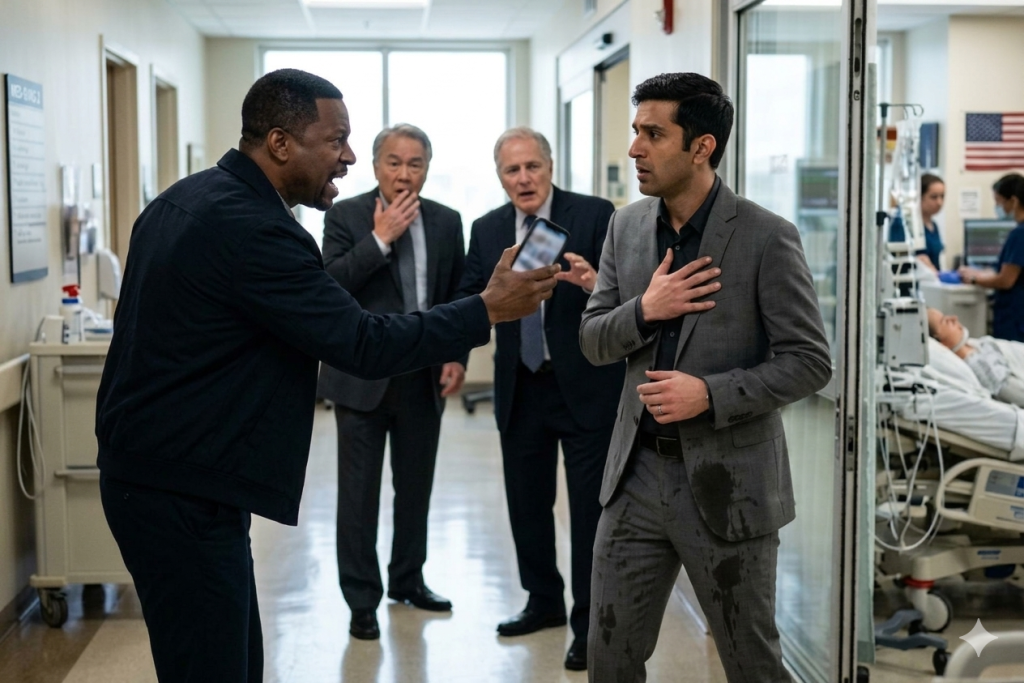
That was when he noticed the people standing outside the ICU glass.
Harold Graves was there.
Tessa’s father.
Beside him stood his seven sons.
They were dressed too well for that hour of night.
Dark suits.
Fresh haircuts.
Dry eyes.
One brother held a paper coffee cup like he had been inconvenienced on the way to a business meeting.
Harold stood with both hands folded over his belt buckle.
He was smiling.
Not broadly.
Not foolishly.
Just enough.
Enough to tell Carter that Harold believed the room, the hallway, and the story around Tessa already belonged to him.
Detective Collins stood nearby, avoiding eye contact.
“It appears to have been a robbery,” Collins said.
Carter looked at him slowly.
“A robbery.”
“That’s the official angle right now.”
“Official angle.”
Collins shifted his weight.
Carter turned back to Tessa.
He looked at her hands.
Her fingernails were clean.
No torn skin beneath them.
No blood.
No fibers.
Nothing.
Six years earlier, Tessa had taken her first martial arts class because Carter was deployed and she hated feeling afraid in parking lots.
She kept going because she liked feeling strong.
Once, in their garage, she had put Carter flat on his back during a practice drill and laughed so hard she had to sit down beside him on the concrete.
“You got cocky,” she had said.
He had never loved her more than in that moment.
Tessa fought strangers.
She did not fight family until it was too late.
That realization entered Carter quietly, and because it entered quietly, it stayed.
He turned to Detective Collins.
“My wife trains,” he said.
Collins blinked.
“In martial arts. If strangers attacked her, she would have fought hard enough to leave something under her nails.”
The detective did not answer.
Carter lifted the medical report from the foot of the bed.
“Thirty-one strikes,” he said.
Harold and his sons heard him through the open doorway.
“A thief hits once and runs. Thirty-one times isn’t robbery.”
He looked at Harold.
“That’s hatred.”
The hallway went still.
A nurse at the station stopped with one hand on a chart.
One of the brothers lowered his coffee.
The small American flag near the reception desk hung motionless under the bright corridor lights.
For a moment, even the machines seemed louder.
Then Damian stepped forward.
He was the biggest of the brothers, heavy through the shoulders, wearing his suit like armor.
“You need to calm down, soldier boy,” he said.
Harold adjusted his tie.
“You’re emotional, Carter,” he said. “Go back to your military games. We’ll handle family matters ourselves.”
Family matters.
Carter had heard men hide behind words before.
Private issue.
Misunderstanding.
Internal problem.
Clean phrases existed so dirty hands could stay presentable.
Damian moved closer and blocked Carter’s path.
“Didn’t you hear him?” he said. “Get lost, government dog.”
Carter smelled whiskey on him.
He wanted, with a clarity that frightened him later, to throw Damian through the glass wall.
He wanted Harold’s face to change.
He wanted those seven sons to feel one clean second of what Tessa must have felt when the people in front of her stopped being family and became danger.
But Carter did not move.
Not then.
He breathed once.
Then he stepped close to Harold.
“You call me a dog,” he said softly, “but attack dogs are trained to remember who gave the command.”
Harold’s smile thinned.
That was the first crack.
Carter stepped back and scanned the seven brothers.
Damian was angry.
Two others looked bored.
Another looked annoyed, as if the night had gone on too long.
But the youngest, Ryan, was pale.
His coffee cup trembled in both hands.
Brown liquid spilled over the plastic lid and dotted the hospital floor.
Carter held his gaze for three seconds.
Ryan looked away first.
That told him more than any statement could have.
Detective Collins stepped between them.
“Captain Carter, please don’t do anything reckless.”
Carter looked at the clipboard in the detective’s hand.
“Reckless is calling thirty-one fractures a robbery before you read the hospital report.”
The nurse at the station stopped pretending not to listen.
Harold noticed the nurse.
His expression changed, not into fear, but into calculation.
Men like Harold counted witnesses before they counted damage.
Then Ryan’s phone buzzed.
The sound was small.
It cut through the hallway anyway.
Ryan flinched so hard the coffee cup slipped from his fingers.
It hit the floor and burst open.
Coffee spread across the clean tile, brown against white, while the plastic lid rolled toward the nurse’s shoes.
Damian turned on him.
“What the hell is wrong with you?”
Ryan did not answer.
He stared at his phone.
His face emptied.
Carter saw only one line before Ryan shoved the screen against his chest.
DELETE THE GARAGE VIDEO.
Harold saw Carter see it.
The rest of Harold’s smile disappeared.
Damian looked from Carter to Ryan.
“What video?”
Ryan’s mouth opened.
No sound came out.
His shoulders folded inward, and for the first time that night he did not look like one of Harold Graves’s sons.
He looked like a frightened young man trapped inside the family that had made him.
Detective Collins finally lifted his head.
“Ryan,” he said carefully, “what garage video?”
Ryan looked toward the ICU glass.
Tessa lay beyond it, silent beneath white sheets.
Then he looked at Carter.
Carter understood then that Ryan was not only afraid of what had happened.
He was afraid of what he had recorded.
Nobody moved for several seconds.
The nurse reached slowly for the phone on her desk, then stopped, waiting for Collins to decide whether he was still going to pretend this was a robbery.
Harold recovered first.
“Give me the phone,” he said.
Ryan stepped back.
It was small, just one step, but the whole family saw it.
Damian saw it too.
His face hardened.
“Ryan,” Damian warned.
Carter moved before Damian could close the distance.
Not violently.
Not recklessly.
He simply placed himself between Damian and the youngest brother.
It was a soldier’s movement, economical and final.
“Detective,” Carter said, eyes still on Damian, “are you going to secure that evidence or should I ask the nurse to call someone who knows how?”
Collins flushed.
The nurse did not hide her reaction this time.
She looked directly at the detective.
Harold’s jaw tightened.
“You have no idea what you’re interfering with,” Harold said.
Carter did not look away from Damian.
“I know exactly what I’m interfering with.”
Ryan’s phone buzzed again.
This time he did not hide it quickly enough.
The message preview lit the screen.
Dad says erase it now.
Collins saw that one.
So did the nurse.
So did Damian.
A strange thing happened to the hallway then.
The story everyone had been trying to hold together began coming apart in public.
Not because Carter shouted.
Not because he threatened.
Because one phone screen glowed at the wrong moment.
Collins reached out.
“Ryan, give me the phone.”
Harold snapped, “He doesn’t have to give you anything.”
Ryan looked at his father.
That look stayed with Carter for a long time.
It was not rebellion yet.
It was the moment before rebellion, when fear realizes obedience will not save it.
Ryan handed the phone to Detective Collins.
Damian lunged half a step.
Carter shifted.
Damian stopped.
The detective held the phone like it had become heavier than it looked.
“I need your passcode,” Collins said.
Ryan whispered it.
Harold cursed under his breath.
Collins opened the phone.
The nurse leaned slightly closer.
The video thumbnail showed the inside of a garage.
Carter recognized the corner of their garage immediately.
The tool shelf.
The old storage bin.
The blue moving blanket Tessa used when she refinished furniture.
His throat tightened.
“Don’t play that here,” Harold said.
His voice had changed.
It had lost the smoothness.
Collins looked at him.
“Why not?”
Harold had no good answer.
The detective stepped away from the ICU doorway and lowered the volume as much as he could while still listening.
Carter watched his face.
That was enough.
Collins’s expression shifted from irritation to focus, then from focus to shock.
The nurse covered her mouth.
Ryan began to shake.
Damian stared at the floor.
Harold’s eyes moved toward the exit.
Carter saw it and stepped into the path without saying a word.
No one touched anyone.
No one needed to.
The balance of the room had changed.
Collins stopped the video.
His hand was not steady anymore.
He looked at Harold.
Then he looked at the sons.
“I’m going to need everyone to stay right here,” he said.
Harold laughed once.
It was a dry, ugly sound.
“You don’t have grounds for that.”
Collins looked toward the nurses’ station.
“Call hospital security.”
The nurse moved immediately.
Harold’s face darkened.
Damian looked at Carter as if deciding whether anger would still work.
Carter stood still.
He had learned long ago that some men mistake stillness for weakness.
They usually learn too late that stillness is just control with its hands visible.
Security arrived in less than three minutes.
Two officers in hospital uniforms stepped into the corridor, followed by another nurse and a night supervisor with a badge clipped to her cardigan.
The hallway was no longer Harold Graves’s private stage.
It had witnesses.
It had a phone.
It had a detective who could no longer keep his eyes on the floor.
Collins asked Ryan to come with him to a private room.
Ryan looked at Carter first.
Carter did not nod.
He did not comfort him.
He simply stepped aside.
That was all the permission Ryan needed.
Harold spoke in a low voice as Ryan passed.
“You walk in there, you are done in this family.”
Ryan stopped.
His shoulders trembled.
Then he said, so quietly most people almost missed it, “Maybe that’s the first decent thing you’ve ever offered me.”
The nurse’s eyes filled.
Damian looked stunned.
Harold went red.
Carter looked through the glass at Tessa.
For the first time since walking into the hospital, he allowed himself to imagine her waking up.
Not healed.
Not safe yet.
Just waking.
Knowing that the hallway outside her room had finally stopped lying.
Ryan’s statement took almost two hours.
Carter spent those hours beside Tessa’s bed.
He did not tell her revenge was coming.
He did not make speeches to a woman who could not answer.
He held her hand lightly and told her ordinary things.
The porch light was still on.
The planters needed water.
The anniversary photo could be replaced, but he would keep the frame if she wanted him to.
At 2:41 a.m., Detective Collins came back.
His face looked older.
He carried a sealed evidence bag containing Ryan’s phone and a printed preliminary statement.
“We’re changing the case classification,” he said.
Carter looked at him.
Collins swallowed.
“And I owe you an apology.”
Carter did not answer right away.
Outside the ICU glass, Harold and the brothers were no longer smiling.
Hospital security had moved them away from the doors.
Damian sat with his elbows on his knees.
Two of the brothers whispered to each other.
Harold stood alone near the wall, his tie loosened, his face empty of charm.
The trophy smile was gone.
That mattered less than Carter expected it to.
What mattered was the paper in Collins’s hand.
What mattered was the phone in the evidence bag.
What mattered was the fact that Ryan had finally said out loud what everyone else had been trying to bury under the word family.
By sunrise, the police report no longer said robbery.
By midmorning, Carter signed his statement.
By noon, the hospital supervisor had filed her own witness account about the hallway confrontation, the dropped coffee, the phone message, and Harold’s attempt to stop Ryan from cooperating.
Paperwork did not heal Tessa.
But it changed the shape of the room around her.
It took the story out of Harold’s hands.
Tessa woke three days later.
Not all at once.
Her fingers moved first.
Then her eyelids fluttered.
Then she made a sound so small Carter almost thought he had imagined it.
He leaned forward.
“I’m here,” he said.
Her good eye opened enough to find him.
She could not speak clearly yet.
The first thing she did was move her thumb against his hand.
Once.
Then again.
It was the smallest answer in the world.
It was enough.
Weeks later, when she could sit up, she asked what happened in the hallway.
Carter told her the truth carefully.
He told her about the report.
He told her about Ryan.
He told her about the coffee cup hitting the floor.
He told her Harold stopped smiling before anyone put a hand on him.
Tessa listened without interrupting.
When he finished, she looked down at her hands.
“They knew I wouldn’t fight them,” she whispered.
Carter’s chest tightened.
“I know.”
She closed her eyes.
“That’s what hurts most.”
He did not argue.
He did not tell her she was strong as if strength erased betrayal.
He sat beside her and waited.
After a long time, she opened her eye again.
“Did Ryan tell the truth?”
“Yes.”
“All of it?”
“Enough to start.”
Tessa nodded once.
It was not forgiveness.
It was not relief.
It was simply the first step out of a room someone else had locked.
Months later, Carter would still remember the smell of bleach in their house.
He would still remember the coffee spreading across the hospital tile.
He would still remember Harold Graves smiling outside the ICU like he had won something.
But the memory that stayed sharpest was smaller than all of that.
It was Tessa’s thumb moving against his hand after three days of silence.
Once.
Then again.
Proof of life.
Proof that Harold had not gotten the ending he wanted.
The police had called it a family matter.
They were wrong.
A family matter is a casserole brought to a porch, a ride to a doctor’s appointment, a hand held through bad news, a door locked because someone inside is worth protecting.
What happened to Tessa was not family.
It was violence wearing the name.
And the moment Ryan’s coffee hit that hospital floor, the lie finally cracked wide enough for everyone to see through it.
