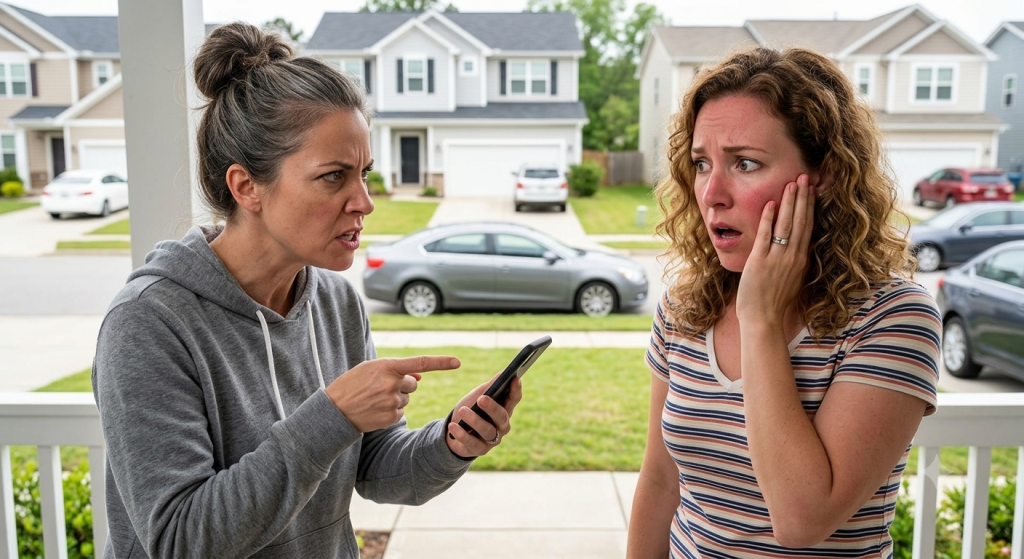
The text arrived at 6:41 on a Tuesday morning while I was standing in my kitchen making my daughter’s lunch.
I had one slice of bread in my hand, peanut butter open on the counter, and the kind of quiet headache that comes from not sleeping enough and doing too much for too many people.
My phone buzzed once.
I glanced down.
From Caleb.
My sister April’s oldest son.
Nineteen years old.
Big opinions.
No job that lasted more than a month.
Expensive taste.
Endless entitlement.
I opened the message.
“I want a $2,000 new phone.
You’ll upgrade me.”
I read it twice just to make sure I was seeing it correctly.
Not “Can you help?” Not “Mine broke.”
Not even a fake layer of politeness.
Just a demand.
Like I was a service.
Like his comfort was my responsibility.
Like the answer was already yes and all I had to do was cooperate.
For a long moment, I stared at the screen.
Then I typed back one word.
“No.”
That should have been enough.
In any healthy family, it would have been.
But April and I had never lived inside anything healthy.
My little sister had spent most of her adult life turning every need into a crisis and every crisis into someone else’s obligation.
When we were children, she cried and our mother rushed to fix things.
When we were teens, she lied and I was told to “be the bigger person.” When we were adults, she failed to plan, failed to save, failed to tell the truth, and somehow I was still the one expected to absorb the fallout.
I was thirty-six.
A single mother.
An operations manager at a medical billing company.
I had a daughter named Mia who was twelve, bright and observant and at that age when kids start noticing every fracture in the adults around them.
I also had a sister who treated me like a private emergency fund.
Over the years, I had paid rent shortfalls, car repairs, groceries, utility shutoff notices, school supplies, sports fees, and one disastrous community college semester for Caleb that lasted exactly sixteen days.
Every request came wrapped in urgency and shame.
Every refusal came back to me as cruelty.
So when my phone buzzed again less than five minutes later and I saw April’s name, I already knew what I’d find.
“Agree or you’re banned from family events.”
I laughed out loud.
It sounded ugly in the silent kitchen.
Family events.
The same events where I was always expected to help pay for food.
The same events where April arrived late and complained anyway.
The same events where Caleb showed up empty-handed and still expected gifts because “he’s young.”
The same events where everyone quietly relied on me and then acted resentful if I ever mentioned being tired.
My daughter came into the kitchen looking for her water bottle.
“What’s funny?” she asked.
“Nothing worth explaining before school,” I said.
She studied my face.
Mia had inherited my ability to detect tension before anyone spoke it.
“Was it Aunt April?”
I smiled tightly.
“Eat your toast.”
But after I dropped Mia off, I sat in my parked car for a full minute with my hands on the steering wheel, trying to understand why this particular demandfelt different.
It wasn’t the money.
I had said yes to larger amounts before.
It was the tone.
The assumption.
The complete erasure of my own life.
I went to work, but I could feel something simmering under my skin all morning.
Around noon, while eating yogurt at my desk, I opened my banking app.
Two days earlier, I had transferred April eight hundred dollars for her car payment.
She had not thanked me.
She had asked if I could cover next month too.
I stared at the transaction for several seconds.
Then I reversed it.
The moment I did, I felt a strange calm.
Not triumph.
Not panic.
Just a clean, cold certainty that I was done being extorted with guilt.
By the next morning, my phone was exploding.
Six missed calls from April.
Three from her husband, Dave.
Four from Caleb.
A voicemail from my aunt asking me to “please be reasonable.”
Then a text from Caleb.
“What did you do? Mom’s crying.
Fix this now.”
I turned my phone off.
It was one of the most peaceful decisions I had made in years.
I took Mia to school.
I bought coffee.
I answered emails.
For a few hours, I felt almost light.
But peace is fragile when someone has built their identity around controlling you.
The next afternoon, my cousin Lindsey sent me a message.
“Are you okay?”
Then another.
“Please tell me you’ve seen April’s Facebook.”
My stomach dropped.
I opened the app and saw my sister’s post at the top of the feed.
There was a photo of me.
A private photo.
Years old.
Taken during a period of my life I had survived but never fully healed from.
It showed me drunk at a party after my divorce, leaning against a wall in a dress that had slipped too low, eyes half-shut, face flushed and vulnerable.
Humiliating enough in private.
Devastating in public.
And April had posted it for everyone.
The caption read: “This is what a responsible single mother looks like when she’s not busy judging everyone else’s life.”
The room tilted.
I didn’t cry at first.
I just stared.
Then I saw the likes.
A woman I used to work with.
A neighbor.
A family friend.
One of Mia’s teachers.
My hands started shaking so hard I had to sit down.
I had known April could be nasty.
I had known she could lie.
I had known she loved public sympathy and private cruelty.
But this crossed into something darker.
Something deliberate.
I drove to her house.
I don’t remember the traffic lights.
I don’t remember the radio.
I don’t remember parking.
Only the sound of my own heartbeat and the way my jaw ached from clenching it.
April opened the door with a look of irritated superiority, as if I had interrupted her nap.
She didn’t deny the post.
She didn’t apologize.
She smirked.
That was all it took.
I slapped her.
The sound cracked in the doorway.
Her head jerked sideways.
For once, she looked genuinely shocked.
I turned and walked away before she could recover enough to perform outrage for the neighbors.
By the time I got home, the post was gone.
But the damage was not.
People had seen it.
Screenshotted it.
Sent it to each other.
Iknew how these things worked.
The internet erased nothing.
That night, after Mia went to bed, I sat alone in my kitchen with my laptop open.
On the desktop was a folder named April.
I had created it nearly a year earlier after one of her lies nearly cost Dave a promotion.
I told myself it was self-protection.
Evidence.
Something to organize the chaos she left behind.
Inside were screenshots, payment records, voice notes, photos, and messages.
Including proof of her affair.
Her lover was a man named Ray.
He worked with Dave.
He was married.
There were motel receipts.
Texts arranging meetups.
Mirror selfies from bathrooms she pretended were girls’ nights.
Conversations where she mocked Dave for being “too clueless to notice anything.”
Messages where she called me “the easiest wallet in the family.”
I scrolled through it all in silence.
At 9:14 the next morning, I texted Dave.
“Can we talk? I think you need to see something.”
He answered within a minute.
“When and where?”
We met at a coffee shop near his office.
Dave looked like a man who had not slept in days.
He was a decent person in the way tired people sometimes are—quiet, worn down, easier to overlook than to appreciate.
I slid my phone across the table.
He began scrolling.
At first he frowned, confused.
Then his face drained.
Then it went blank.
He stopped on one screenshot and stared at it for a long time.
It showed a conversation where April told Ray she had lied to Dave about being at dinner with friends.
Attached was a selfie from a motel room, timestamped the same night.
Dave finally looked up.
“How long have you had this?”
“Almost a year,” I said.
His jaw tightened.
“Why didn’t you tell me?”
I answered honestly.
“Because I didn’t want to blow up your family.
I thought maybe she’d stop.
I thought it wasn’t my place.
But after what she posted about me, it became my place.”
He nodded once.
Not because he accepted it.
Because he understood.
He stood up, thanked me in a voice that sounded borrowed, and left.
By Friday, the fallout had begun.
April called me screaming.
Then threatening.
Then sobbing.
Then pleading.
Dave had left the house.
Caleb was posting vague quotes about fake family and betrayal.
April told anyone who would listen that I had fabricated everything because I was jealous of her marriage.
That part would have been laughable if it weren’t so pathetic.
Then something unexpected happened.
A cousin sent me a screenshot of April’s deleted Facebook post about me.
Someone had saved it before she took it down.
When relatives saw it, some stayed quiet.
Some distanced themselves.
A few even apologized for not recognizing sooner how far she was willing to go.
For the first time in her life, April was not being rescued.
I thought that might finally stop her.
I was wrong.
Sunday afternoon, Mia came home from her friend Emma’s house with a face I recognized instantly: the careful, hurt expression children wear when they are trying not to make trouble out of adult ugliness.
She set down her backpack and stood in the kitchen doorway.
“Mom?”
“Yeah, baby?”
She twisted one strap in her fingers.
“Why would Aunt April tell Emma’smom that you post bad stuff online?”
Every muscle in my body went still.
“She said what?”
Mia swallowed.
“She told her maybe I shouldn’t come over for a while.
She said our family is dealing with things and some people aren’t sure if I’m safe.”
For one terrifying second, I couldn’t speak.
April had not stopped at humiliating me.
She was reaching for my daughter.
I crouched down and kept my voice gentle.
“Did Emma’s mom say this to you?”
“She tried not to.
But I heard her talking to Emma in the hallway.
And when I left, she was acting weird.” Mia’s eyes filled.
“Am I in trouble?”
I pulled her into my arms so fast she nearly lost balance.
“No,” I said into her hair.
“You are not in trouble.
You did nothing wrong.”
After I sent her upstairs, I called Emma’s mother.
Mrs.
Cooper answered sounding embarrassed.
Once I reassured her I wanted honesty, not a fight, she admitted April had messaged three school moms.
Three.
The story she told was calculated and vicious.
According to April, I was unstable after “a breakdown.” I had a history of inappropriate behavior online.
I was lashing out at family and could not be trusted to make good decisions.
She said relatives were monitoring the situation.
Then Mrs.
Cooper hesitated and said, “There’s something else.
She asked whether the school has pickup paperwork on file.
She said family might need to step in if things get worse.”
I sat down hard in a dining chair.
Step in.
My sister was laying groundwork.
Maybe for gossip.
Maybe for leverage.
Maybe for something worse.
I opened another folder on my desktop.
Not April.
Precautions.
Inside were texts and notes I had kept over the years whenever April said something about Mia that felt off.
One text from six months earlier: “You know if you ever lose it, Mia would be better off in a home with two parents.”
Another: “I could easily get school pickup forms if I needed to.
I know how these things work.”
Then a voicemail I had saved because the tone bothered me.
I played it.
April’s voice came through the speaker, light and joking.
“Maybe I should just take Mia for a while and show her what structure looks like.
God knows she’d probably be better off.”
At the time, I had rolled my eyes and filed it away.
Now it sounded like a warning.
I called my lawyer first.
Then the school.
Then, on my lawyer’s advice, I filed a police report documenting the harassment, the photo exposure, and the false claims involving my child.
Monday morning, I went to the school office in person.
I updated every emergency contact, added password protections to pickup authorization, provided photos of April and Caleb, and told the principal no one from my sister’s household was permitted to contact Mia or collect her.
The principal, a calm woman named Mrs.
Henley, listened carefully and said, “You did the right thing by coming in immediately.”
I wish that had been enough.
It wasn’t.
Wednesday at 2:17 p.m., my phone rang while I was at work.
It was the school.
My heart nearly stopped.
Mrs.
Henley’s voice was professional but tense.
“Your sister came to the office fifteen minutes ago.She claimed there was a family emergency and that you asked her to pick Mia up.”
I stood so fast my chair rolled backward.
“Where is my daughter?”
“She is safe.
Your sister was denied access.
We followed your instructions.
She became verbally aggressive and left before police arrived.”
I had to grip the edge of my desk to stay upright.
April had actually gone to my child’s school.
That night, I sat with Mia at the kitchen table and explained, in age-appropriate terms, that Aunt April was making unsafe choices and that if anyone ever tried to change pickup plans, Mia must wait for the office to call me directly.
Mia listened quietly and then asked, “Is Aunt April mad because you said no?”
Children can sometimes reduce an entire adult disaster to one clean truth.
“Yes,” I said.
“That’s exactly why.”
The next morning, I met my lawyer, Renee, and gave her everything.
The Facebook screenshots.
The voice mails.
The messages.
The school incident report.
The evidence of impersonation and false allegations.
Renee went through it with sharp, efficient calm.
Then she looked up and said, “We’re not just dealing with family drama.
We’re dealing with harassment, defamation, and attempted interference involving a minor.”
Hearing it phrased that way changed something in me.
For years, I had allowed April’s behavior to stay inside the soft, blurry category of family mess.
Something painful but private.
Embarrassing but survivable.
No.
What she had done had crossed into conduct with consequences.
We filed for a restraining order.
We sent cease-and-desist letters.
We preserved every piece of digital evidence.
And because of the intimate nature of the photo she had posted, Renee referred me to a civil attorney experienced in image-based abuse claims.
Then one more bomb dropped.
Ray’s wife contacted me.
Her name was Nicole.
She had gotten my number from Dave.
We met at a bakery halfway between our neighborhoods.
Nicole wore no makeup and looked like someone whose life had been split down the center overnight.
“I’m not here to blame you,” she said before she even sat down.
“I know you exposed the affair because she targeted you.
I just need to know if there’s anything else.”
I handed her printed copies of the messages involving Ray.
She read them without crying.
That almost broke my heart more.
When she finished, she said, “He used joint business funds for some of these hotel stays.
I can prove it.”
That mattered.
Ray and Dave worked for the same regional supply company.
If company funds had been misused, the affair could cost more than a marriage.
Within a week, Ray was under internal investigation.
Within two weeks, he was terminated.
Nicole filed for divorce.
Dave, meanwhile, filed his own.
April spun harder.
She posted quotes about narcissists.
Claimed she was being silenced.
Claimed jealous people were jealous of her “confidence.” She even tried to hint that Dave had been abusive, but she had no evidence and too many contradictions.
Then the restraining order hearing arrived.
April came in looking polished and furious, as if she still believed the right outfit could make facts disappear.
Caleb sat behind her with his arms crossed, glaring at me like I had ruined his life by declining to buy him a luxury phone.
Reneepresented everything.
The explicit Facebook post.
The messages to school mothers.
The attempt to pick Mia up under false pretenses.
The prior voice mails and texts about taking my daughter.
April’s attorney tried to frame it all as family misunderstanding and emotional conflict.
Then Renee played the voicemail.
“Maybe I should just take Mia for a while and show her what structure looks like.”
The judge’s expression changed.
By the end of the hearing, the order was granted.
April was prohibited from contacting me or Mia directly or indirectly.
She was ordered to stop discussing Mia with third parties.
The judge also warned her, very clearly, that any future attempt to interfere with custody or school access would trigger immediate consequences.
Outside the courthouse, April finally dropped the polished act.
“This is all because of a phone?” she hissed.
I looked at her and, for the first time, felt no fear.
No guilt.
No sisterly loyalty trying to claw its way back to life.
“No,” I said.
“This is because you thought there would never be consequences.”
Life did not magically become easy after that.
Mia needed reassurance.
We changed some routines.
I told a few trusted parents the truth so gossip would not fill the silence.
One of Mia’s teachers—the one who had liked April’s post—sent me a private apology.
I appreciated it, though I never forgot it.
I also went to therapy.
Not because April had broken me, but because surviving people like her leaves bruises you can’t always see.
Months later, Dave and I met once more for coffee.
He looked steadier.
Sad, but steadier.
“She still tells people you destroyed the family,” he said.
I stirred my drink and smiled without humor.
“The family was already broken.
I just stopped pretending it wasn’t.”
He nodded.
“Caleb got a job.”
I raised an eyebrow.
“At a phone store,” Dave said.
For the first time in months, I laughed.
A real laugh.
The kind that loosens something tight in your chest.
At home that evening, Mia sat cross-legged on the couch doing homework.
She looked up and asked, “Are things finally over?”
I thought about how to answer.
People like April never really end.
They just lose access.
“Yes,” I said finally.
“The important part is over.”
She nodded like that was enough.
Then she went back to math, safe in a house where the doors were locked, the records were clear, and the next attack was no longer waiting to ambush us.
Sometimes I still think about that first text.
“I want a $2,000 new phone.
You’ll upgrade me.”
It seemed so small at the time.
Petty.
Absurd.
Almost ridiculous.
But that message was not really about a phone.
It was about entitlement so deep it had become identity.
It was about a family system built on taking from the person least likely to make a scene.
It was about how quickly some people turn cruel when you stop funding their comfort.
And maybe the biggest red flag was not April’s threat.
It was how long I had mistaken endurance for love.
I don’t know whether Dave should have left sooner, whether Caleb will ever become decent, or whether April will ever understand what she destroyed with her own hands.
I only know this:
The day shecame for my daughter was the day every last ounce of guilt died.
And once guilt was gone, the truth got very easy to tell.
