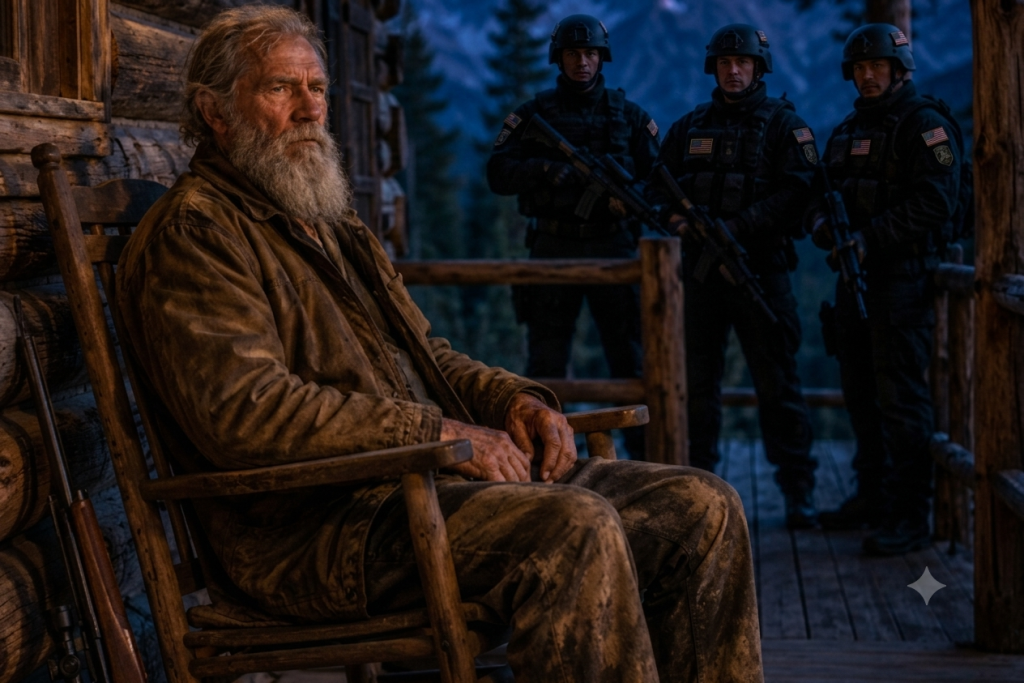
A Homeless Marine Sniper Inherited a Mountain Cabin—Then Eight Hunters Learned Why They Once Feared Iceman Chapter 1: The Clearing
The cold mountain air cut through the clearing like a blade.
Eight hunters stood in a semicircle, their expensive camouflage gear still clean, their boots barely scuffed by the rough Montana ground. Their rifles gleamed in the pale November sun, optics polished, slings new, jackets branded with names that meant very little to anyone who had ever truly lived outdoors.
In the center of them, a man knelt in the dirt.
His clothes were torn. His beard had gone wild. His face was all sharp edges and hollow shadows, the look of a man who had spent too many nights sleeping under bridges, in shelters, in alleyways where winter felt personal. His hands trembled against the frozen earth.
Lieutenant Colonel Garrett Mitchell stood over him with his arms folded across his chest and a smile that never touched his eyes.
“So this,” Garrett said, turning to the others, “is the great Marine sniper instructor.”
A few of the men chuckled.
“This,” Garrett continued, his voice smooth with contempt, “is Iceman.”
He looked back down at the kneeling man.
“Look at you, Ethan. Six years on the street, and you can barely hold your hands steady.”
Ethan Wade lifted his head.
Even on his knees, even with dirt ground into his palms and an old coat hanging off him like a tarp over a fence post, there was something in his face that made the laughter thin out faster than Garrett liked. It wasn’t anger. It wasn’t fear either.
It was calculation.
Ethan’s pale blue eyes moved once around the circle.
He saw the details automatically, because men like him never stopped seeing.
The hunter with the fancy carbon-stock rifle had his finger too close to the trigger.
The man in the orange cap had not secured his sling properly.
The oldest one was favoring his left knee.
One had never truly fired beyond a hundred yards in his life, despite the custom turret on his optic.
Another kept glancing toward the timber line every four seconds.
Amateurs wrapped in money.
Garrett noticed Ethan scanning and smirked.
“You still sizing people up?” he asked. “Old habits die hard.”
Ethan said nothing.
Behind Garrett, the cabin sat on a low rise above the clearing—small, weathered, built from heavy pine logs gone silver with time. Smoke no longer curled from the chimney. The porch sagged a little on the west side. Snow clung in old drifts beneath the trees and in the folds of the ridge beyond.
It looked like the kind of place a man could disappear in.
That, Ethan suspected, was exactly why Garrett wanted it.
“Tell them,” Garrett said. “Go on. Tell them who you used to be.”
Ethan stared at him.
Garrett took a step closer. “Tell them about Fallujah. Tell them about Helmand. Tell them how they used to whisper your name like you were some ghost that walked in daylight.”
Still nothing.
One of the hunters, a broad man with red cheeks and a silver watch that looked ridiculous over his glove, laughed.
“I thought this guy was supposed to be dangerous.”
“He was,” Garrett said. “Once.”
The red-cheeked man looked Ethan over. “Doesn’t look like much now.”
“No,” Garrett replied. “Now he looks like what happens when the war ends and nobody needs you anymore.”
That got a few more laughs.
Ethan heard them, but they landed far away. His attention had shifted to the wind brushing through the pines above the clearing. It was running west to east, light at first, then lifting harder in uneven pulses. A weather change. Snow coming by evening, maybe sooner.
Garrett crouched down until he was face-to-face with him.
“You inherited this cabin from Samuel Boone,” he said quietly. “You don’t belong here. You never did.”
Ethan finally spoke.
“Sam thought I did.”
Garrett’s smile tightened.
Samuel Boone had been one of the only men Ethan had ever trusted completely. Former Marine scout sniper. Former spotter. Former mountain guide. The kind of man who could stay silent for an hour without making silence feel empty. He had owned this cabin for nearly thirty years.
And now he was dead.
Garrett stood again and held up a folded packet of papers.
“You can do this the easy way,” he said. “Sign the access easement. Give us legal use of the north ridge, and my friends here walk away happy. Or you can make this difficult.”
Ethan looked at the papers, then at the men holding the rifles, then back at Garrett.
“The north ridge runs through the whole line,” Ethan said. “Once you get access, the cabin doesn’t matter. Next step is taking the land.”
Garrett’s expression hardened. “You always were smart.”
“You always liked taking things that weren’t yours.”
For a second the air changed.
The hunters sensed it, even if they didn’t understand it. Something old had just surfaced between those two men. Something far heavier than property lines.
Garrett struck Ethan across the mouth with the back of his hand.
It was quick, hard, and mean.
Several hunters flinched. Not because they pitied Ethan, but because the sound of the hit had been uglier than they expected.
Ethan’s head snapped to the side. Blood touched the corner of his lip.
Garrett leaned down close.
“You are not in a courtroom,” he said softly. “You are not on a base. You are not protected by anyone. Out here, all you are is a half-frozen bum with bad luck.”
Ethan slowly turned his face back.
“You brought eight men,” he said.
Garrett frowned.
Ethan’s voice stayed flat.
“That means you remember.”
No one laughed this time.
Garrett straightened and glanced at the others, irritated that the moment had not gone his way. “Get him up.”
Two hunters stepped forward, hauled Ethan to his feet, and shoved him toward the porch. He stumbled once, caught himself, then stopped beside the cabin steps.
Garrett walked toward him again, boots crunching in old snow.
“By sundown,” he said, “you’ll be gone. If you’re smart, you’ll head back down the mountain and never come back. If you stay, then whatever happens next will be your fault.”
Ethan looked past Garrett toward the trees.
The timber started less than forty yards from the cabin. Thick lodgepole. Spruce. Deadfall. Broken rock. Narrow game trails. A ravine east of the property, an old logging road south, a saddle to the west, and above all of it the high ridge that controlled everything below.
He knew the map already. Not from memory.
From instinct.
Sam Boone had chosen this place for the same reason a sniper chose high stone and shadow.
Visibility. Silence. Escape.
Garrett thrust the papers against Ethan’s chest.
“Last chance.”
Ethan let them fall into the snow.
The red-cheeked hunter muttered, “Stupid bastard.”
Garrett nodded once, as if he had expected it all along.
Then he smiled.
Not a normal smile. Not even a cruel one.
It was the smile of a man who had finally been handed an excuse.
“All right,” Garrett said. “We’ll do it the hard way.”
He turned and motioned to the others.
“Back to the lodge. Leave him.”
The hunters obeyed, though several looked over their shoulders as they walked away.
At the edge of the clearing, Garrett paused and faced Ethan one last time.
“You know what your problem always was?” he called.
Ethan said nothing.
Garrett’s voice carried sharp in the cold.
“You mistook discipline for moral authority. That’s why men like you end up alone.”
The group disappeared into the trees.
The mountain went quiet.
For a long moment Ethan Wade stood motionless, blood cooling on his lip, breath ghosting in front of him.
Then he bent, picked up the papers from the snow, tore them clean in half, and looked toward the ridge.
“Sam,” he murmured, “you left me one hell of a welcome.”
The wind shifted again.
And somewhere above the clearing, a raven called once, harsh and dark, as if the mountain itself had just awakened.
Chapter 2: Boone’s Last Gift
The first time Ethan had heard about the cabin, he was standing outside a shelter in Missoula, waiting for coffee that tasted like burnt water.
He had been wearing the same coat then. The same boots, too, though one sole had been splitting away at the toe. Snowmelt ran in dark streams along the curb, and a volunteer in a church jacket had just told him breakfast was eggs, toast, and sausage.
Then a county vehicle rolled up.
A woman stepped out.
She was in her late thirties, tall, broad-shouldered, dark hair pulled under a wool cap, a badge clipped to a heavy canvas jacket. Not sheriff. Game warden, maybe. Or county enforcement. She scanned the line of men outside the shelter and stopped on Ethan as if she had known his face before she arrived.
“Ethan Wade?”
He didn’t answer at first.
She came closer. “Former Gunnery Sergeant Ethan Wade?”
That made several heads turn.
Ethan looked at her, wary and tired. “Depends who’s asking.”
“Rachel Boone.”
The name hit him like a hand against old bruises.
Samuel Boone’s daughter.
He had met her once, years ago, when she was a teenager in pigtails who hated having Marines at the cabin because they tracked mud through the kitchen. Ethan remembered Sam laughing while Rachel glared at him from behind a plate of pancakes.
Now she stood in front of him with lines around her eyes and the same stubborn jaw her father had carried into every argument.
“I’m sorry,” she said. “My dad passed three weeks ago.”
Ethan felt nothing for exactly two seconds.
Then the world tilted.
Not visibly. Not enough for anyone else to notice. But inside him something old cracked open.
“How?” he asked.
“Heart gave out in his sleep.”
Ethan looked down at the paper cup in his hand.
Sam Boone had survived Iraq, Afghanistan, two avalanches, one bear encounter, and a winter alone in the mountains after his truck rolled into a ravine. Dying in bed seemed almost offensive.
Rachel watched him carefully.
“He left you something,” she said.
Ethan let out a humorless breath. “That can’t be right.”
“It is.”
She handed him an envelope with his name written across the front in Sam’s blocky, deliberate handwriting.
Ethan stared at it for a long time before opening it.
Inside was a short letter.
Kid, If you’re reading this, then I finally ran out of winters. The cabin is yours if you want it. Land, outbuildings, north ridge, all of it. I know what happened to you after Karen and Lily. I know the bottle got the better of you for a while, and maybe after that the rest of the world did too. But you were never weak, and you were never what they said you became. There’s food in the cellar. Wood in the shed. Papers in the lockbox under the bench. Come home if you still remember how.
—Sam
Ethan read it twice.
Then a third time.
When he looked up, Rachel was still there, hands in her pockets against the cold.
“He talked about you,” she said. “Not often. But enough.”
Ethan folded the letter carefully. “Why me?”
Rachel glanced away toward the mountains beyond town. “Because he trusted you.”
That was all.
No legal speech. No sentimental nonsense. Just the plain truth.
Three days later, Ethan took a bus as far as it would go, then hitched a ride with a rancher hauling feed, then walked the last five miles uphill with a duffel bag, the deed papers in his coat, and Sam’s letter in his inside pocket.
The cabin had been exactly as Sam described.
Wood stacked high.
Cellar stocked.
Tools where they belonged.
A battered lockbox hidden under the mudroom bench.
Inside the box had been the deed, tax documents, a ring of old keys, and a second envelope with one line written across it:
Read this only if Garrett Mitchell finds you first.
Ethan had not opened that one immediately.
He had set his duffel on the floor, stood in the middle of the cabin, and breathed in the scent of pine, cold iron, old books, coffee grounds, and wood smoke soaked into the logs over decades.
For the first time in years, he had been inside a place that did not feel temporary.
No shelter rules. No cots lined in rows. No city noise.
Just stillness.
And memory.
There was the shelf where Sam kept his field guides. The iron stove with the warped left hinge. The scar in the table from when Ethan had cleaned a rifle too carelessly and Sam had thrown a spoon at his head. The window above the sink that looked east into the trees where dawn came blue and sharp.
It should have felt peaceful.
Instead it felt dangerous.
Because a cabin like that could tempt a man into hope.
Ethan had slept on the floor that first night, even though the bed was made. Old instincts. A room with too much comfort made him restless. He woke before dawn to the creak of branches, the ache in his spine, and the terrifying realization that he did not immediately know where he was.
For ten seconds he was back in some half-frozen place overseas, waiting for artillery.
Then he smelled pine and ash and remembered.
Later that morning he opened the second envelope.
Inside was another letter from Sam.
If Garrett shows up, it means two things: first, he knows I’m gone. Second, he’s scared of what I kept. Behind the false wall in the loft, there’s a metal case. You’ll know it when you see it. He’ll come for the land, but that isn’t what he really wants.
Don’t underestimate how far a guilty man will walk to bury the truth.
That was when Ethan found the case.
The loft wall behind the old blanket chest had a panel that didn’t fit flush. He pried it back and pulled out a flat military transport case, weatherproof and heavy. Inside were radio logs, a satellite phone data card, copied operational reports, and a thumb drive sealed in plastic.
On top lay one more note in Sam’s handwriting.
Kunar Province. March 14. The day Mitchell lied and men died.
You were right. I kept proof.
Ethan had sat down hard on the edge of the loft bed, the case in his lap.
He remembered that day in detail so sharp it still cut.
A mountain village in Afghanistan. Thin air. Late snow. Garrett Mitchell then a rising officer with polished ambition and no patience for enlisted warnings. Ethan had flagged movement in the wrong draw, wind-carried chatter, signs the approach route was compromised. Garrett had overridden him. Boone had backed Ethan.
Garrett sent the patrol anyway.
Three Marines died in the first burst. Two civilians in a nearby compound were killed in the chaos that followed. Later the report somehow said the intelligence had been incomplete and the sniper overwatch had failed to identify the threat in time.
Ethan had challenged it.
Boone had challenged it harder.
Garrett survived the inquiry. The report held. Careers bent, but not his.
Soon after that, Ethan’s marriage collapsed under distance, grief, and long deployments. Then his wife Karen and daughter Lily were killed by a drunk driver outside Oceanside while he was still wearing a uniform that meant less to him than people assumed. After that, everything slid.
Drinking.
Fights.
Separation.
Discharge.
Then drifting.
Garrett had probably heard the same rumors everyone else had heard.
That Iceman had gone soft in the head.
That the great instructor had become a drunk.
That the man who could put a round through a keyhole at half a mile now slept behind dumpsters.
Most of it had been true.
But not all of it.
Now, standing in the clearing with blood on his lip and Garrett somewhere in the trees, Ethan finally understood the shape of the threat.
Garrett did want the land.
But more than that, he wanted what Sam had hidden.
Proof.
Ethan walked back inside the cabin, locked the door, and stood very still.
The room suddenly felt smaller.
He took the metal case from beneath the floorboard where he had re-hidden it, opened it again, and checked its contents. Everything was still there.
He closed it.
Then he moved with quiet, deliberate speed.
He took down Sam’s old topo maps.
Marked the north ridge, the logging trail, the ravine, and three fallback positions Boone had once taught him to use for winter tracking drills.
He checked the cellar for lantern oil, batteries, and canned food.
He found the rifle cabinet in the back room—empty except for one old bolt-action Remington 700 in .308, a box of hand-loaded rounds, and Sam’s spotting scope wrapped in a wool blanket.
Pinned to the inside of the cabinet door was a note:
Try not to miss. Ammunition isn’t cheap.
Despite everything, Ethan smiled.
It was a small smile. Brief. But real.
Then he cleaned the rifle, checked the bore, tested the action, and laid it across the table.
Outside, the wind strengthened.
Snow began to come down in thin, uncertain grains.
By sundown, Garrett Mitchell had promised, Ethan Wade would be gone.
Ethan looked at the rifle, then at the hidden case on the floor, then toward the darkening window.
“No,” he said quietly to the empty cabin.
“Not this time.”
Chapter 3: The Lodge Men
Garrett Mitchell’s hunting party was based out of Crown Elk Lodge, seven miles downslope on leased timberland with a heated trophy room, satellite internet, and a chef flown in from Bozeman.
Sam Boone had hated the place on principle.
“Men who need bourbon flights to feel rugged,” he had once muttered, according to Rachel.
Garrett loved it.
The lodge suited everything about him—wealth dressed as competence, indulgence disguised as tradition, power wrapped in camo patterns and patriotic slogans. The men he hosted there each November were donors, lawyers, developers, surgeons, and one retired police captain who liked telling stories about urban violence to make the others feel hard.
They were the kind of hunters who paid large sums of money to stand on managed land and believe the mountain had tested them.
Late that afternoon, as snow thickened beyond the lodge windows, Garrett stood by the stone fireplace with a glass of bourbon while his guests argued over whether the ragged man at the cabin had really once been famous in the Corps.
“You’re telling me that bum trained snipers?” Hal Reese asked. He was the red-cheeked one from the clearing, a Dallas oral surgeon with expensive rifles and the restless insecurity of a man who always measured himself against tougher men and always came up short.
“He did,” Garrett said.
“And you let him talk to you like that?”
Garrett swirled the bourbon once. “I let him reveal himself.”
Frank Doss, the retired captain, frowned. “He didn’t reveal much.”
Garrett looked at him. “He told me he recognized the play.”
Doss shrugged. “Maybe he’s stubborn.”
“Maybe,” Garrett said.
But he knew better.
Ethan Wade had not been stubborn in the clearing. He had been taking inventory.
Garrett remembered that look from Afghanistan, when Ethan had watched villages, ridgelines, doorways, windows, and men’s faces with the patient focus of someone building a firing solution in his head. Back then Garrett had resented it. Officers were supposed to own the room. Ethan rarely tried, but somehow did anyway.
Cody Bell, the youngest man in the lodge, sprawled on a leather couch and scrolled through photos on his phone. He was some kind of outdoor brand celebrity—teeth too white, beard too perfect, always talking about “the authentic western experience.”
“So what’s the real issue with the property?” Cody asked. “I thought we were just trying to open up the north access for next season.”
Garrett set down his drink.
“That is the issue.”
No one answered, but several men exchanged looks.
They all knew there was more.
A week earlier Garrett had pressed unusually hard for this trip, pushing them to come before the usual hunting window, insisting the Boone property had become “legally vulnerable.” He had used vague language about easements and future development opportunities. Brent Holloway, who had money in resorts and private clubs, was especially interested.
Brent leaned forward in his armchair now. “If the cabin owner is unstable, can’t the county force some kind of review?”
“Eventually,” Garrett said. “But I prefer faster solutions.”
“And if he won’t sell?”
Garrett smiled faintly. “Then he leaves.”
Tyler Quinn, who had barely spoken all afternoon, looked up from the far end of the table.
He was the only actual combat veteran in the room besides Garrett, a former Army Ranger in his early thirties who had done two tours, gotten out, and somehow drifted into this world of guided hunts and rich men seeking secondhand danger.
“That man wasn’t unstable,” Tyler said.
The room went quiet for a beat.
Garrett turned to him. “You saw enough to diagnose him?”
Tyler held his gaze. “I saw enough to know he wasn’t broken the way you wanted him to look.”
Hal Reese snorted. “Come on. The guy was shaking.”
Tyler’s expression didn’t change. “Yeah. But his eyes weren’t.”
Garrett filed that away.
A problem, perhaps.
Maybe not a large one yet, but men like Tyler were unpredictable because they still recognized real danger when it stood in front of them. The others only knew the costume of it.
Garrett walked to the window and looked out at the snow.
He had spent six months trying to locate Sam Boone’s records after hearing through an old contact that Boone was ill and “still mad about Kunar.” Then Boone died faster than expected. Garrett had moved immediately. He secured cooperation from Sheriff Lyle Banning, lined up legal pressure on the property, and arranged this trip as cover.
Then the inheritance surfaced.
Ethan Wade.
Of all people.
Garrett had almost laughed when he heard it.
The fallen legend. The drunk. The street ghost.
He had pictured a man so washed out by failure that he’d sign anything for a little cash and a ride into town.
But in the clearing, Garrett had seen enough to know the truth was more complicated.
Ethan was worn down, yes.
But the essential machinery remained.
That made him dangerous.
Garrett turned from the window. “Nobody goes near the cabin tonight.”
Brent frowned. “Why not?”
“Because the snow’s coming in harder, and I want him tired, cold, and uncertain. Tomorrow we push.”
Frank Doss nodded. “What if he runs?”
Garrett’s smile returned. “Then he runs onto open ground in my county, with no truck, no support, and no supplies.”
Tyler glanced toward the storm. “Or he stays where the terrain favors him.”
Garrett looked at him for a long second, then laughed softly.
“You think he can outplay eight armed men?”
Tyler didn’t smile. “Depends on the man.”
Garrett said nothing.
Later that night, after the others went to drink and boast over the giant elk mounted in the great room, Garrett stepped outside alone and took a call from Sheriff Banning.
“Well?” Banning asked. “You get him to sign?”
“No.”
“You want me to push the trespass angle?”
“Not yet.”
Snow hissed through the dark around Garrett’s collar.
“He knows,” Garrett said.
Banning was silent a moment. “Knows what?”
“Enough.”
“That cabin really got something in it?”
Garrett’s jaw hardened. “You don’t need details. I just need the county to stay slow for another forty-eight hours.”
“You promised me the club expansion would make this easy.”
“It will.”
Banning sighed. “Don’t make a mess up there, Garrett.”
Garrett looked up toward the invisible ridge where the Boone cabin sat under falling snow.
“Too late,” he said.
Inside the lodge, laughter rose around a poker table.
Outside, the mountain disappeared behind the storm.
And seven miles uphill, in a log cabin surrounded by dark timber, Ethan Wade extinguished every light, took Sam Boone’s old spotting scope to the loft window, and watched the faint glow of the lodge through the snow.
Then he smiled without warmth.
He had found them.
Now he would let them wonder when he would move.
Chapter 4: First Warning
Ethan did not sleep much that night.
He never had, even before the streets. Before the bottle. Before the funerals and the shelters and the years spent drifting through places that smelled like bleach and old grief. But the mountain changed the shape of wakefulness. In the city, sleeplessness felt like exposure. In the cabin, it felt like preparation.
By dawn, six inches of fresh snow covered the clearing.
Ethan had already moved the metal case from the cabin.
He packed it in oilcloth, placed it inside an old survey tube, then carried it through the trees in darkness to a narrow crevice beneath a broken basalt shelf half a mile east of the cabin. Sam had once used the place to store winter fuel away from bears. Unless someone knew exactly where to look, they would never find it.
When he returned, he swept his tracks with a pine bough and let the snow swallow the rest.
Then he made coffee in Sam’s dented pot, ate canned peaches and stale crackers, and watched the tree line.
At 8:17 a.m., he saw the first sign.
Movement in the south timber.
Not close. Maybe one hundred eighty yards downslope, where the logging trail bent through the pines.
He lifted the spotting scope.
Two men.
Hal Reese and Cody Bell.
Hal moved like a man used to flat terrain and expensive guides. Cody moved carefully but kept glancing back toward the trail, which told Ethan there were others behind them.
A probe.
Not an assault.
He kept watching.
At 8:23, Tyler Quinn appeared on the west flank.
At 8:24, Frank Doss showed himself low behind a deadfall.
Garrett was not visible.
That meant one of two things: he was holding back to command, or he was the only one doing it correctly.
Ethan set down the scope and slid from the loft.
He took the Remington, chambered nothing, and moved out the rear door into the white silence behind the cabin.
The snow was dry enough to squeak under careless steps. He wasn’t careless.
He skirted the spring line, crossed behind the wood shed, and slipped into a stand of spruce where the lower branches touched the snow and broke human outlines into something the eye hated tracking.
Voices floated faintly through the trees.
“Cabin’s still there,” Hal said.
Cody laughed softly. “Good thing. I was worried it walked off.”
Tyler’s voice came low and controlled. “Quit talking.”
A few seconds later, Frank Doss called from below. “You see him?”
“No,” Hal answered.
“Then maybe the bum ran.”
Ethan lay prone behind a log and studied them through a gap in the branches.
Not one of them was using the mountain right.
They bunched too close. They failed to clear angles. They made noise every time they crossed crusted snow. Frank used his scope like binoculars. Hal kept letting his muzzle drift over his partners.
Rich men with weapons.
Garrett had brought an audience, not a team.
Ethan eased backward, circled east, and climbed a short rise above the line they were moving through. From there he could see the cabin, the men below it, and the slope beyond. Still no sign of Garrett.
Fine.
He found a stable notch between two roots, rested the rifle, and drew a breath that came out white.
He did not intend to kill anybody.
Not yet. Maybe not at all, if they let him choose.
He watched Hal Reese stop beside a stump and lift a set of compact binoculars.
Hal had a stainless-steel thermos clipped to his pack. When he leaned forward, the metal flashed.
Ethan adjusted one click for wind.
Exhaled.
Squeezed.
The shot cracked across the clearing.
Hal yelped and pitched sideways into the snow.
Cody dropped to his knees with a curse. Frank threw himself behind a log. Tyler went flat and actually looked uphill instead of spinning blindly like the others.
Steam hissed from Hal’s ruined thermos as coffee spilled into the snow.
“No one move!” Tyler barked.
“Jesus Christ!” Hal shouted. “He shot at me!”
“No,” Tyler snapped. “He shot your thermos.”
A long silence followed.
Then, from somewhere no one could place, Ethan’s voice came cold through the trees.
“Next one’s your scope.”
Cody’s head jerked around. Frank tried to locate the speaker and failed.
Hal’s face had gone white under the cold.
Frank called out, voice cracking at the edges. “You threatening us?”
“No,” Ethan said. “I’m educating you.”
Tyler’s eyes narrowed, searching, but even he could not fix the exact point.
“Back off,” Ethan said. “This is your first warning.”
Cody looked toward Tyler. “You hearing this?”
Tyler never took his gaze off the timber. “Yeah.”
Hal whispered, “Where is he?”
No one answered.
Then a new voice rang from lower on the slope.
“Stand up, Ethan.”
Garrett.
There he was, finally.
He stepped out behind a cluster of firs sixty yards below Frank Doss, using the lower contour as cover. Smart. Better than the rest. He held a rifle but kept it low.
“You fire another shot,” Garrett called, “and I call the sheriff, the county, and every federal agency that still remembers your name.”
Ethan gave a humorless laugh from the timber.
“They remember yours too.”
Garrett’s jaw tightened.
“You’re making this worse than it needs to be.”
“You brought armed men onto my land.”
“Your land?” Garrett said. “You’ve had it less than a week.”
“That’s still longer than you deserve it.”
Hal Reese was breathing too fast now, every exhale visible in panicked bursts.
Garrett seemed to register how quickly control was leaving him.
He raised his voice. “This is done. Pull back.”
Frank blinked. “We’re leaving?”
“For now,” Garrett said.
Nobody argued.
They backed away in awkward, frightened steps, keeping rifles pointed at the trees, every shadow suddenly suspect. Hal nearly slipped twice. Cody kept whispering, “Holy hell, holy hell,” under his breath.
Only Tyler moved with discipline.
Before he disappeared into the timber, he looked once toward the high rise where Ethan had fired from. Not directly at him. But close enough to show he understood.
Then they were gone.
Ethan stayed motionless for another full minute.
Then two.
Then five.
Only when the mountain settled again did he rise, sling the rifle, and move.
He did not go back to the cabin immediately.
Instead he circled wide and followed their retreat.
At the lower trail junction, he found what he expected: deep tire tracks, three ATVs, and a utility side-by-side left under a tarp while they tried to make the approach on foot.
He knelt beside the vehicles.
Then he went to work.
Sam had always taught that men panic fastest when their way out disappears.
Ethan used a multitool to remove two distributor caps, pulled one ignition relay, and slit a fuel line on the oldest ATV so cleanly it wouldn’t reveal itself until they tried to start it. On the side-by-side, he disconnected the battery and tucked the terminal where it would take time to find.
He left one thing untouched.
Garrett’s machine.
Then, using a grease pencil from Sam’s toolbox, he wrote three words across the inside of Hal Reese’s windshield:
YOU WERE WARNED
He was already back in the high timber when the hunters returned.
He heard the confusion first.
Then the swearing.
Then Hal’s voice, thin with anger and fear: “He was down here. He was right here.”
Garrett said something Ethan could not make out.
A few seconds later, Tyler’s voice carried clearly.
“He’s not hunting us,” Tyler said. “He’s controlling us.”
That was the first thing anyone had said all day that Ethan respected.
And down in the snowy trail cut, for the first time in years, the legend Garrett Mitchell had mocked in the clearing stopped feeling like a ghost from Ethan Wade’s past.
It felt like a living thing.
And the hunters were beginning to feel it too.
Chapter 5: The Ridge Line
By midday the storm had broken open into bright, brutal sunlight.
Fresh snow lit the mountain like polished bone. Every branch cast a sharp shadow. Every track stood out with humiliating clarity. For men unaccustomed to being seen by the land itself, it was the worst possible weather.
Ethan spent the afternoon making the ridge his again.
He moved from one position to the next with the slow, measured economy Sam Boone had drilled into him years ago. Never rush when the ground will do the work for you. Never occupy a place just because it looks good; occupy it because it solves a problem. Never forget that fear spreads faster downhill.
At the western saddle, he set a simple noise trap using fishing line and two empty cans from the cellar.
At the old fenceline above the ravine, he marked a false trail leading toward unstable scree.
Near the spring, he buried a sealed thermos, energy bars, and a wool blanket under a stump in case he had to stay out overnight.
Then he went back to the cabin long enough to warm his hands, clean the rifle, and read Sam’s Kunar notes for the third time.
They were worse than Ethan remembered.
Boone had saved radio timestamps, route objections, corrected maps, and a copy of the after-action report with handwritten annotations in the margins. Garrett’s lies weren’t vague. They were precise. Intentional. He had shifted coordinates, altered sequence, and reworded his own orders to make Ethan’s team seem slow and confused.
The evidence wouldn’t resurrect anyone.
But it would tell the truth.
That mattered more than Ethan wanted to admit.
As dusk approached, he heard an engine coming hard up the trail.
Not the hunting party.
One truck.
County issue.
He took the spotting scope to the loft window and watched a green four-wheel-drive climb toward the clearing. Rachel Boone got out with a rifle in a scabbard and a badge on her jacket, the same as in Missoula.
She stood in the snow below the porch and looked directly at the cabin.
“I know you’re here,” she called.
Ethan opened the door but kept the screen shut.
“You came alone?”
She glanced at the tree line. “Yes.”
“Why?”
“Because Sheriff Banning called to ask if I knew anything about a deranged squatter threatening a legal hunting party on Boone property.”
Ethan almost smiled.
Rachel looked at the bruise on his face, then at the torn paper near the porch where the snow had not yet fully covered it.
“I’m guessing that version leaves some things out.”
“Some.”
She climbed the steps slowly, visible hands, and stopped in the doorway. Up close she looked tired in the way law officers from mountain counties often did—not cynical exactly, but permanently unimpressed by excuses.
“He wants the cabin,” she said.
“And what’s in it.”
Her eyes sharpened. “So Dad was right.”
Ethan nodded once.
Rachel drew a slow breath through her nose, glanced back toward the clearing, then stepped inside and closed the door.
The warmth from the stove touched her cheeks. She removed her gloves.
“He told me almost nothing,” she said. “Just that if Garrett Mitchell came sniffing around after his death, it wasn’t about hunting rights.”
Ethan set Sam’s transport case on the table and opened it.
Rachel stared.
The room went still except for the fire ticking in the stove.
“My God,” she said softly.
“Your father kept everything.”
“He always did.”
She lifted one of the copied route maps and looked at the annotated coordinates. “This is enough to open an inquiry.”
“If the right people see it.”
Rachel met his eyes. “Why didn’t you send it in already?”
The answer sat between them like another person.
Because Ethan had spent too many years believing the world had moved on without him. Because damaged men often stop expecting justice. Because evidence has a strange weight when it touches the dead.
Finally he said, “I wasn’t sure it mattered.”
Rachel put the map down carefully. “It matters.”
Ethan looked away toward the stove.
Outside, the light was fading blue. Snow on the porch reflected it inward, making the cabin feel half buried in evening.
Rachel studied him for a moment. “Garrett’s got Banning leaning his way,” she said. “Maybe more. But Banning doesn’t know what this is. If I can get it to the state investigators or the Corps—”
“He’ll try before that.”
“I know.”
She glanced toward the loft, then the back room, mentally measuring the cabin’s vulnerabilities the way her father once would have.
“What do you need?”
Ethan almost laughed at the question.
No one had asked him that in years.
Not what’s wrong with you. Not are you drinking. Not can you move along. Just: What do you need?
He thought about it honestly.
“A safe line out if I have to move the evidence.”
Rachel nodded. “Done.”
“A way to reach you that Garrett can’t monitor.”
She took a card from her pocket, wrote two frequencies on the back, and slid it across the table. “Forest service channel. Dad’s old handheld should still pick them up if it has charge.”
Ethan checked the drawer by the lantern shelf.
The radio was there.
Still working.
Rachel looked around the cabin, the rifle on the table, the maps, the can of coffee, the boots drying by the stove.
“You planning to stay?” she asked.
Ethan didn’t answer right away.
Then: “Sam left me a home.”
Rachel’s expression softened just slightly. “Then stay.”
Headlights flickered through the trees below.
Both of them froze.
Rachel moved to the window first.
“Banning,” she said.
A second vehicle stopped behind the sheriff’s truck.
Garrett Mitchell stepped out.
Of course he did.
Rachel swore softly.
Ethan shut the case and locked it.
Below, Sheriff Lyle Banning was already calling out.
“Rachel! You up there?”
She turned to Ethan. “Back room. Don’t show until I say.”
He hesitated.
She stared him down with Boone stubbornness. “Do it.”
Ethan moved.
From the back room he could hear boots on the porch and the door opening.
Banning’s voice entered first, falsely cheerful. “Evening. Didn’t expect company.”
Rachel’s voice stayed flat. “Funny. I can say the same.”
Garrett came in behind him.
“Rachel,” he said. “Didn’t know you were handling trespass complaints now.”
“Didn’t know you were deputizing yourself as a land lawyer.”
Banning cleared his throat. “Where is he?”
Rachel folded her arms. “Who?”
“The veteran.”
“You mean the legal owner of this property?”
A pause.
Then Garrett spoke, too smooth. “The legal owner who fired on my hunting party.”
Rachel didn’t miss a beat. “Funny. All I saw was property invasion by armed men who don’t know where county lines end.”
Banning shifted. “Rachel, let’s not make this harder than it is.”
From the back room, Ethan could see Garrett through a crack in the door.
Still polished. Still controlled.
But the control had strain in it now.
Garrett’s eyes moved across the cabin—bench, loft ladder, stove, table. Measuring. Searching.
He knew the evidence might still be here.
Rachel stepped subtly sideways, blocking his line to the back room.
“Search warrant?” she asked.
Banning hesitated.
Garrett answered for him. “We don’t need one if there’s an armed threat.”
Rachel looked him dead in the eye. “Then you better be real sure who the threat is.”
Silence.
Then Ethan walked out.
Banning reached reflexively toward his sidearm. Garrett turned sharply. Rachel did not move at all.
Ethan stopped by the table, empty hands visible.
“You want something?” he asked.
Garrett’s eyes flicked once to the case lock on the table, then back to Ethan.
“I want this handled peacefully.”
Ethan almost admired the audacity.
Rachel didn’t let him answer.
“It is handled,” she said. “Mr. Wade owns this property. You and your clients are not to enter it again without written permission. Sheriff, you can note that.”
Banning frowned. “Rachel, come on.”
“That’s the law.”
Garrett’s gaze stayed on Ethan. “This isn’t over.”
Ethan’s voice turned cold as creek water in January. “I know.”
Something in Garrett’s face shifted then—not fear exactly, but recognition. He had come up the mountain hoping to intimidate a ruined man. Instead he had found Ethan Wade standing in a warm cabin on defensible ground, backed by Boone’s daughter, with the past pressing against the walls.
Garrett smiled tightly. “Be careful, Ethan. The mountain’s full of accidents.”
Ethan held his eyes.
“So are liars.”
Garrett turned and left.
Banning followed after an awkward pause.
Rachel waited until the trucks were gone before she exhaled.
“They’ll be back,” she said.
“I know.”
She picked up the case. “Then tonight we move the proof.”
Ethan looked at the dark window, where the last of the light had drained from the snow.
“Yes,” he said.
“And this time, we make Garrett chase the wrong thing.”
Chapter 6: Ghosts in the Timber
They moved the evidence after midnight.
Rachel took the decoy.
Ethan kept the truth.
It had been his idea.
Sam’s old metal case was too obvious now. Garrett had seen it on the table. So Ethan emptied it, placed old maps and tax papers inside, wrapped it in canvas, and gave it to Rachel to transport down the mountain by truck on the most visible route possible. If Garrett had watchers—and he almost certainly did—they would see movement and assume the records were gone.
The real files Ethan split into three bundles.
One went into the survey tube hidden in the basalt crevice.
One he sealed inside a coffee can and buried beneath the ash pile behind the woodshed.
The last, the thumb drive and the corrected route map, he kept on him.
Insurance.
Rachel left at 12:40 a.m.
By 1:15, Ethan saw headlights moving far below the cabin.
Not on the county road.
Tracking Rachel.
Good.
By dawn, two things had happened.
First, Rachel radioed from a secure line that she had been tailed halfway to town, then deliberately lost them on a service road and lodged the decoy case in the evidence locker at her office. If Garrett tried to intercept it, he would come up empty.
Second, Ethan found fresh tracks around the cabin.
Three men this time.
One had circled the east wall and tested the windows.
One had checked the wood shed.
One had gone to the back spring and stopped there long enough to smoke.
Garrett’s party was no longer pretending to be hunters.
Now they were conducting a search.
Ethan followed the tracks north through the timber until the snow told him the rest of the story.
They had split.
Two men headed toward the saddle.
One moved downslope to the ravine.
And a separate set—Garrett’s by gait and boot pattern—angled for the higher ridge, the best observation point above the property.
Smart again.
Garrett was finally hunting like he meant it.
Ethan spent the next hour shadowing the lower team.
It turned out to be Hal Reese and Frank Doss.
The mountain despised both of them.
Hal talked too much, cursed at every branch that snagged him, and kept wiping sweat from his neck despite the cold. Frank moved better, but not by much. He was too used to sidewalks and suspect interviews, not terrain that punished hesitation.
“You think he’s really got military files?” Hal asked.
Frank grunted. “Don’t care. Garrett says find the stash, we find the stash.”
“What if the bum shoots again?”
Frank gave him a sidelong look. “Then shoot back.”
Hal laughed weakly. “Easy for you to say.”
They crossed a drifted section of the ravine edge where snow covered rotten ground.
Ethan knew the patch.
Sam had once used it during tracking exercises to teach him how weather lies. The surface looked solid until weight broke through the crust.
Hal stepped onto it first.
The ground collapsed to his thigh with a yell.
Frank lunged to grab him and almost went in too.
Ethan cursed under his breath.
This was the problem with stupid men on dangerous ground. They made every slope worse.
Hal thrashed, rifle tangled under him, boot trapped in the hidden washout. Frank tried pulling him free and only sank deeper at the edge.
Then Frank heard it.
A single click from somewhere uphill.
He froze.
Ethan had chambered a round.
“Don’t move,” Ethan called.
Frank went rigid.
Hal panted wildly, half buried.
“If you try to drag him from that angle,” Ethan said, “you’ll break his leg.”
Frank swallowed. “Then help.”
Ethan appeared on the slope twenty yards above them, rifle ready but low.
Hal’s eyes bulged. “Jesus—”
“Quiet,” Ethan said.
For the first time since this began, Hal Reese looked less angry than ashamed.
Ethan studied the ground, then slid down to a safer line on their right. “Frank. Unclip his pack.”
Frank did it.
“Now his rifle.”
Frank hesitated.
Ethan’s voice sharpened. “Now.”
Frank stripped the rifle away.
Ethan moved closer, keeping his weight on roots and stone, then tossed a length of rope down from his own pack.
“Loop under his shoulders,” he said.
It took a minute, but Frank managed. Ethan anchored, braced, and hauled while Frank pushed. Hal came free with a scream and collapsed in the snow, sobbing curses into his sleeve.
His ankle was swelling fast.
Frank looked from Ethan to the rifle in Ethan’s hands.
“You could’ve left us here,” he said.
“Yes,” Ethan replied.
Frank nodded once, as if the answer had somehow confirmed more than it explained.
Ethan slung Hal’s rifle over one shoulder, then pointed downhill. “There’s an old ranger warming hut a quarter mile south. Get him there before the temperature drops.”
Hal stared up at him, face pale and wet. “Why are you helping us?”
Ethan looked toward the high ridge where Garrett’s tracks had gone.
“Because I’m not Garrett.”
He turned to leave, then tossed Hal’s rifle bolt into the snow at Frank’s feet.
“Find it after you get him under a roof.”
Frank looked down at the bolt, then back up—but Ethan was already gone.
By noon the story had spread through the hunting party.
At Crown Elk Lodge, Hal Reese sat with his ankle wrapped and his pride shattered, telling anyone who would listen that Ethan Wade could have killed both of them and didn’t.
Frank Doss, who respected competence more than decency, said even less but looked twice as uneasy.
Tyler Quinn listened from the fireplace and said nothing.
Garrett, meanwhile, stood in the mudroom staring at a hand-drawn map of the Boone property while one of the lodge hands reported the incident.
“He pulled Reese out?” Garrett asked.
“Yes, sir.”
“And disarmed him.”
“Yes, sir.”
Garrett nodded once, slow.
Mercy complicated fear. Garrett knew that. A killer could be hated. A disciplined man who chose restraint became myth.
He turned to Tyler. “You were right.”
Tyler did not smile. “About what?”
“He is controlling this.”
Garrett folded the map. “Which means we stop reacting and start closing.”
“How?” Tyler asked.
Garrett met his eyes. “We flush him.”
That afternoon Ethan found the first sign that Garrett had changed tactics.
Smoke.
Not from the lodge.
From the west timber, close enough to threaten the cabin if the wind turned.
He moved fast over the saddle and found a line of small fires set in dead brush—too neat to be accidental, too separated to become a true wildfire in wet snow, but perfect for one purpose:
Drive movement.
Garrett wanted him displaced.
Ethan stamped out the first two, shoveled snow over the third, and tracked the arsonists through a tangle of lodgepole to a rocky overlook where Brent Holloway and Cody Bell crouched with lighters and a fuel bottle.
Idiots.
Ethan stepped into view behind them.
Cody spun so hard he dropped the bottle.
Brent swore and reached for his rifle.
“Don’t,” Ethan said.
Brent stopped.
The silence there was immense. The kind that made breathing sound incriminating.
Cody raised both hands instinctively. “We were just—”
“Breaking the law,” Ethan said.
Brent tried for bravado. “You don’t scare me.”
Ethan glanced at the tiny fire licking through a brush pile ten feet away. “Then you should spend more time on this mountain.”
He kicked snow over the flames, then looked at Brent.
“Tell Garrett this is his last clean chance to walk down.”
Brent lifted his chin. “Or what?”
Ethan’s face went empty.
“Or he remembers why they called me Iceman.”
For the first time since coming up the mountain, Brent Holloway looked genuinely unsettled.
Cody looked worse.
When Ethan disappeared back into the timber, neither man tried to follow.
By evening, the snow started again.
He returned to the cabin soaked with melt and smoke, fed the stove, and sat in the dark without lighting the lamp.
The mountain outside had gone white and soundless.
Inside, memory came easier than he liked.
He saw Boone beside him in a hide site, whispering wind values.
He saw Karen standing in their kitchen in California, smiling with flour on her cheek.
He saw Lily asleep in the back seat of a car he never got to open again.
Then he saw Garrett Mitchell over a map in Kunar, dismissing warnings he did not want to hear.
A man could survive terrible things and still be destroyed by what came after. Ethan knew that better than anyone.
But sitting in Sam’s cabin, with the storm closing in and the land answering to no one but weather, he felt something returning that had not lived in him for a long time.
Not rage.
Not even purpose.
Shape.
He knew who he was on this mountain.
And Garrett Mitchell had just set fire to the wrong man’s winter.
Chapter 7: The Day Mitchell Lied
The next morning Tyler Quinn came to the cabin alone.
He did not announce himself until he was thirty yards out, hands away from his rifle, voice pitched to carry without sounding aggressive.
“Wade,” he called. “It’s Quinn.”
Ethan watched him from the loft for a long moment before opening the door.
Tyler stood in falling snow with his face bare to the cold. No camo today. Just a wool jacket, pack, rifle slung behind him.
“You’re either brave,” Ethan said, “or tired of making good choices.”
Tyler gave a faint, tired smile. “Probably both.”
Ethan didn’t invite him in. “Talk.”
Tyler glanced at the porch, then the clearing. “Garrett told the others you’re unstable, armed, and likely hiding stolen military records.”
“Convenient.”
“He also said if this turns ugly, he can make sure the county report lands your way.”
“I assumed.”
Tyler shifted his weight. “I’m not here for him.”
Ethan waited.
Tyler looked up at the cabin, then back at Ethan. “I looked you up before this trip. Not officially. Just enough to know your name wasn’t a campfire story.”
That didn’t surprise Ethan. Younger veterans often did their homework on old names.
“I was Ranger battalion,” Tyler said. “Afghan border work mostly. Different unit, same kind of mountains. I’ve seen officers like Mitchell.”
Ethan leaned one shoulder against the doorframe.
“What do you want?”
“The truth.”
Ethan gave a humorless laugh. “You came to the wrong century for that.”
Tyler didn’t move. “Maybe. But I know when a man’s lying to control a room, and Garrett’s been doing that since we got here. If this is about more than a cabin, say it.”
The snow thickened around them, dusting Tyler’s shoulders.
Ethan considered him.
Then he stepped aside.
“Five minutes,” he said.
Inside, Tyler stood by the stove and slowly took off his gloves, eyes moving over the maps, the rifle, the coffee pot, the careful order of the room. He looked like a man walking into a church where he wasn’t sure he belonged.
Ethan set Sam’s annotated Kunar map on the table.
Tyler stared.
“March 14,” Ethan said. “Village approach route. High draw east of the orchard. We flagged movement here.”
He tapped the corrected coordinate.
“Mitchell ignored it.”
Tyler’s jaw tightened as he followed the lines.
Ethan continued. “He wanted speed. Aggression. Visibility for his report. He sent the patrol through the wrong fold in the terrain. First burst hit lead and rear elements. Killed three Marines before anyone even found cover.”
Tyler looked up. “And the report blamed you?”
“Sniper team failed to identify threat in time. Delayed corrective communication. That version protected his command decision.”
Tyler stood very still.
“Did Boone keep the proof?” he asked.
Ethan nodded.
“That’s what this is really about.”
“Yes.”
Tyler exhaled slowly through his nose. “Jesus.”
He looked down again at the map, then at Ethan. “Why didn’t this blow up years ago?”
Ethan almost answered with the easy version: politics, rank, timing.
But that wasn’t the real answer.
“Because men get tired,” he said. “Because some of us lose the rest of our lives while the paperwork’s still warm. Because grief doesn’t leave a lot of room for crusades.”
Tyler absorbed that without flinching.
Finally he said, “Garrett told the others you washed out because you couldn’t handle what happened in the field.”
Ethan’s face stayed neutral. “Garrett tells stories that leave out his part.”
Tyler nodded. “I figured.”
There was a quiet then, the kind that could harden into trust or break into suspicion depending on who was standing in it.
Ethan chose.
“If you stay with him,” he said, “you’ll be on the wrong side when this ends.”
Tyler met his eyes. “I already know.”
“Then go.”
Tyler hesitated. “You think he’ll come here today?”
Ethan looked at the window, where the snow blew sideways now.
“He’ll come when he thinks desperation helps him.”
Tyler reached into his jacket and set a small object on the table.
A lodge master key.
“Service sheds, fuel lockers, and the west gate,” he said. “Garrett keeps a radio repeater in the mechanic’s barn. If you want the lodge deaf, that’s where.”
Ethan studied him for a beat.
“Why give me this?”
Tyler’s expression tightened in a way Ethan recognized too well. “Because I spent enough time in uniform learning what cowardice looks like when it gets promoted.”
Then he turned and left.
Ethan watched from the porch until Tyler disappeared into the timber.
An hour later, Rachel radioed from town.
“I sent copies to the state investigator and a Marine legal contact,” she said. “Digital and hard copy. That part’s moving.”
“That’s the good news?” Ethan asked.
She was quiet for a second. “Banning just filed a public safety hold request. Claims you’re barricaded, armed, and threatening civilians.”
Ethan smiled thinly. “There’s the bad.”
“Mitchell’s pushing for county tactical support.”
“Will he get it?”
“No. Not fast enough. But he doesn’t need it if he means to do something stupid before the paperwork catches up.”
Ethan looked toward the west through the frosted window.
“He does.”
Rachel’s voice sharpened. “What are you seeing?”
“Pressure.”
“Ethan—”
“He’ll hit the cabin soon.”
A beat.
Then Rachel said, “I’m coming up.”
“No.”
“I’m not asking.”
He closed his eyes once. Boone stubbornness. Again.
“Take the east service road,” he said. “Not the main trail. And Rachel—”
“What?”
“If the cabin burns, the evidence survives.”
She went silent.
Then: “Don’t talk like that.”
“I’m talking plainly.”
Another beat.
“Hold,” she said. “I’m forty minutes out.”
The radio clicked dead.
Ethan stood in the dim cabin and listened to the wind.
Then he moved.
He took Tyler’s lodge key, crossed the property west by south, and cut down through the trees toward Crown Elk Lodge.
By midafternoon he was belly-down above the mechanic’s barn, watching through Sam’s spotting scope.
Garrett stood outside with Brent Holloway and Frank Doss. Cody Bell smoked nearby, all his influencer swagger gone. Tyler was absent.
Garrett pointed back toward the Boone property, anger visible even at distance. Brent gestured sharply. Frank shook his head once. Nobody looked happy.
A smaller antenna jutted from the barn roof.
There was the repeater.
Ethan shifted, found the mounting bracket through the scope, held for light crosswind, and fired.
The shot cracked over the valley.
The antenna sheared sideways and toppled off the roof.
Below, chaos.
Frank dove. Cody screamed. Brent fell against the barn door.
Garrett did not dive.
He spun and looked uphill instantly, rage flaring through the scope like heat.
Ethan rolled off the position and vanished before the echo finished.
Behind him, the lodge had just gone radio-deaf.
Ahead of him, the cabin waited in gathering snow.
And somewhere inside Garrett Mitchell, the careful officer who once survived by editing truth was being replaced by something more useful to Ethan:
A cornered man.
Chapter 8: Snow and Fire
Rachel Boone reached the east service road at 4:12 p.m.
By then the weather had turned vicious.
Wind slammed through the trees in long, body-shifting gusts. Snow came sideways hard enough to erase distance. The mountain was becoming the kind of place where men disappeared three hundred yards from shelter and were found in spring.
She parked behind a cutbank below the Boone property and continued on foot.
Halfway up, she found Tyler Quinn waiting near a fallen cedar.
He stepped out with both hands visible.
Rachel took one look at him and said, “Convince me not to arrest you.”
Tyler gave a bleak laugh. “Fair.”
He told her everything in less than two minutes—the fake safety complaint, Garrett’s pressure on Banning, the broken radio repeater, the likely plan to hit the cabin before any outside investigators could lock down the property.
Rachel listened, face hardening with every sentence.
“You staying in this?” she asked.
Tyler looked uphill through the snow. “I’m already in it.”
She nodded once. “Then move.”
They climbed together.
At the cabin, Ethan had already prepared for fire.
The stove banked low. Water buckets filled. Snow shovels by both doors. Blanket rolls ready to smother sparks. More importantly, he had stripped the cabin of anything irreplaceable.
Sam’s letters were in oilskin beneath his coat.
The last evidence bundle was in his pocket.
The room itself could burn if it had to.
The truth would not.
He heard them before he saw them.
Three engines.
Fast.
Not approaching by the main trail this time.
They came from the south, cutting cross-country where the old logging road opened briefly into the lower meadow. Through the loft scope Ethan identified two ATVs and the side-by-side—one Garrett’s, one Frank’s, and the side-by-side driven by Brent Holloway.
Cody Bell rode with Brent.
Garrett rode alone.
No sheriff.
No law.
Just a rich man’s private war.
Ethan slipped out the back with the rifle and moved uphill into the storm.
By the time Garrett reached the clearing, the cabin looked dark and abandoned.
He stopped his ATV hard enough to fishtail in the snow, cut the engine, and signaled the others into position.
Frank Doss dismounted reluctantly, scanning the tree line.
Brent was sweating despite the cold.
Cody didn’t hide his fear anymore.
Garrett took control immediately.
“Frank, east side. Brent, with me. Cody, stay on the vehicle and watch the back line.”
“Watch for what?” Cody shouted over the wind.
Garrett looked at him with contempt. “For him.”
No one said what all of them knew:
That it might not matter if they saw Ethan Wade first.
Garrett mounted the porch.
The front door was unlocked.
He opened it and stepped inside.
The cabin smelled like warm iron and ash.
He moved fast through the front room, then the loft, then the back room. No case. No files. No man.
His jaw clenched.
Outside, Frank shouted, “Nothing east!”
Brent yelled, “No cache behind the shed!”
Garrett walked back into the front room and saw it then.
Pinned to the table with a hunting knife.
A single sheet of paper.
He crossed the room and read the line written on it in block letters:
YOU SHOULD HAVE LISTENED IN KUNAR
Something in Garrett snapped.
He swept the coffee tin from the shelf and smashed it against the wall.
Outside, Frank heard the crash and came to the doorway. “Garrett?”
Garrett turned, face gone hard and strange.
“Fuel.”
Frank blinked. “What?”
“Fuel,” Garrett repeated. “Burn it.”
Frank stared at him.
“You’re out of your mind,” he said.
Garrett stepped close, voice low and lethal. “That cabin is evidence contamination at this point. We clear the structure, and this becomes a property dispute involving a violent trespasser and an accidental stove fire during an armed confrontation.”
Frank’s face changed. “No.”
Brent entered behind him. “What’s happening?”
Frank pointed at Garrett. “He wants to torch the place.”
Brent went pale. “Are you insane?”
Garrett’s stare cut to him. “Do you want your expansion or not?”
“This isn’t expansion,” Brent said. “This is prison.”
Cody Bell appeared in the doorway next, breathing hard. “I saw movement in the treeline—”
Then the first shot came.
Not at them.
At the side-by-side.
Its windshield exploded inward in a burst of safety glass.
Cody screamed and threw himself off the porch.
Brent stumbled back. Frank dropped to a knee.
Garrett moved to the window—but Ethan was not there.
A second shot cracked from a different angle.
One ATV engine block sparked and died.
“Outside!” Garrett shouted.
They spilled from the cabin into roaring wind and white chaos.
Ethan shifted positions before the echoes finished.
He had no interest in a stand-up gunfight. He wanted them confused, separated, and blind to where he truly was.
He put a round through Garrett’s second ATV tire.
Another into the fuel can Brent had left mounted on the rear rack, spraying gasoline harmlessly into snow.
Then he stopped shooting and let the silence do the rest.
Down in the clearing, panic widened.
“Where is he?” Cody shouted.
Frank yelled back, “Shut up!”
Brent fired twice at nothing.
Garrett didn’t fire at all.
He stood half turned in the storm, eyes scanning the upper ridge.
He knew.
He knew the old truth now with full force:
Ethan Wade was home on terrain built like a sniper’s prayer.
Rachel and Tyler reached the upper treeline just as Garrett made his next move.
He seized a fuel can from the porch, splashed it across the cabin steps, and struck a flare.
Rachel saw the sudden orange light and swore.
“Move!”
Tyler was already running.
Garrett tossed the flare.
Flame leapt up the porch in a hungry sheet.
The old dry boards caught immediately, fire racing under the eaves where decades of resin and dust had waited for one bad man with a match.
For one breath the entire clearing glowed gold against the storm.
Then Ethan fired.
The round hit the lantern hanging above the porch.
Glass burst.
Burning oil dumped across the railing and exploded bright enough to force everyone backward.
Garrett shielded his face.
Frank shouted, “You lit half the damn house!”
Rachel came through the trees at a run, badge out, rifle in hand.
“Federal evidence hold!” she roared. “Drop your weapons!”
Everyone froze.
For half a second that might have been enough.
Then Cody Bell panicked and fired blindly toward the timber.
Tyler tackled him from the side.
Brent turned and ran for the remaining ATV.
Frank dropped his rifle into the snow and raised both hands, done with all of it.
Garrett spun toward Rachel, fury and desperation finally stripped of polish.
“You have no idea what you’re doing,” he shouted.
Rachel leveled her rifle. “I know arson when I see it.”
The cabin crackled behind them as fire chewed along the porch roofline.
And from somewhere above, unseen in the storm, Ethan Wade chambered another round and watched the whole clearing through ice, wind, smoke, and memory.
This was no longer a property dispute.
This was collapse.
And Garrett Mitchell was standing in the center of it with nowhere left to hide.
Chapter 9: The Basin
The fire should have taken the whole cabin.
It did not.
Sam Boone had built like a man who expected winter to punch first and hardest. Thick green logs, stone chimney, metal roof patched three times, and snow packed deep against the north wall slowed the burn enough for Rachel and Tyler to make the difference. They hit the porch with shovels, wet blankets, and snow while Frank Doss, eager now to look less criminal, helped stomp out flames under the eaves.
Garrett used the confusion to run.
Ethan saw it instantly through the scope.
Not downhill toward the road.
Uphill.
Toward the basin.
That was smart in a desperate, ugly way. The basin sat above the western saddle in a bowl of rock and timber where old mining cuts and snow drifts turned tracking into guesswork. It also held the abandoned fire lookout tower, half-collapsed and long off the maps. Sam had once used it for long-range drills. Garrett knew that from Kunar debriefs and one winter training exercise years ago.
He was heading for height and concealment.
Maybe for a last shot.
Maybe just for leverage.
Ethan moved before anyone else realized.
He crossed the upper timber at an angle, using storm cover and old game tracks, climbing toward the basin while Rachel shouted behind him for Garrett to stop.
Garrett never did.
By the time Ethan hit the lower edge of the bowl, snow was up to mid-calf in the drifts and the wind had turned savage. Visibility dropped to fifty yards, then thirty, then opened suddenly over white ground where rock broke through like black teeth.
He found Garrett’s trail by disturbance more than prints.
Fast movement. Angry movement. Not tactical now. Just survival laced with panic.
Ethan followed.
The basin had always felt unlike the rest of the mountain. Sound behaved strangely there. It bounced off stone and came back warped, close when it was far, left when it was right. Boone had loved the place for that.
“Listen to what the hill lies about,” he used to say. “Then use it.”
Ethan heard the first shot before he saw Garrett.
The round snapped off rock ten yards to his left.
Too fast. Too exposed.
Garrett was not trying to hit him yet. He was trying to halt him.
Ethan slid behind a basalt shoulder and stayed low.
“Ethan!” Garrett shouted from somewhere ahead and right. “This ends now.”
The echo pushed the voice left.
Old trick. Bad execution.
Ethan did not answer.
Snow struck his face like sand as he moved to a new angle.
Below, voices drifted up from the saddle.
Rachel. Tyler. Frank, maybe.
They were coming.
Garrett knew that too.
Which meant the window was closing.
Another shot. Higher this time.
Ethan caught a glimpse of movement near the skeleton of the lookout tower.
There.
He shifted, settled prone, and tracked.
Garrett emerged behind a collapsed beam with his rifle, coat open, hair wet with snow, face twisted into something rawer than Ethan had ever seen in him. Not command anymore. Not even arrogance.
Just a man cornered by his own history.
“Show yourself!” Garrett shouted.
Ethan almost did.
Instead he fired.
The round struck the beam inches from Garrett’s rifle barrel and blasted splinters into his face.
Garrett dropped back with a curse.
Then everything went silent except wind.
Ethan moved again.
He took position behind a fallen steel drum half buried in drift and watched the tower through the scope.
Garrett’s boot showed once.
Then vanished.
“Why couldn’t you let it die?” Garrett called.
This time Ethan answered.
The basin threw his voice wide.
“Because they didn’t.”
A long pause.
Then Garrett laughed. It sounded wrong in the storm.
“You think this makes you noble? You were always the same, Ethan. Cold. Judgmental. Hiding behind discipline like it made you better than other men.”
Ethan stayed on the scope.
“You sent them into a kill box.”
“I sent them where command required.”
“You rewrote the report.”
Garrett’s breathing carried faintly even through the wind.
“I corrected the record.”
“You buried the truth.”
Garrett’s voice sharpened. “I saved what could still be saved.”
And there it was.
The confession’s shape, if not its final form.
Ethan spoke louder. “By sacrificing them?”
“By preventing one tactical disaster from becoming a career massacre!” Garrett shouted back.
His head and shoulder flashed into view as he leaned around the beam.
Ethan held fire.
Not enough yet.
Below, Rachel’s voice rose somewhere near the basin edge.
“Garrett! State investigation is active! Put the weapon down!”
Garrett ignored her.
“You think the Corps wants truth?” he shouted into the white. “They want continuity. Structure. Advancement. They wanted a clean report, and I gave them one. You and Boone wanted morality in a machine built for outcomes.”
Ethan’s finger tightened slightly on the trigger.
“Three Marines died.”
Garrett laughed again, brittle and furious. “And if my report had collapsed command, twenty more careers would’ve gone with it. Operations. Funding. Chain impact. That’s how the real world works.”
Rachel was closer now.
“So you framed him?” she yelled. “To protect your promotion?”
Garrett spun toward the sound.
“There are bigger things than one sniper’s feelings!”
The basin swallowed the words and flung them back.
One sniper’s feelings.
Tyler reached the lower rocks at that exact moment and heard it clearly.
So did Frank Doss.
So did Rachel Boone, body camera on, red light blinking under a crust of snow.
Garrett realized it a second too late.
His head snapped toward Rachel.
Then toward the camera on her chest.
Then back toward Ethan’s unseen position.
Panic returned full force.
He raised his rifle at Rachel.
Ethan fired.
Not at Garrett.
At the rusted hinge pin of the half-collapsed lookout beam above him.
The shot shattered the corroded metal. The beam dropped, slammed Garrett’s rifle aside, and drove him to his knees in the snow with a cry of shock and pain.
Tyler was on him in seconds.
Frank came next, kicking Garrett’s weapon away.
Rachel reached them last, breath ragged, rifle up, voice like steel.
“Lieutenant Colonel Garrett Mitchell, you are under arrest for arson, illegal entry, evidence tampering, and aggravated assault pending federal coordination.”
Garrett tried to twist free.
Tyler pinned him harder.
“Don’t,” Tyler said.
Garrett stared up through blowing snow, chest heaving.
His face had gone pale under the red scrape from splintered wood.
He looked toward the ridge where Ethan still lay hidden.
For a long moment neither man moved.
Then Garrett spoke, not loudly, but with all the venom left in him.
“You were supposed to disappear.”
Ethan rose from behind the drum and stepped into view.
The storm wrapped around him in white sheets, beard rimed with frost, rifle in hand, face cut from cold and old grief. He looked less like a homeless drifter now than something the mountain itself had built out of snow, patience, and consequence.
“No,” Ethan said.
“I was supposed to remember.”
Garrett said nothing after that.
Maybe because there was nothing left to say.
Maybe because for the first time in his life, the record was no longer his to write.
Chapter 10: What Remained
By dawn the next day, the mountain had settled into a hard blue calm.
Helicopters did not come.
SWAT teams did not come.
No dramatic federal convoy climbed the ridge.
What came instead were the quieter instruments of real consequence: state investigators, military legal officers on the phone, county evidence forms, witness statements, arson photos, body camera footage, and a sealed chain-of-custody log with Samuel Boone’s name on the original file references.
Truth rarely arrived in thunder.
Usually it arrived in folders.
Garrett Mitchell was transported under guard before noon, his expression blank and dangerous in the way of men still hoping hierarchy might rescue them. Sheriff Banning tried to talk his way around prior knowledge, then discovered too late that Rachel Boone had documented every relevant contact. Frank Doss, terrified now of being dragged under, gave a full statement. Brent Holloway retained counsel before lunch. Cody Bell spent two hours insisting he had been “misled” and “under duress,” which nobody found persuasive.
Hal Reese, with his ankle in a splint and his pride in worse condition, told the investigator, “I thought we were on a legal access dispute. Then the colonel tried to burn down a cabin with us standing in it.”
Tyler Quinn said less than the others, but what he said mattered most. He gave a clear timeline, confirmed Garrett’s intent, and added the sentence that would later circulate through more than one report:
“Ethan Wade used force with discipline, restraint, and repeated warning opportunities. If he had wanted dead men on that mountain, there would have been dead men on that mountain.”
Rachel almost smiled when she read that part.
The cabin survived.
Barely.
The porch was gone, half the front railing blackened to twisted shapes, and smoke had worked its way under the eaves. But the logs held, the roof held, and the room Sam Boone had loved most still smelled more like pine than ruin.
Ethan spent the morning shoveling debris in silence.
Tyler helped until Ethan finally told him to go down and make his statement before lawyers started shaping things. Tyler listened.
At midday Rachel climbed the porch remains with two cups of coffee in a thermos and stood beside Ethan while he looked at the damage.
“He’d hate this,” she said.
“Sam?”
“Yeah.”
Ethan nodded. “He’d complain about the carpentry and then tell us to quit standing around.”
Rachel handed him a cup.
For a while they drank in silence.
Below them, investigators moved around the clearing, photographing tracks, fuel residue, broken glass, and bullet impacts. The snow preserved everything. The mountain had kept a better record than any of them.
Rachel finally spoke.
“The Marine legal office confirmed receipt of the files,” she said. “They’re reopening the matter.”
Ethan looked at the coffee steaming in his hands.
“Good.”
She studied him sidelong. “That’s all?”
“What else should it be?”
“I don’t know. Relief. Anger. Vindication.”
He considered it.
Then shook his head.
“Too late for vindication.”
Rachel didn’t argue.
She knew enough about war, men, and grief to leave certain truths untouched.
After another minute she said, “The cabin deed’s clean. No contest so far. Boone left everything to you outright, and Mitchell’s people have no standing.”
“His people?”
She snorted softly. “Funny how quickly rich friends become former acquaintances when arson’s on camera.”
That got the smallest curve of a smile out of him.
Rachel saw it and let herself smile too.
“You have options,” she said. “State veterans’ housing office can help. There’s a claims advocate in Helena who owes my office a favor. We can also get you connected to—”
“No.”
She turned.
Ethan looked out at the ridge. “Not no to help. Just no to being processed like a damaged package.”
Rachel absorbed that. “Fair.”
He took another sip, then added, “I’ll take the number.”
That surprised her enough that she laughed.
“There he is.”
He looked at her. “Who?”
“The man Dad kept betting on.”
The words landed harder than he expected.
He had spent six years being the man people stepped around, watched carefully, or forgot entirely. The one who smelled like cold nights and bad choices. The one veterans’ charities photographed and politicians mentioned in speeches without ever wanting near their dinner tables.
Sam Boone had never treated him that way.
Rachel wasn’t either.
It made the cabin feel more dangerous than the gunfire had, because hope asked more of a man than fear ever did.
That evening, after the investigators left and the clearing went quiet again, Ethan climbed to the loft with Sam’s letters and read them in the fading light.
Not just the last ones.
All of them.
Boone had kept notes over years—half letters, half field observations, some never mailed, some maybe never meant to be found. They spoke of weather, elk routes, bad knees, good coffee, and occasional brief mentions of Ethan’s life gleaned from old Marine contacts.
Saw through a friend of a friend that Wade’s in Spokane now. Shelter maybe. Wish he’d answer mail. Still think the boy confuses punishment with penance.
If he ever comes up here, I’ll make him split wood until he remembers he’s alive.
Ethan sat on the loft bed while the mountain darkened outside the small square window.
For a long time he did not move.
Then he looked down at his hands.
Still scarred.
Still unsteady sometimes.
Still his.
He had thought the world had ended in pieces years ago—one part in Afghanistan, one part on a California road, one part in the bottom of a bottle, and the rest in the long humiliations of being unseen.
But maybe a man could be destroyed and still not finished.
Maybe those were different things.
Below him the cabin creaked gently as it cooled.
He could smell wet ash, pine resin, old paper, coffee, and smoke from the half-burned porch.
It smelled like survival.
For the first time in a very long while, Ethan Wade slept in a bed and did not wake convinced he had no place left to stand.
Chapter 11: The Hunters Learned
News moved strangely in western Montana.
It took forever to travel when it mattered and no time at all when it tasted like scandal.
Within a week, everyone from the feed store in Darby to the veterans’ bar in Missoula had heard some version of the story: rich out-of-state hunters, a decorated Marine sniper, a mountain cabin, gunfire in the snow, a burned porch, an arrest, and old war records coming back to life.
Most versions were wrong.
That didn’t matter.
What mattered was that Garrett Mitchell’s certainty had broken in public.
The state charged him first.
The military review came second.
Then civil suits started.
Brent Holloway’s resort partners pulled out of the land expansion. Crown Elk Lodge lost bookings. Sheriff Banning was placed on administrative leave pending inquiry. Hal Reese returned to Texas with a cast and an abrupt new reluctance to brag about wilderness experience. Cody Bell posted a vague video about “trauma in the backcountry,” got mocked for a week, and deleted it.
Frank Doss mailed Rachel Boone a notarized supplemental statement and a check for cabin repairs.
Tyler Quinn came back up the mountain with lumber.
He parked at the clearing, got out, and stood there awkwardly until Ethan came from the woods carrying a chain saw.
“Figured you could use a hand,” Tyler said.
Ethan looked at the lumber in the truck bed.
“You any good with a hammer?”
“No.”
“Then stack boards.”
Tyler grinned. “That I can do.”
They worked in silence most of the first day.
It was comfortable silence, which Ethan found more revealing than long speeches. Tyler asked no prying questions. Ethan offered no sudden wisdom. They measured, cut, carried, and rebuilt the porch Sam had lost to Garrett’s fire.
Near dusk, Tyler finally said, “You know people are talking about you like some kind of mountain ghost.”
Ethan kept driving nails. “People get bored.”
Tyler nodded. “Still. They’re saying the hunters learned why you were feared.”
Ethan set the hammer down and looked out across the clearing.
Snow remained in the shadows, but lower slopes had started to show dark earth and stubborn grass. Spring wasn’t close, not really, but winter had begun to loosen.
“Fear’s not much,” he said after a while.
Tyler leaned on the porch post. “What is?”
Ethan thought of Sam. Of Karen and Lily. Of Kunar. Of the years wasted in alleys and under overpasses. Of Rachel’s coffee on the burned porch. Of the cabin deed in his pocket and the repaired roof over his head.
Then he said, “Being left standing after the lie is over.”
Tyler didn’t answer.
He didn’t need to.
A month later Rachel drove up with official papers.
She found Ethan splitting wood behind the shed.
He looked healthier already, though he would have denied it. Beard trimmed shorter. Weight back in his face. Movements less haunted by exhaustion.
She held up the envelope.
“Preliminary review results.”
He set the maul down.
“Well?”
Rachel walked closer, smiling in spite of herself. “The old report is being formally challenged. Multiple falsifications. Enough to trigger a command ethics inquiry and service record correction.”
Ethan absorbed that quietly.
“And?” he asked.
“And your objections were validated.”
He let out a slow breath.
No tears. No dramatic collapse. Just breath.
But Rachel saw his shoulders loosen as if a strap worn too long had finally been cut.
“I brought something else,” she said.
From the truck she retrieved a wooden plaque, simple and hand-carved.
It read:
BOONE-WADE CABIN
Ethan stared at it.
“You didn’t have to do that.”
Rachel shrugged. “Dad would’ve.”
He took the plaque carefully, like it might break.
That evening they mounted it beside the front door.
It looked right there.
Not because Ethan had earned redemption in some clean, cinematic way. Life didn’t work like that. Loss remained loss. The dead did not return. Years did not refund themselves just because truth finally limped into daylight.
It looked right because the cabin now belonged to two stubborn men across time: one who had kept the record, and one who had finally refused to run from it.
The first heavy snow of true winter came in early December.
Ethan stood on the repaired porch at dawn, coffee in hand, and watched flakes settle over the clearing, the spruce, the ridge, and the trail that led down toward a world he no longer felt entirely exiled from.
There were still hard days.
Nights when memory came mean and sharp.
Mornings when his hands shook.
Hours when the silence in the cabin became too full of names.
But there was wood in the shed. Food in the cellar. A rifle cleaned and locked away. A radio that worked. A county officer who knew where to find him. A younger veteran who sometimes came up with supplies and poor carpentry. A legal record slowly correcting itself.
And there was the mountain.
Not forgiving.
Not sentimental.
Just honest.
A raven landed on the porch rail, cocked its head at him, and let out one rough cry.
Ethan smiled into the cold.
Far below, on the county road, a truck was climbing.
Probably Rachel.
Maybe Tyler.
Maybe both.
He turned back into the warm cabin, where firelight touched the logs and Sam Boone’s letters rested in a neat stack by the lamp.
The hunters had come to his mountain expecting a vagrant with no fight left in him.
What they found was a man they had mistaken for finished.
And on the day they learned why he had once been feared, Ethan Wade learned something better than fear.
He learned that a man could lose almost everything and still keep the part that mattered most.
The part that chose.
The part that endured.
The part that remembered.
He closed the door against the snow, set the coffee down, and fed another log into the stove.
Then he stood for a moment in the center of the cabin, listening to the crackle of flame and the steady winter wind outside, no longer like a drifter passing through, but like a man who had finally, painfully, unmistakably come home.
THE END
