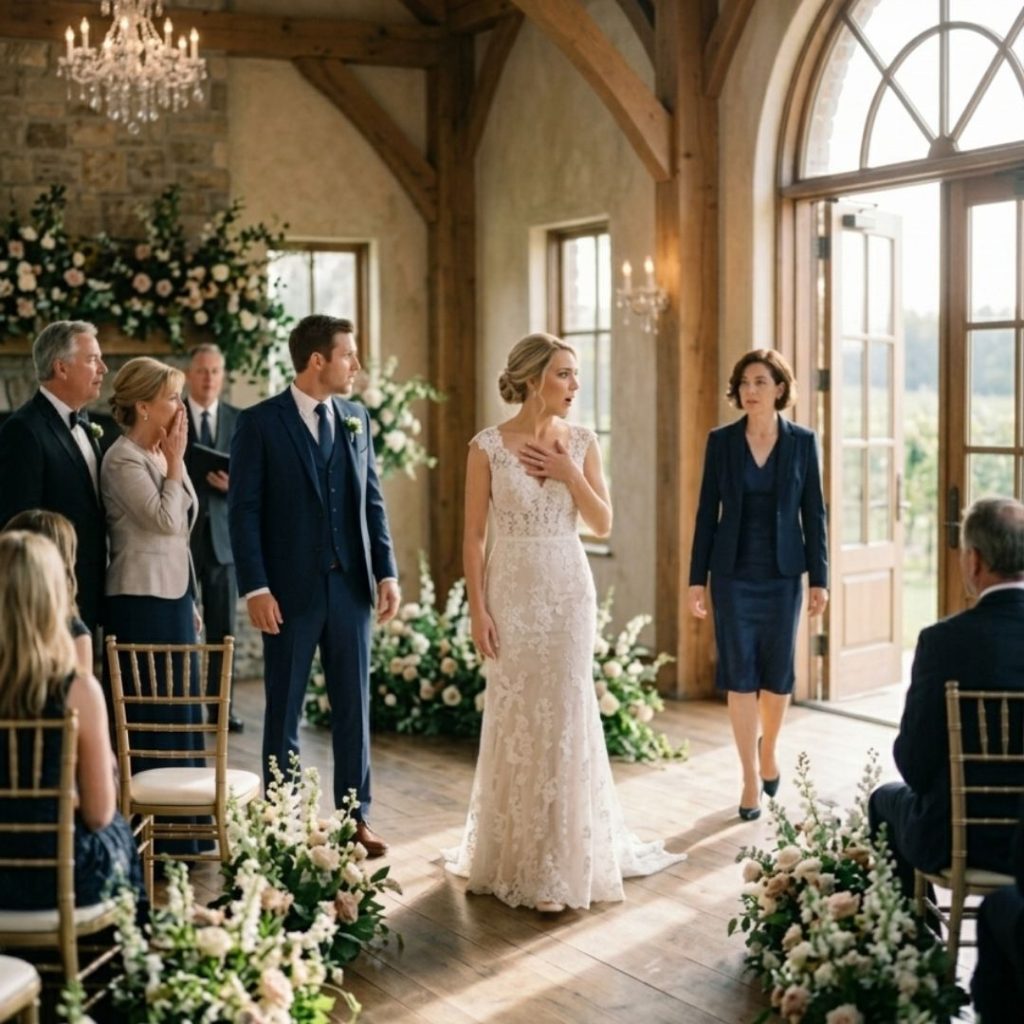
After Spending Eleven Years Telling Everyone Her “Ugly” Older Sister Was a Jealous Failure Who Ran Away From Home, a Bride Thought She Had Finally Married Into a Billionaire Family—Until One Unexpected Wedding Guest Walked Through the Vineyard Doors, the Groom Recognized Her as the Surgeon Who Saved His Sister’s Face, and a Single Question Exposed a Lifetime of Lies in Front of Hundreds of Guests…
The humidity of a late June evening in Ohio has a way of clinging to your skin like a punishment, heavy and damp, wrapping itself around your shoulders until even breathing feels like work. In the summer of 2015, that heat pressed down on my parents’ backyard outside Toledo with the weight of a wet wool blanket. It carried the smell of lighter fluid, charred hot dogs, cut grass, and the cheap artificial vanilla frosting of a supermarket sheet cake that had my name written across it in blue icing.
Congratulations, Hannah.
The cake sat on a plastic folding table beneath a sagging white canopy, surrounded by paper plates, sweating soda cans, a bowl of potato salad going warm in the heat, and a stack of napkins that kept trying to blow into the grass. My mother had complained about the cost of the cake three separate times before anyone arrived, as if my high school graduation had been a reckless personal indulgence instead of the first real celebration I had ever allowed myself to hope for.
I was eighteen years old, standing in the patchy grass of that backyard wearing a synthetic blue shift dress I had pulled from a clearance rack at TJ Maxx. I had paid for it myself with wrinkled five-dollar bills earned babysitting the hyperactive toddlers down the street. The dress didn’t fit quite right. It pinched at my shoulders and hung loosely around my waist, making me look both too young and too old at the same time. But when I bought it, I had thought it looked serious. Polished. Almost elegant.
To me, it felt like armor.
That afternoon, I had walked across the stage of my high school auditorium as valedictorian. I had stood under the hot stage lights while the principal mispronounced my middle name, accepted a certificate in a cheap blue folder, and looked out at a sea of faces until I found my parents in the audience. My father, Alan, had been checking his phone. My mother, Denise, had been whispering something to my younger sister, Sloane, who looked bored enough to be offended by the whole event.
Still, I had smiled.
Because tucked safely into my worn canvas backpack inside the house was an embossed letter from a prestigious university in Boston. It was not just an acceptance letter. It was a full-ride academic scholarship covering tuition, housing, and a stipend. I was the first person in the Whitaker family to go to college. Not community college, not a local state school I could commute to while continuing to absorb my family’s disappointment, but an elite university on the East Coast. Boston. A place that sounded like brick buildings, serious libraries, snow, coffee shops, and a future large enough that maybe I could finally stretch inside it.
I genuinely, naively believed that achievement would change something.
I thought it might wash away the invisible, heavy dust of neglect that had settled over my childhood. I thought the scholarship might force my parents to look at me differently. I thought being valedictorian, being wanted by a university that had never met Sloane, never seen my awkward blue dress, never heard my mother sigh at my hair, might finally balance the ledger.
For one night, I thought I might become visible.
Instead, my mother stood by the folding table with a glass of cheap pinot grigio balanced in her hand, looking me up and down the way people inspect fruit at the grocery store before deciding it is bruised. Her eyes lingered on my thick-rimmed glasses, on the unruly curls of my dark hair that had frizzed in the Ohio moisture, on my shoulders hunched slightly inward in that awkward adolescent way of someone who had not yet learned how to inhabit her own bones without apologizing.
Then she let out a long theatrical sigh that cut cleanly through the backyard chatter.
“Well,” Denise said, her voice carrying easily over the lawn. “At least she’s smart. God knows beauty skipped her entirely.”
For half a second, no one reacted.
Then my father laughed.
He didn’t even turn away from the grill. He stood there with a spatula in one hand and an amber bottle of domestic beer in the other, shoulders shaking with amusement while smoke curled around him. “Ain’t that the truth,” he said. “She’ll have to hit the books twice as hard to make up for what the mirror missed.”
My younger sister, Sloane, was sixteen then, perched on a lawn chair like a queen receiving suitors. She had always known how to arrange herself for maximum effect. Even at sixteen, she was already striking—blonde, lithe, delicate in the way people praised without asking whether it had cost anyone else something. She had glossy lips, smooth skin, and the terrifying instinct of a girl who understood her physical currency before she understood kindness.
She tilted her head and looked at my clearance-rack dress.
“You look like somebody’s substitute teacher, Hannah,” Sloane said, swirling her soda can. “The kind who smells like chalk and damp basement.”
The backyard erupted.
Not in violent laughter. Not the kind of cruelty that announces itself honestly.
It was worse.
It was casual.
It was the easy, collective chuckle of aunts, uncles, cousins, next-door neighbors, and family friends who had eaten the potato salad my scholarship was supposed to celebrate and now found it perfectly natural to watch an eighteen-year-old girl shrink into herself until she felt small enough to slip between the cracks of the deck.
I remember the feeling of my blood turning to ice water.
I remember looking around the circle of faces—people who shared my DNA, people who had watched me grow up, people who had seen me win science fairs, bring home perfect report cards, tutor classmates, make myself useful, make myself quiet—and feeling a profound, alienating detachment.
“Why would you say that?” I asked.
My voice was very quiet, barely more than a whisper against the hum of the neighbor’s air conditioner and the buzz of insects in the heat.
My mother’s smile vanished instantly.
Not because she felt remorse.
Because I had embarrassed her by naming the cruelty out loud.
Her mouth tightened into the pinched expression of an adult who finds a child’s boundary deeply inconvenient.
“Oh, don’t be so dramatic, Hannah,” she said. “For heaven’s sake, you know we’re just joking. You’ve always been so sensitive. If you can’t take a little ribbing from your own flesh and blood, you’re never going to survive out in the real world.”
But it was never a joke.
A joke requires a shared understanding of affection. A joke has somewhere soft to land.
This was a boundary line drawn in the dirt with a sharp stick. It was the final formal declaration of my status in the Whitaker household. I was the utility player, the background noise, the plain unpolished stone meant to make Sloane’s diamond shine brighter.
I did not cry in front of them.
That remains one of the first things I am proud of.
I stood there, my hands clenched in the cheap blue fabric of my dress, and let them laugh. I looked at the cake with my name on it, the frosting beginning to soften in the heat, and understood something I had spent my entire childhood trying not to understand.
There was no achievement large enough to earn love from people committed to withholding it.
Two weeks later, I left for Boston.
There was no family caravan. No tearful airport goodbye. No mother tucking cash into my palm. No father insisting on carrying my bags. No sister pretending she would miss me for the sake of a photo.
I packed my entire life into two battered suitcases I bought at a garage sale and counted out exactly $312 from my savings envelope. My father claimed he couldn’t justify the gas money to drive me forty-five minutes to the Greyhound station during “prime lawn-mowing hours,” so I walked to the local transit stop with one suitcase dragging behind me and the other bumping painfully against my hip.
The morning was already hot.
My backpack straps cut into my shoulders.
At the corner, I turned and looked back once.
The house stood exactly as it always had—beige siding, cracked driveway, plastic flowerpots my mother never watered, Sloane’s bedroom window open with music spilling out. No one came to the porch. No curtain moved. No door opened.
I kept walking.
The erasure was not a sudden explosion. It was a slow, methodical bleaching of my existence from their lives.
By Thanksgiving, when I called home to ask about travel arrangements, my mother informed me that my childhood bedroom had been completely gutted. She said it casually, as if telling me the weather.
“Sloane needed more space,” Denise said. “It’s her beauty and pageant preparation suite now. You know how many gowns she has.”
I sat on the edge of my narrow dorm bed in Boston, surrounded by textbooks, cafeteria coffee, and the first clean quiet I had ever known, listening to my mother describe the vanity mirror framed with blinding LED bulbs, the clothing racks, the new white carpet.
“So where would I sleep if I came home?” I asked.
There was a pause.
Then she sighed.
“Oh, Hannah. Don’t make this difficult. You’re the one who chose to go so far away.”
By Christmas, a cousin accidentally forwarded a digital copy of the family holiday card to my school email. There stood Alan, Denise, and Sloane in matching cream sweaters in front of a roaring fireplace. Sloane’s hair fell in perfect blonde waves over one shoulder. My mother’s hand rested proudly on her back. My father smiled like a man whose family was complete.
The caption read: Blessings from our beautiful trio to yours.
Beautiful trio.
I stared at it for a long time.
Three people.
A family math problem solved by removing me.
By the following summer, when I called to check on my grandmother, she spoke to me with a strange, hesitant pity. She mentioned that Denise had told the extended family I had “distanced myself” because I thought I was too good for Ohio, that I had become “cold” and “inconvenient” and had chosen not to maintain family ties.
I sat in the university library with a stack of organic chemistry notes in front of me and listened as my grandmother tried to gently ask whether I was lonely.
I nearly told her everything.
Then I thought of my mother’s face when I asked why she had called me ugly in front of everyone.
Don’t be so dramatic.
I swallowed the truth.
“I’m busy, Grandma,” I said. “But I’m okay.”
After we hung up, I sat there for another hour, staring at the same page without reading a word.
Then I did the only logical thing a scientist in training could do.
I stopped begging for a seat at a table where I was clearly considered an intruder.
I let the silence take over.
Eleven years is a vast expanse of time if you spend it building something from scratch.
In the medical world, those years are not measured the way other people measure them. They are not measured in birthdays, vacations, weddings, or holidays. They are measured in exams taken on three hours of sleep, in anatomy labs that smell faintly of formaldehyde and fear, in twenty-four-hour shifts that turn into thirty, in the sharp tang of surgical scrub, in vending machine dinners, in the hum of hospital ventilation systems at 3:00 a.m., and in the profound weight of human vulnerability.
I did not remain the awkward girl in the blue shift dress.
By twenty-nine, I had earned my medical degree from Harvard, completed a grueling residency in general surgery, and secured a highly competitive fellowship in reconstructive plastic surgery and facial trauma at one of the premier medical centers in Boston. My days were no longer defined by the cruel barbs of a suburban backyard. They were defined by the quiet, intense focus of an operating room.
My specialty was not the superficial vanity my family would have assumed if they heard the words plastic surgery. I was not smoothing the wrinkles of wealthy women who feared age, though I never judged anyone for wanting to recognize themselves in a mirror. My work lived somewhere deeper, holier, and more difficult.
Reconstruction.
I worked with burn survivors whose skin had been stolen by fire. I worked with victims of industrial accidents, domestic violence, car crashes, dog attacks, and congenital conditions that had shaped the way strangers looked at them before they ever had a chance to speak. I worked with children who had stopped smiling because smiling pulled too painfully against scar tissue. I worked with adults who had covered every mirror in their homes. I worked with people whose identities had been shattered in seconds and who came to me hoping, sometimes against all reason, that their faces could become theirs again.
In my clinic, I learned a truth my family’s shallow worldview could never comprehend.
True beauty is not a genetic lottery won by the lucky and guarded by the cruel. It is an architecture of resilience. It is the dignity of a face rebuilt, a smile restored through microsurgery, a person looking into a mirror after tragedy and choosing to recognize themselves again.
My life in Boston became deliberate, beautiful, and peaceful.
I lived in a sun-drenched brownstone apartment in the South End, filled with towering monstera plants, walls of medical textbooks, and the soft clutter of a life no one could erase without my permission. My kitchen held good coffee, copper pans I bought one at a time, and a bowl of lemons near the window because I liked the color. My bedroom had white curtains that moved gently when spring air came in from the street. My living room held framed photographs of colleagues, patients who had given permission, and friends who had become the kind of chosen family I once thought existed only in books.
There was Elise, my head nurse, who could silence an arrogant resident with one eyebrow. There was Dr. Marcus Chen, my mentor, who taught me that calm hands begin with an honest mind. There was Mara, a pediatric anesthesiologist who had seen me cry in a supply closet after my first child trauma case and never mentioned it again except to bring coffee the next morning.
They valued my mind.
My steady hands.
My heart.
Not my usefulness as a contrast to anyone else’s beauty.
Not my willingness to absorb insult.
Not my silence.
I had built a sanctuary of my own making.
And then, on a Tuesday morning in early April, the illusion of permanent escape arrived in a heavy ivory envelope.
It came with the rest of my mail: a medical journal, two bills, a postcard from a conference organizer, and that thick envelope with raised gold calligraphy that looked expensive enough to resent.
Dr. Hannah Whitaker.
My fingers froze on my name.
I opened it standing at my kitchen island while a cup of black coffee cooled beside my hand.
Sloane Marie Whitaker and Nathaniel Harrison Reed request the honor of your presence at their wedding celebration.
Saturday, the twentieth of June, 2026.
Four o’clock in the afternoon.
The Meritage Vineyards, Columbus, Ohio.
There was no handwritten note inside. No apology from Denise or Alan. No message from Sloane acknowledging that we had not spoken in more than a decade. Not even a casual text testing the waters. Simply my name printed on thick cardstock, invited back into a world that had erased me and apparently expected me to be grateful for the privilege of appearing as a footnote.
I sat down slowly.
Eleven years of radio silence.
Eleven years of being functionally dead to them.
Why now?
My first instinct was to drop the invitation directly into the chrome trash can beneath my sink. I did not need their drama. I did not need to reopen old scars that had healed cleanly only because I had stopped picking at them. I did not need to fly back to Ohio in June to watch Sloane perform the victory lap she had been rehearsing since childhood.
But over the next few days, something strange happened.
The invitation remained on my kitchen island.
I walked past it before clinic. I saw it when I came home after surgery. I moved it once to wipe the counter, then put it back exactly where it had been. It became less a request and more a question.
Was I still afraid of them?
Not angry.
Not disgusted.
Afraid.
The answer mattered.
One night, after a fourteen-hour procedure repairing a young man’s cheekbone and eyelid after a motorcycle crash, I came home, washed the hospital from my hands, and stood over the invitation in my quiet kitchen.
I was not the fragile eighteen-year-old girl in a clearance-rack dress anymore. I did not look like her. I did not think like her. I did not carry her desperation for my mother’s approval or my father’s pride. I had built an entire life in rooms where my name meant skill, discipline, and trust.
Ignoring the invitation felt like fleeing.
Going felt like walking back into the old backyard and finally realizing I was taller than the fence.
So I RSVP’d.
One guest.
No dietary restrictions.
To understand what happened when I walked into that vineyard in Columbus, you have to understand the specific, rarefied world of my professional life in Boston and how completely it had decoupled from my family’s narrow horizon.
Sixteen months before the wedding invitation arrived, a major trauma case came through our hospital doors just after midnight. A massive apartment fire in the Back Bay had trapped several residents. The emergency department became a storm of smoke inhalation, burns, sirens, shouted orders, and the terrible raw smell of fire injuries that every trauma doctor knows and never forgets.
Among the victims was a fourteen-year-old girl named Lily Reed.
She had survived, but the left side of her face, shoulder, and neck had sustained deep catastrophic third-degree burns. She was a talented cellist, a bright, vibrant teenager whose life had changed in the time it took a faulty electrical line to turn a home into an inferno. By the time I met her, she was sedated, bandaged, and surrounded by machines. Her brother stood outside the burn unit doors looking like the world had torn him in half.
His name was Nathan Reed.
Nathan was a prominent figure in New England venture philanthropy, a brilliant and intensely private man in his early thirties who had taken custody of Lily after their parents died in a private plane crash years earlier. He had money, influence, and the kind of social reach that could summon almost anyone. When Lily was brought in, he had the resources to fly any surgeon in the world to Boston.
But our chief of trauma told him plainly, “If you want her face rebuilt with the precision of a master artist, you want Dr. Hannah Whitaker.”
For more than a year, Lily was my patient.
I performed seven distinct, highly complex reconstructive surgeries on her. I spent hundreds of hours under surgical microscopes, transferring tissue grafts, connecting blood vessels thinner than strands of hair, rebuilding contour, preserving symmetry, protecting the function of her eyelid and mouth, fighting not merely to save her skin but to preserve the expressions through which a young girl tells the world she is still herself.
Reconstruction is slow work. Painful work. Hopeful work. It happens in stages, and every stage asks the patient to be brave again.
Lily was brave in a way that humbled me.
Some days, she refused to look into a mirror. Some days, she joked with the nurses. Some days, she asked whether her friends would stare. Once, after a difficult dressing change, she whispered, “Will I ever look like me again?”
I sat beside her bed and said, “Yes. Maybe not exactly the old way. But yes, Lily. You will look like you.”
Nathan was there every day.
He sat in clinic waiting rooms with terrible hospital cafeteria coffee gone cold in his hands. He learned the language of grafts, revisions, scar contractures, nerve function, and infection risk. He watched over his sister with a fierce protective devotion that I admired deeply. He was not one of those wealthy relatives who tried to purchase certainty from doctors. He asked precise questions. He listened to hard answers. He never pretended his money could bribe biology into mercy.
Because we were fighting for Lily’s future together, Nathan and I developed a profound bond of mutual respect. He saw me exhausted after fourteen-hour surgical marathons, wearing faded scrubs, my hair tied in a messy bun, dark circles under my eyes, mask marks pressed into my skin.
He did not see an ugly high school graduate.
He saw a woman with the power to stitch a broken life back together.
He saw a surgeon.
Once Lily’s reconstruction reached a stable and beautiful point, once she smiled for the first time without flinching and Nathan wept openly in my office, he tried to donate a massive multimillion-dollar endowment to my research wing. I guided his generosity instead toward a foundation that funded reconstructive surgeries for underprivileged children.
He respected that.
We stayed in touch through professional circles. Occasionally, we shared a quiet dinner to discuss medical philanthropy, burn recovery access, and Lily’s progress. He never pushed past boundaries. I never confused gratitude with intimacy. Our relationship was warm, respectful, and careful.
Nathan did not talk much about his dating life. He was intensely protective of his privacy because of his wealth, and I respected boundaries to a fault. I knew only that he had started seeing someone who lived between Boston and New York, a woman he described vaguely as an interior designer and influencer from the Midwest. Our conversations remained anchored in philanthropy, medicine, and Lily’s recovery.
What Nathan did not know—what he could never have guessed in a million parallel universes—was that the woman he had fallen for, the woman who had carefully curated an image of a refined, old-money Midwestern darling for him, was my sister.
Sloane Whitaker.
And Sloane had spent the last two years spinning an elaborate web of lies to fit into Nathan’s world.
The Meritage Vineyards outside Columbus was an exercise in performative wealth. Rolling green hills framed imported white tents. Fairy lights wound through rustic wooden beams. A massive gravel driveway curved between manicured rows of grapevines and overflowed with luxury European SUVs, black town cars, and sports cars with engines loud enough to announce insecurity.
Sloane had clearly achieved her lifelong dream.
She had found a man whose bank account could fund the life of absolute luxury she believed she inherently deserved.
I arrived in a sleek black town car just before the ceremony. When the driver opened my door, the late afternoon sun struck the emerald-green silk of my gown. The dress was a masterpiece of clean architectural tailoring, high-necked with an open back, falling into a fluid column that moved like liquid glass when I walked. My dark hair was styled into smooth waves. My glasses had long ago been replaced by contact lenses, though I still kept my old frames in a drawer in Boston as a reminder of the girl who had survived needing them. My posture was that of a surgeon who held the literal balance of life and death in her hands.
I did not look like a substitute teacher.
I looked like command itself.
As I walked toward the reception entrance, I felt no tremor in my hands. That surprised me. I had expected some old fear to rise when I saw Ohio again, when I smelled cut grass and summer heat, when I heard familiar accents in the air. But the anxiety never arrived. What I felt instead was distance.
Not numbness.
Distance.
The kind that comes when a wound becomes a scar and a scar becomes history.
I stepped into the cocktail lounge and entered a sea of pastel linen, expensive suits, champagne flutes, and the low polite roar of old-money networking. Servers moved between guests with silver trays of tiny appetizers. A string quartet played near a floral archway. Photographers captured laughter that had been arranged rather than felt.
As I made my way toward the champagne wall, a sharp collective gasp cracked the air near the entrance.
My mother had seen me.
Denise Whitaker stood beside a high cocktail table, draped in a mother-of-the-bride dress that was far too tight and featured a distracting amount of rhinestones. She was holding a crystal flute of champagne while chatting with women who looked like they belonged to a country club board.
When her eyes landed on me, her glass tilted. Pale champagne spilled over her manicured fingers and dripped onto the pristine white tablecloth.
“Hannah?” she whispered.
Her voice cracked with an ugly, raspy friction.
Beside her, my father, Alan, looked profoundly uncomfortable in a tuxedo that squeezed his beer-softened midsection. He stopped mid-sentence, jaw dropping slightly as his eyes tracked the smooth, unbothered way I held myself.
“Denise. Alan,” I said, stepping toward them with a polite, completely detached smile. My voice was smooth, trained by years of speaking to panicked families in sterile consultation rooms. “It’s been a long time. The vineyard is lovely.”
My mother did not ask how I was.
She did not ask about my life.
She did not ask about the eleven years of missing time.
Her eyes immediately darted across my emerald gown, searching for a label with a feral consumer instinct, before returning to my face. She looked furious—not because I had arrived, but because she could not instantly find the leverage to make me feel small.
“You,” Denise hissed, stepping closer so her country club friends could not hear. “You actually came.”
“You invited me.”
“Sloane sent a courtesy invitation.”
“Then it was courteous of me to accept.”
Her mouth tightened. “And what are you wearing? You look—” She stopped, visibly irritated that the insult would not assemble itself. “Who told you that you could just walk in here looking like that?”
“The invitation didn’t specify a modesty cloak, Mother,” I said.
My father’s face darkened.
“Don’t get smart.”
I looked at him calmly. “I built an entire career on getting smart.”
He blinked.
For the first time in my life, my father had no immediate answer for me.
Before my mother could recover, the heavy oak doors at the back of the lounge opened. The bridal party entered for pre-wedding photographs, moving in a cloud of silk, lace, perfume, and laughter.
Then came Sloane.
My sister looked spectacular in a traditional multi-thousand-dollar lace ball gown, platinum hair pinned up with diamonds, makeup glowing under the soft lights. She carried a bouquet of white peonies and moved with the manic triumphant energy of a woman who believed she had finally secured the life the world owed her.
She was laughing at something her maid of honor said, turning her head with practiced grace.
Then she saw me.
The transformation was physical.
The blood left Sloane’s face so quickly that her heavy bridal blush looked like two artificial stains on her cheekbones. She stopped dead, nearly tripping over the tulle of her own train. Her bouquet tightened in her hands until the stems groaned.
To Sloane, I was supposed to be a permanent ghost, a shameful secret buried deep in the flat earth of Toledo. She had spent the last two years telling Nathan’s family and friends that she was virtually an only child, that her unfortunate estranged sister was unstable, jealous, and had abandoned the family years ago to live a messy life on the East Coast. She had invited me, I later realized, out of a bizarre narcissistic dare, assuming I would either decline from shame or appear looking exactly like the awkward, broken teenager she had terrorized in 2015.
She never expected me.
Not like this.
“Hannah?” Sloane choked out. “What are you doing here?”
“You sent an invitation,” I said, my voice carrying with calm authority. “I assumed you wanted your family present.”
Her eyes flashed with panic.
The word family had become dangerous in that room.
Alan stepped forward, old habits of defensive aggression flaring. “Listen here, girl, you don’t come into your sister’s wedding trying to make a scene.”
“Is everything all right over here?”
The voice was deep, resonant, and perfectly familiar.
From behind the floral archway, the groom stepped into the cocktail lounge.
Nathan Reed was immaculate in a custom black tuxedo, dark hair brushed back, his face carrying the familiar serious intensity I had come to know so well in the corridors of Boston Med. He looked every inch the wealthy, composed groom—until he saw the shape of the tension around us.
Sloane instantly turned, her entire demeanor shifting into that of a fragile helpless lamb. She reached out and wrapped her manicured hands around Nathan’s arm with a desperate anchoring grip.
“Nathan, darling,” she stammered, her voice rising an octave. “It’s nothing. This is just… an old acquaintance who showed up unexpectedly. She was just leaving. We don’t want to disrupt the schedule for photos.”
Nathan did not look at Sloane.
His eyes had bypassed his bride entirely and locked onto me standing in my emerald dress.
I watched the gears turn in his brilliant analytical mind. I watched recognition move through him. I watched him see the woman who had spent consecutive fourteen-hour stretches rebuilding his sister’s face, the woman whose name was etched onto faculty boards at one of the most prestigious hospitals in New England, standing across from him in the middle of his wedding venue.
The wealthy groom veneer dropped away.
“Dr. Whitaker?” Nathan said.
His voice cut through the ambient noise of the lounge like a thunderclap.
The room seemed to drop five degrees.
Denise stared at Nathan, then at me, her mouth opening and closing.
“Dr… Doctor?” she said weakly. “Nathan, honey, what are you talking about? This is just Hannah. She’s… she’s a high school grad from Toledo.”
Nathan ignored my mother entirely.
He detached Sloane’s hands from his arm with a slow, deliberate movement that felt more violent than a shove. Then he walked across the polished floor until he stood two feet in front of me.
“Hannah,” he said, eyes wide, voice shaking with a dangerous mixture of confusion and sudden realization. “What is going on here? Why didn’t you tell me Sloane was your sister?”
The silence that followed was total.
The kind of silence that comes right before a structural column fails.
Sloane looked like she might faint. “Nathan,” she whispered. “You know her?”
Nathan turned his head slowly to look at his bride.
“Do I know her?” he asked, voice low and vibrating with disbelief. “Sloane, this is Dr. Hannah Whitaker. She is the chief reconstructive trauma surgeon at Boston Med. She spent an entire year performing microsurgery to save Lily’s face after the fire. She is the reason my sister can look in a mirror today without crying.”
A collective murmur rippled through the guests crowded near the doorway.
My mother gripped the edge of the table.
My father stared at me as if I had become someone else through witchcraft rather than work.
Nathan turned back to Sloane. “You told me your sister was a deadbeat. You told me she was an unstable high-school dropout who ran away to live off government assistance and cut contact with your family because she was jealous of your success.”
Sloane’s lips parted, but no sound came.
“You told me your parents were devastated by her lifestyle,” Nathan continued. “You told me she embarrassed the family.”
Denise lunged verbally before Sloane could answer.
“Nathan, sweetheart, you don’t understand. Hannah has always been a liar. She’s always tried to ruin things for Sloane. She’s jealous. She’s bitter. She—”
“Be quiet,” Nathan said.
He did not yell.
He did not need to.
The sheer icy authority in his voice silenced my mother instantly. She actually stepped back and nearly bumped into a caterer carrying a tray of champagne.
Nathan looked at Sloane, his eyes moving over the expensive lace dress, the diamonds, the perfect makeup—all of it suddenly looking like cheap plaster over a crumbling wall.
“Every time I talked about Dr. Whitaker,” he said, “every time I told you about the brilliant, humble surgeon who was saving my sister’s life, you changed the subject. You didn’t want me to meet her outside the hospital. You didn’t want me to realize her last name was Whitaker. You hid her existence from me because you knew the moment I met your sister in a normal setting, your entire narrative about your perfect family would collapse.”
Sloane began crying.
Not delicate bridal tears.
Heavy, panicked tears that dragged black mascara down her face.
“Nathan, please,” she sobbed. “I love you. I just wanted to fit into your world. My family—we just wanted the best for us. Hannah didn’t care about us. She left us.”
Nathan’s expression became something I had seen only once before: the day Lily’s infection risk spiked after surgery, when he realized money could not bully death.
“She didn’t leave you,” he said. “You erased her.”
The words landed with brutal clarity.
Nathan looked at my parents then. Really looked.
At my mother’s rhinestones. My father’s cheap tuxedo. Their faces twisted not with regret, but with the terror of exposure.
“You erased a woman of absolute genius and integrity because she didn’t fit your shallow definition of value,” Nathan said. “And then you lied to me about it for two years.”
Alan stepped forward. “Now hold on. You don’t know what went on in our house.”
“No,” Nathan said coldly. “But I know what stood in front of me in my sister’s hospital room. I know who rebuilt Lily’s face. I know who sat with her when she was afraid to look in the mirror. I know who refused a personal endowment and redirected it to children who needed surgery. That woman is standing right there. And none of you recognized her value because you were too busy worshiping a reflection.”
Sloane sank slowly to her knees, her gown ballooning around her like a collapsing white cloud.
“Nathan,” she pleaded. “Please. We can fix this. I panicked. I was ashamed. I didn’t know how to explain.”
Nathan let out a short bitter laugh.
“You didn’t know how to explain that your sister is a respected surgeon instead of a failure?”
Sloane covered her face.
The guests whispered openly now.
A wedding planner hovered near the floral arch with a headset and a face that had gone completely blank. Somewhere near the bar, a glass shattered. No one moved to clean it.
Nathan stepped back and looked around the vineyard lounge—the floral arrangements, the champagne, the string quartet, the high-society farce built on lies.
“The wedding is off,” he said clearly.
The room erupted into chaos.
Denise screamed Sloane’s name as if the humiliation were Sloane’s fault alone. Alan moved toward Nathan shouting about contracts, deposits, and legal obligations. Sloane sobbed on the floor, her bouquet lying beside her, crushed and leaking white petals across the polished wood. Bridesmaids fluttered uselessly. Guests began filming before remembering they were supposed to be too refined for that.
Nathan did not look back.
He walked toward the corner of the room where Lily Reed stood near the exit.
She was fourteen, wearing a beautiful silver dress that covered some of her surgical scars and revealed others with quiet defiance. Her hair was pulled back softly from her face. The left side bore the traces of everything she had survived, but she stood straight, her bright eyes fixed not on the chaos or the fallen bride, but on me.
Then she smiled.
A small, brave smile.
My throat tightened.
Nathan placed a hand gently on Lily’s shoulder, then walked back to me one last time. His face was pale, but his eyes were clear.
“I am so sorry, Hannah,” he said quietly. “I am sorry they treated you like that. And I am sorry I brought them into your orbit, even by accident.”
“You didn’t bring them anywhere, Nathan,” I said softly, looking past him at my sister sobbing on the floor. “They’ve been stuck in that backyard their entire lives. I just finally stopped standing in it.”
His mouth tightened with emotion.
Behind him, my mother was trying to push through two bridesmaids toward me.
“Hannah!” she snapped. “Don’t you dare leave. You owe your sister an explanation.”
That nearly made me laugh.
I turned toward her slowly.
“I owe Sloane nothing.”
Denise’s face flushed. “After what you’ve done?”
“What I’ve done?” I asked. “I came because I was invited.”
“You humiliated her.”
“No, Mother. I arrived. The humiliation came from the lies.”
For a moment, the room around us seemed to narrow into that old backyard. I could almost smell lighter fluid and supermarket frosting. I could almost feel the blue dress pinching my shoulders. I could almost hear the casual laughter.
At least she’s smart. God knows beauty skipped her entirely.
I looked at my mother and felt nothing but distance.
“You spent my whole childhood teaching me that beauty was the only currency that mattered,” I said. “You never imagined I would leave and build a life in a world where your currency was worthless.”
My father muttered, “You always thought you were better than us.”
“No,” I said. “You told everyone I did because it was easier than admitting you treated me like I was less.”
Sloane lifted her tear-streaked face.
“You ruined my life,” she whispered.
I looked at my sister, the beautiful girl who had become a woman still kneeling at the altar of her own reflection.
“No,” I said. “You built your life out of erasing mine. Today someone asked where the missing pieces went.”
Nathan’s security team had begun moving quietly through the room, not aggressively but with unmistakable control. The wedding planner was speaking into her headset. Guests were being guided away from the lounge. Someone had started calling vendors. The machinery of cancellation moved quickly when wealth required it.
I walked toward Lily before leaving.
She stepped forward first.
“Dr. Whitaker,” she said.
“Hannah,” I corrected gently. “Today, you can call me Hannah.”
She smiled again. “You look beautiful.”
That nearly broke me in a way my mother’s cruelty never could.
“Thank you,” I said. “So do you.”
She touched the edge of the scar near her jaw, not hiding it, just acknowledging it. “Nathan told me you might be here. But he didn’t know you were…” She glanced toward Sloane, confused and sad. “He didn’t know.”
“No,” I said. “He didn’t.”
Lily looked past me at the chaos. “I’m glad he knows now.”
“So am I.”
Nathan escorted Lily out first. I followed moments later, refusing to hurry. My mother called my name once more, sharper this time, but I did not turn around. Her voice had ruled entire rooms in my childhood. That day, it could not even stop my footsteps.
An hour later, my town car moved smoothly down the interstate, heading away from Columbus, away from Ohio, away from the wreckage of the Whitaker family’s social ambitions.
The sun was setting over the flat Midwestern landscape, painting the sky in deep bruised shades of violet, gold, and crimson. The fields stretched out on either side of the highway, vast and open, indifferent to the petty cruelties of human beings. There was something comforting about that indifference. The land did not care whether Sloane cried in a ruined gown or Denise lost access to country club admiration. The sky did not care who had been called beautiful or ugly. It simply widened.
My phone buzzed in my lap.
For a second, I expected Denise.
Or Alan.
Or Sloane.
Instead, it was a text from Elise, my head nurse in Boston, asking about a patient’s postoperative chart for Monday morning.
I read it twice and smiled.
Not because of the chart.
Because my real life had continued without interruption.
I typed out a precise professional response, reminding her to check drainage output and adjust the follow-up schedule if swelling increased, then set the phone down and looked out the window.
Eleven years earlier, an eighteen-year-old girl had ridden a Greyhound bus along a highway like this one, crying silently into her canvas backpack, believing she was fundamentally flawed, ugly, and unworthy of a place in the world. She had thought the family holiday card meant she had been erased from the only story that mattered. She had believed distance was exile.
I wished I could reach back through time and sit beside her on that bus.
I would take her hands, the ones she thought were too big and awkward, and tell her what they would someday do. I would tell her those hands would hold scalpels with extraordinary precision. They would rebuild faces. They would comfort frightened children. They would sign medical charts, research papers, foundation documents, and a life no one could bleach away. I would tell her the mirror they held up to her was warped, cracked, and designed to distort her image.
I would tell her she was never ugly.
She was unfinished.
And she belonged only to herself.
But as the car accelerated toward the airport, bringing me back to Boston, I realized I did not need to go back. The girl in the blue dress was not waiting on that bus anymore. She was stitched into me, not as a wound, but as architecture.
She had survived the backyard.
I had left it.
That was enough.
Two days after the canceled wedding, Nathan called.
I was in my apartment, barefoot in the kitchen, watering a monstera plant that had grown so large it seemed determined to become furniture.
“Hannah,” he said when I answered. His voice sounded exhausted.
“Nathan.”
“I wanted to tell you personally before you heard it elsewhere. Sloane’s family is trying to frame what happened as emotional manipulation. They’re saying you intentionally deceived everyone by hiding your connection to me.”
I laughed softly. “Of course they are.”
“I don’t believe them.”
“I know.”
There was a pause.
Then he said, “I keep thinking about all the times I mentioned you. All the times Sloane changed the subject. I thought she was uninterested in medicine. I never imagined…”
“You had no reason to imagine it.”
“I should have.”
“Nathan, people who tell lies for a living rely on good people assuming normal motives. That’s not your failure.”
He exhaled. “Lily asked if she can send you a note.”
“She never has to ask.”
“She said you looked like someone from a movie.”
I smiled despite myself. “Tell her I said she looked like someone who survived fire and still chose silver.”
His voice softened. “She’ll like that.”
Another silence.
Then he said, “I’m sorry about your family.”
For once, the phrase did not make me flinch.
“I’m not,” I said.
He seemed surprised.
“I’m sorry for the girl I was,” I continued. “I’m sorry she had to grow up in that house. But I’m not sorry the truth came out. I’m not sorry Sloane’s lie failed. And I’m not sorry I went.”
“No,” Nathan said quietly. “Neither am I.”
After we hung up, I stood in the kitchen listening to the city outside my window. Boston sounded different from Toledo. Traffic, footsteps, distant sirens, someone laughing on the sidewalk below. The noise of a life I had chosen.
My mother called thirteen times that week.
I did not answer.
My father left one voicemail.
“You think you’re something special now,” he said, voice rough with resentment. “But you embarrassed your mother. You embarrassed your sister. You embarrassed this family. I hope that fancy hospital teaches you loyalty someday.”
I saved it.
Not because I needed evidence.
Because sometimes it is useful to remember why a door stays closed.
Sloane sent one text.
You destroyed everything because you were jealous.
I looked at it while sitting in the hospital cafeteria between surgeries, wearing blue scrubs, my hair under a surgical cap, coffee going cold beside me.
For a moment, I imagined replying.
Jealous of what?
A canceled wedding?
A life built on lies?
A family that loved only mirrors?
Instead, I deleted the message.
The next patient needed me steady.
Months passed.
Nathan and Lily remained in my orbit, though carefully. Lily continued follow-up care. Her reconstruction progressed beautifully. Her scars matured. Her smile strengthened. She returned to cello slowly, first in private lessons, then with a youth orchestra. The first time she performed publicly after the fire, Nathan sent me a video.
In it, Lily stood beneath stage lights in a simple black dress, cello between her knees, bow moving across strings with a concentration so fierce it made my chest ache. Her scars were visible. So was her joy.
I watched the video three times.
Then I cried.
Not because of sadness.
Because restoration is not the same as erasure. That is what my family had never understood. Healing does not mean pretending damage never happened. Healing means making a life large enough that the damage is not the only thing visible.
Sloane tried to recover publicly.
For a while, social media became her battlefield. She posted vague quotes about betrayal, jealousy, and people from your past trying to ruin your happiness. She deleted photos with Nathan, then restored some, then deleted them again. Influencer friendships faded quickly once the wedding collapse became gossip. People who had loved standing near Nathan Reed’s wealth became less interested in Sloane Whitaker alone.
My parents returned to Toledo humiliated.
I heard through a cousin that Denise stopped attending certain luncheons. Alan complained loudly that rich people had no respect for working families. They told relatives I had become arrogant, cold, and “surgically enhanced,” which was almost funny considering I had never altered my face except to stop apologizing with it.
For the first time in my life, their lies could not reach me.
Not because they stopped.
Because I had stopped organizing my identity around correcting them.
A year after the wedding, I returned to Ohio once.
Not to see my family.
My grandmother had died, and despite everything, I went to the funeral. She had not protected me the way I once wished she had, but she had loved me in small, imperfect ways. She had sent birthday cards. She had kept my graduation announcement on her refrigerator long after my mother removed every photo of me. She had cried on the phone when she realized too late how thoroughly I had been erased.
The funeral was held in a small church with green carpet and stained-glass windows. My parents sat in the front row with Sloane. I sat near the back.
No one approached me before the service.
Afterward, in the parking lot, Denise stepped into my path.
She looked older. Smaller. Her hair was still carefully styled, her makeup still heavy, but something brittle had entered her face.
“Hannah,” she said.
“Denise.”
The word struck her. Not Mom. Denise.
“You couldn’t even sit with your family?”
“I did.”
Her mouth tightened. “You know what I mean.”
“Yes,” I said. “I do.”
Sloane stood behind her in a black dress, arms folded, face hard. My father lingered near the car, refusing to come closer but watching.
Denise inhaled shakily. “Your grandmother loved you.”
“I know.”
“She wanted the family together.”
“No,” I said gently. “She wanted peace. Those are not the same thing.”
My mother’s eyes flashed. “You always have to sound superior.”
“No. I just don’t translate myself for you anymore.”
Sloane scoffed. “Still dramatic.”
I looked at my sister.
She was still beautiful. Even grief looked carefully arranged on her. But for the first time, I saw how tired she looked beneath it. Beauty without truth is a demanding employer.
“I hope you build something real someday,” I said.
Her expression flickered.
Not apology.
Not understanding.
But something.
I walked away before she could turn it into an insult.
That night, flying back to Boston, I looked down at the dark quilt of land beneath the plane and thought about the two worlds that had shaped me.
The Whitaker illusion taught that value was genetic and skin-deep, that lies could guard social status, that family was a tool for leverage, that beauty was something to hoard and weaponize.
The architecture of reality taught something else.
Value is carved through work.
Truth endures surgical light.
Family is chosen by respect.
Beauty is not the absence of scars, but the courage to live visibly after the wound.
I carried both worlds inside me, but only one had a key to my future.
Years after the backyard, after Boston, after the wedding that collapsed under the weight of one question, people sometimes asked whether I felt vindicated.
The honest answer is yes.
I am human. Of course there was a part of me that felt satisfaction watching my mother’s glass spill, watching Sloane’s face pale, watching my father realize the daughter he dismissed had become someone important in a room where his opinion held no currency.
But vindication was not the deepest feeling.
The deeper feeling was release.
Because the question Nathan asked—Why didn’t you tell me Sloane was your sister?—did more than expose Sloane’s lie. It shattered the cruel illusion my family had built around me. It revealed that I had not disappeared because I was unworthy. I had disappeared because they could not survive the comparison between what they said I was and what I had become.
Their version of me required my absence.
My life did not.
That was the difference.
On the anniversary of the canceled wedding, I was in surgery for nine hours reconstructing the lower face of a young woman injured in a car accident. The work was delicate and exhausting. When we finished, when the final sutures were placed and the patient was stable, I stepped back from the table and felt the familiar ache in my shoulders.
Elise came beside me.
“Beautiful work,” she said.
I looked at the patient, at the careful lines, the restored contour, the possibility we had protected.
“Yes,” I said. “It is.”
I was not talking about myself.
Not only.
That evening, I went home to my brownstone apartment, watered my plants, answered Lily’s text about her next cello audition, and stood for a while by the window while Boston moved below me.
I thought again of the girl in the blue dress.
The one who thought armor had to be cheap synthetic fabric because no one had taught her that dignity could be grown from the inside out.
I no longer wanted to rescue her from the backyard.
She had already rescued me by leaving.
I leaned my head against the cool glass, watched the city lights flicker on, and smiled into the quiet, beautiful evening.
The mirror my family held up to me had been warped, cracked, and cruel.
But I had stopped looking into it.
And when I finally saw myself clearly, I was not ugly.
I was not erased.
I was not the missing fourth person in their beautiful trio.
I was Dr. Hannah Whitaker.
Surgeon.
Daughter of no one’s cruelty.
Architect of my own life.
And every scar I carried had become part of the design.
THE END
