My father had been that man.
I was trying to be.
What I knew about cranberries at the beginning could have fit on the back of a matchbook. What I would know by the next autumn would fill a composition book, and eventually did. I still have it, a green Mead notebook water-stained along the spine, sitting on the same cellar shelf where I found the coffee can.
But at first, standing in that flooded pasture, I knew only the essential thing.
Wild cranberry does not establish itself in bad ground.
It is particular in a way most plants are not. It needs a specific pH, a specific relationship between surface water and peat, a specific rhythm of wetness and exposure. Where it grows, it has likely been growing for a long time. Where it has been growing for a long time, the hydrology is not sick. It is not broken.
It is managed, even if no living man remembers who first managed it.
Two men who owned that pasture before me had seen standing water and concluded the land was drowning.
My father had seen standing water and asked what was living in it.
That difference changed everything.
I bent down the way he must have bent down, slowly, with one hand on my knee, and touched one of the low runners where it disappeared into the dark waterline. The stem was thin, not even the diameter of a pencil. But it was alive. The bud at the tip was closed tight, still weeks from showing much of anything, but it was there.
Forty feet of waterline coverage in 1951 could mean considerably more by the time I found it.
Established cranberry colonies spread at their own pace. I had read in a county extension pamphlet that runners could move two to three feet a year under favorable conditions. That did not sound like much until a man gave the plant thirty-eight years and stopped thinking in impatient seasons.
I stayed in that water for a long time doing arithmetic.
If the colony had already been mature in 1951, and my father’s note suggested it was, then it had begun years before he saw it. But even counting from 1951, conservative spread of two feet a year meant more than seventy additional feet by the time I stood there. Not in one straight line necessarily. In arcs. In mats. In slow, stubborn, living expansion.
Forty feet could become acres if the waterline held and the peat shelf extended under the surface the way I suspected it did.
I stood and looked at the pasture differently.
Not as a drowned failure.
As a hidden system.
The trick was that I did not know enough yet to trust what I was seeing.
I had found the note. I had found the plant. I had bought the land for almost nothing because nobody else wanted to inherit its problems. But owning a thing and understanding it are not the same. A deed can be recorded in an afternoon. Knowledge takes longer.
What I needed was someone who understood cranberries, not from an extension bulletin, but from standing in cold water year after year until the plant had taught him the difference between wet ground and useful wet ground.
There was a man in Hardin County.
I had heard his name once at a drainage seminar three years earlier, when an extension agent mentioned him almost as an aside during a question period. He had grown a small cranberry operation along the Black Fork, or so the agent said. Whether the man still farmed it, whether he would talk to a stranger from Hendricks County with questions and no standing in the cranberry business, I had no idea.
But I had the road name.
That was enough to start.
I found the seminar notes in a manila folder labeled DRAINAGE—COUNTY EXTENSION 1986, tucked into the metal file cabinet beside my back door. Three years and they were still there, which is more than I can say for most paperwork that crosses a farm. The name was on the second page, written in pencil by the extension agent himself.
No phone number.
No address.
Just a road in Hardin County.
I pulled the paper Rand McNally map from the glove box of my truck and unfolded it on the kitchen table. The road ran northeast of Kenton, roughly parallel to the Black Fork for several miles before bending away toward the river bottoms. If the man was still there, the drive would be fifty-one miles one way. One hundred two miles round trip for a conversation that might last ten minutes and end with a door closing in my face.
I left at six the next morning, before frost had fully come off the windshield.
The drive took just over an hour. The country changed slowly. Fences. Ditches. Low farms. Corn stubble. Bare November trees standing like black ink against the morning. I found the road without trouble, but what I was looking for, I was not entirely sure. A wet operation, maybe. Bog ground visible from the road. Standing water. Something.
I drove the full length twice before I saw it.
A low field east of a white two-story farmhouse. Flooded, but not abandoned. There was something deliberate about the edges. A rusted gate leaned beside the drive, and a hand-painted sign, faded almost beyond readability, stood in the ditch.
I pulled in.
A man came out of the barn before I had fully stopped the truck.
He was older than me by maybe fifteen years, wearing canvas work pants and a flannel shirt with no coat despite the cold. He did not wave. He stood with his hands at his sides and watched me get out the way a man watches who has had strangers pull into his drive before and not always for good reasons.
I introduced myself.
I told him where I was from. I told him about the pasture, the standing water, the rust-colored surface, the sedge, the vine growth I had found at the northeast margin, the pamphlet I had read, and the note my father had left in a coffee can.
He did not say anything for a long moment.
Then he looked past me at the flooded field.
Then back at me.
“How long had the water been standing before you noticed the color?”
I told him I did not know exactly.
He nodded slowly, as if the imprecision told him more than a number would have. Then he turned and walked toward the barn without a word.
I followed.
That is the kind of invitation some men give.
Not spoken.
Assumed.
Inside, the barn smelled of sawdust, rubber, damp boards, and something faintly sweet I could not place right away. He led me past a workbench cluttered with hand tools, past stacked wooden flats, and through a side door into a low building attached to the rear. The smell grew stronger there, sweet and tart together, like fruit crushed and left to settle.
There were tanks along the far wall, long and shallow, wooden-sided. Each held maybe four inches of water, and floating in that water were cranberries, deep red, almost the color of old brick, crowded so thickly the surface barely showed.
The man stopped beside the nearest tank and looked down at it the way a man looks at something he has tended for a long time.
“The color comes in stages,” he said. “Early, the berries are white. Then blush. Then pink. Red comes when sugars build and skins tighten and nights get cold enough. Water doesn’t turn red. Not exactly. It reflects the berries. But at the right angle, in the right light, especially after rain, the whole surface can look like blood.”
He said it had startled him too, the first autumn he saw it.
His father had planted the first beds in 1961 on ground everybody in the county told him was ruined.
I asked what kind of ground his father had started with.
He looked at me then.
“Peat and standing water. Sandy underneath. A low depression that flooded every spring and never fully drained. Neighbors called it a sinkhole field.”
His father had paid almost nothing for it.
I stood there a moment without speaking.
He walked to a shelf at the end of the room and pulled down a binder, the kind with a cloth cover that used to come from farm supply catalogs. He set it on a wooden table near the tanks and opened it. Inside were handwritten pages, typed sheets, clippings from extension bulletins, soil test results dated 1959, 1963, 1967.
He did not hand it to me.
He simply opened it and stepped back.
I understood that meant I could look.
The first page held a hand-drawn sketch of his father’s original parcel. Dimensions marked in pencil. A shaded central area labeled STANDING WATER—SEASONAL.
Below the sketch was a single line of handwriting I had to lean close to read.
What drains slow holds what drains fast won’t keep.
I straightened.
He was watching me.
He asked whether I had done a soil test yet on my south end.
I told him I had not. Not a proper one. I had walked the fence line with the extension agent once, but that was mostly conversation, not testing.
He nodded the way a man nods when he already knew the answer before asking.
He pointed to one of the soil test results in the binder, dated March 1963. It was a standard state university extension form with columns for pH, organic matter, cation exchange capacity. His father’s numbers were circled in pencil.
The pH in the low end of the shaded section read 4.1.
He tapped it once.
“That number surprised the county agent at the time,” he said. “Nobody expected soil that wet to be that acid. Wet ground around here usually reads closer to neutral. But this wasn’t ordinary wet ground.”
The acidity came from something. It took his father three more years and a second test to understand what.
He turned two pages forward.
There was a clipping from a Purdue extension bulletin dated 1966. It was about Vaccinium macrocarpon, the American cranberry. The clipping had been folded and refolded so many times the creases were soft as cloth. Someone had underlined one sentence in blue ink.
Native stands occasionally persist in glacially formed depressions with sustained surface moisture and pH below 4.5.
I looked up.
He was watching my face the way you watch a man read a letter you have already read a dozen times, waiting for the moment it lands.
His father had found them in the second summer, he told me.
Not planted.
Not seeded.
Just there.
Low to the ground in the shallowest margin of the standing water. A trailing mat of small leaves, and by September, fruit the color of a stoplight. His father had not known what they were at first. He took a handful to the feed store in town. The man behind the counter laughed and said he had never seen wild cranberries this far south in Indiana, not in forty years of farming.
His father wrote that down too.
It was on the next page, a plain sheet of ruled paper, the handwriting smaller and more careful than the notes around it, like he was copying something he wanted preserved exactly.
Cranberry native, southeast corner bog margin. Not planted. Not managed. Present since at least 1961, possibly longer. Nobody believed me until I brought a jar.
The jar part almost made me smile.
The old man closed the binder gently and said the trouble with my pasture—the flooded corner, the standing water that never fully went away—was that I might be looking at it wrong. I might be seeing a problem where his father had slowly learned to see something else.
I sat with that.
The barn around us ticked and settled. Outside, wind moved across the flooded field. The shallow tanks were still. Red berries pressed together on the surface, holding their color with no concern for what anyone understood.
He asked if I wanted coffee.
I said yes, mostly to give my hands something to do.
We went into the house. The kitchen lamp was old brass with a white shade, throwing a circle of yellow light that did not quite reach the walls. He brought two mugs and sat across from me without rushing anything. That was a quality I noticed about him. He let silence lie there without feeling obliged to fill it.
My father had been like that.
I suspected his father had been too.
He said his father spent three seasons only watching that corner of the bog before doing anything about it.
Not planning.
Not researching.
Not “developing.”
Watching.
Where the water moved after hard rain. Which direction it drained and how slowly. Whether the cranberry mat expanded or held steady. What birds came in November. He noted everything in the same careful hand, page after page. A kingfisher in late October. Water level dropping two inches between August 15 and 22 in a dry year. Fruit staying firm on the vine into December, long after first hard freeze.
I asked what his father had done with that information.
The old man wrapped both hands around his mug and said his father had done almost nothing.
That was the part people never understood.
He mowed around it. Kept cattle out. Maintained a five-strand fence along the north edge. Let the bog be a bog.
For thirty-one years, he protected it by leaving it alone.
Every September, it came back redder and thicker than the year before. The value of that was not something his father had tried to put a number on. He had not called the university to brag. Had not talked to a lawyer. Had not invited officials.
He wrote in the binder.
The old man flipped back one more page and pointed.
Do not drain. Do not till. Do not explain to anyone who isn’t ready to listen.
That last line stopped me cold.
It had been written in 1974.
But it read like a warning meant for exactly that moment, for exactly the man sitting at that kitchen table who had paid twenty dollars for standing water and wondered what he had done.
Then the old man told me there was something else I needed to understand.
Something his father had suspected but never confirmed.
Something that, if true, changed the picture considerably.
He let the sentence sit between us the way farmers let silence sit, not to be dramatic, but because the next thing needed room.
I stopped reaching for my coffee.
The stove ticked the way old iron ticks when fire has burned low.
He said his father had noticed something in wet years. In 1962 and again in 1968, when the spring water table came up and the bog filled past its usual edge, the water crept along the south bank and touched the base of a small clay rise just inside what was now my property line.
The rise looked natural.
A low berm maybe four feet high and eight feet wide. The kind of hump glacial country leaves when ice changes its mind.
But in wet years, when water touched it, the water downstream turned the color of iron rust.
Not cranberry red.
A different red.
Heavier.
Metallic.
His father crouched over it in spring 1968 and pushed a length of fence wire down through the berm as far as his arm could reach. What came back was not just clay.
There was wood.
Old wood.
Dark and hard.
The kind of hardness that comes from long burial and anaerobic mud. Wood pressed rather than rotted.
He pulled out a piece no longer than a finger and kept it.
It was in the binder now, sealed inside a small glassine envelope taped to the back cover. The old man peeled back the tape carefully and slid the envelope across the table.
I picked it up.
The piece inside was dense, almost black, with a grain I did not recognize. Not oak. Not elm. The edges had been worked. Not sawed clean, but shaped with an adze or hand tool.
The old man said his father showed it to a man at the county historical society in the fall of 1969.
The man studied it, then asked where it came from.
His father said only that it came from his neighbor’s low ground near the creek.
The historical society man said it looked consistent with materials from the mid-1800s, possibly earlier. He said there had been French trading routes through the county that predated statehood. He said the creek itself likely had a different shape before the 1880s drainage projects. He asked to come look.
His father said he would need to ask the landowner first.
Then he never asked.
The man never called back.
Thirty-one years passed.
The old farmer looked at me across the table.
“Your twenty dollars may have bought you something nobody has put a price on yet.”
The stove ticked.
Outside, November wind moved through dry cornstalks at the field’s edge like a long, slow breath.
I drove home that night with the windows down despite the cold. I needed air. I needed to hear something besides the ticking stove and the weight of what he had said. The fields on either side of the county road were stripped bare, stubble pale in the headlights, and I kept thinking about the word consistent.
The historical society man had said the timber looked consistent with the mid-1800s, possibly earlier.
That word changed the way I understood the forty-seven acres I had bought.
I did not sleep well.
I lay in bed listening to wind work at the corner of the house and thought about French trading routes. I did not know enough to know what that meant exactly, but I knew what a creek meant before drainage projects. A creek before 1880 in this county would have been wider, slower, with shallower banks. In high water, it might have carried a flat-bottomed boat.
Water like that was an artery.
People follow arteries.
Wednesday morning, I called the county recorder’s office and asked about survey history for the parcel.
The woman on the phone was patient. She said the original plat for that section dated to 1856. Before that, records were federal General Land Office surveys. If I wanted to go earlier than statehood, I would need territorial documents, some held in state archives and some in a university collection two counties east.
I wrote all of it down.
I also wrote down the creek name as it appeared on the 1856 plat, not the name on current road signs. The old name was French-sounding, though anglicized enough that a man could miss it if he was not looking.
I was looking now.
That afternoon, I walked the forty-seven acres again.
The cranberry bog sat still. The surface was dark and quiet, nothing like the burning red of October. I stood at the south edge and looked at the slope of the land, the way the ground fell gradually toward the old creek bed. The earth was soft even in November, my boots leaving full impressions.
I crouched and put my hand flat on the surface.
Cold came through my palm.
Under that cold, there was a slight give. Not from loose soil, but from saturation. From something that had been wet a very long time, possibly longer than any living person remembered.
I thought about the timber fragment.
The adze marks.
The man who had shaped that wood by hand and set it beside this water.
That night, I spread county maps on the kitchen table and weighted the corners with a salt shaker, a coffee mug, and my father’s old flashlight.
The 1856 plat was hand-drawn. Lines not quite parallel. Measurements given in chains and links rather than feet. I had a conversion table in a surveying manual my uncle left me, the spine cracked at the page I needed, which told me how often he had looked there himself.
One chain is sixty-six feet.
Twenty chains to a quarter mile.
I worked the numbers slowly.
The original parcel boundary, the one labeled with the French name, ran slightly different from the current fence lines. Not by much. Maybe forty feet at the widest. But the southeast corner, the one closest to the bog’s deepest point, fell inside what was now my property by a margin that would have been invisible to anyone who had not measured.
I sat with that a while.
Outside, wind pressed against the north side of the house, the steady November push that comes when the season stops pretending. The coffee had gone cold. I did not get up to warm it.
The name on the 1856 plat belonged, I learned from deed abstracts, to a French Canadian family that had held a land grant in the county before Indiana was formally a state.
They had not just harvested wild cranberries.
They had grown them.
The bog had been intentional.
The drainage system, the timber plank, the shallow berm along the eastern edge I had always taken for a natural rise—these were constructed things. Built by people who knew exactly what they were doing. People who understood cranberries needed both standing water and controlled drainage. People who laid out the hydrology of this small piece of ground with the same care a modern engineer would give a municipal project, except with hand tools and knowledge passed down from somewhere farther north, from country where cranberry bogs were old business.
The berm was what stopped me.
I had walked it a dozen times without seeing it.
I had stood on it in August when the ground was dry and thought it was just a wrinkle in the terrain.
But it was not a wrinkle.
It was deliberate.
And if the berm was deliberate, then the whole system might still be intact. Still capable of doing what it had been designed to do.
That meant the flooding was not failure.
It was the land doing exactly what someone had taught it to do more than a century earlier, when water, time, patience, and necessity were still available in the right proportions.
I called the county extension office on a Tuesday morning in early October, the kind of morning when fog sits low over bottomland until almost ten and burns off slowly.
I had the old survey map spread on the kitchen table. I had my father’s note. I had the notebook I had begun keeping. I had questions I did not quite know how to ask.
The man who answered had been with the extension office for more than twenty years. He knew drainage. He knew glacial ground. He knew the hydrology of the western county better than most men knew their own kitchens. When I described what I had found—the berm, the inlet channel, the outlet valve housing buried under hawthorn roots—he went quiet.
Then he asked me to repeat the dimensions.
I read them from the notebook.
Rectangular basin, two hundred forty feet by three hundred ten.
Berm height, four feet two inches at crown.
Inlet width, eighteen inches.
He said, “I need to come out and look.”
He came the following Friday with a younger woman from the state agricultural office, someone who studied wetland restoration. She wore mud boots, carried a metal probe, and asked better questions than any person I had spoken to about that land except the old man in Hardin County.
She walked the berm without speaking for a long time.
She crouched at the outlet housing and cleared root matter with her hands, then looked at the stonework underneath.
She stood and said one word before anything else.
“Intact.”
The whole system was intact.
The outlet valve housing was dry-laid limestone, fitted without mortar in a technique that dated to the mid-19th century, and it had held. The berm itself had compacted over more than a century into something close to permanent. The inlet channel needed clearing of silt and roots. Maybe two days of work with the right equipment. But the grade was still correct. The slope was still correct. The hydrology was still correct.
Whoever designed it, she said, understood the frost line. Understood the spring flood pulse from the creek. Understood the specific depth the cranberry root system required through winter months.
“I’ve seen restoration projects at university research stations spend more money and achieve less precision,” she said.
I asked what it would take to bring the system back into operation.
She pulled out a notepad and started writing numbers.
Inlet clearing.
One replacement timber for the valve mechanism.
Rough-cut white oak, eight inches square.
Survey to confirm outlet grade.
Some repair on the low end of the berm where a deer trail had worn a shallow crossing over thirty or forty years.
She looked up and gave me a figure.
It was less than the second owner had wasted in one season trying to drain the pasture.
We did the inlet clearing in September, after the first cool nights came through.
Two days, just as she estimated.
The silt had compacted to about eighteen inches in the channel throat. Underneath it, the original stone course was still seated, still level, still fitted the way someone had placed it by hand in a time when no one had the option of doing the same job twice.
The white oak timber came from a sawmill eleven miles east, a small operation run by a man whose father had supplied lumber to farms in the county for forty years before him. I gave him the dimensions from the notebook. He said his father had cut similar stock for similar purposes and he knew exactly what I needed.
He cut it true.
It seated into the valve housing the way the original must have seated.
Snug enough to hold pressure.
Loose enough to move cleanly when needed.
We tested the system on a Thursday morning in early October.
The wetland professor stood at the outlet end. I stood at the inlet gate with one hand on the control timber. The creek was running well from two days of rain. I lifted the gate three inches, the way the notebook specified for initial fill.
At first, the water moved slowly.
It always does when it is remembering an old path.
It spread into the low ground, seeking what water seeks. Then it found the old channels within the bog bed, shallow distribution cuts still present beneath decades of sedge and dead grass.
And it spread evenly.
Designed water.
Not floodwater.
The professor said nothing for a while.
Neither did I.
The cranberries came back in their own time.
Not that season.
Not the next.
That was a hard lesson for a man who had spent too much of his life measuring crops by spring, summer, fall, and ledger lines. But cranberries had their own arithmetic, older and less interested in my impatience.
In the third year, the surviving root crowns began to spread.
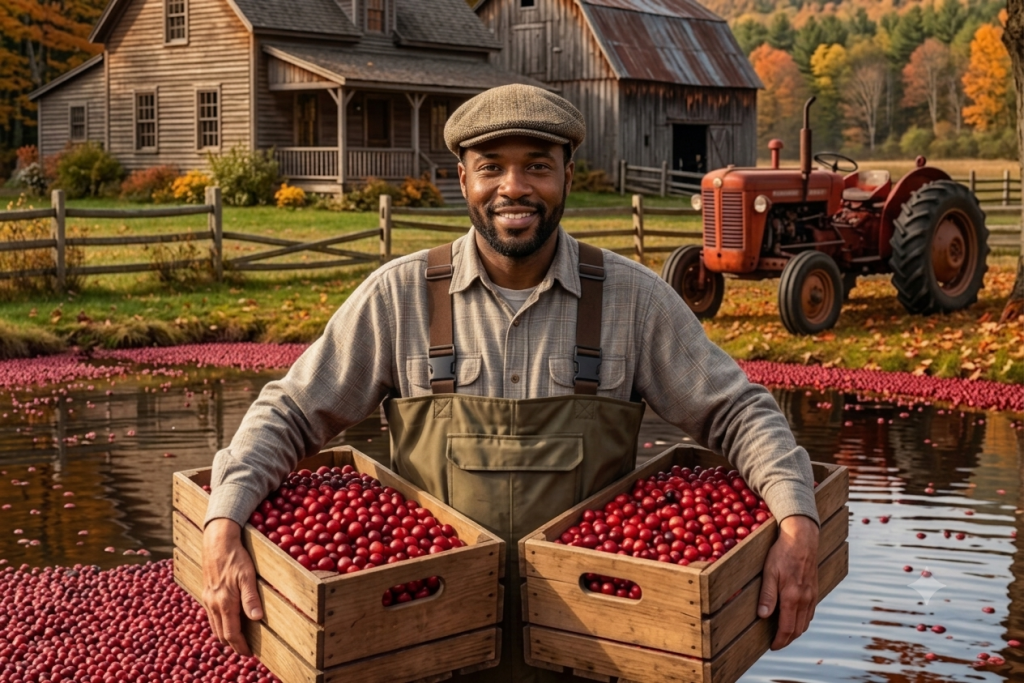
By the fifth year, there was enough surface coverage that in late September, when the water went up for the harvest float, the bog went red.
Not a little red.
Not the faint blush of something trying.
Red enough to stop me at the edge.
Red enough to make the whole water surface look lit from beneath.
The same red I had seen once as a boy, leaning against my father’s leg, not old enough to understand what I was looking at.
I was not a cranberry farmer.
Not really.
I was a corn and soybean man, same as my father, same as his father before him. But I tended those forty-seven acres the way I tended everything else on my place: with patience, attention, and the understanding that the man who built something before you very likely knew something you do not.
The first small harvest did not make me rich.
That is not how real stories usually work.
It made me certain.
There is a difference.
Certainty does not pay a note by itself, but it keeps a man from selling too early, draining too deep, or letting some expert with a clipboard tell him that water is only a problem because the expert arrived in the wrong season.
The cranberries sold locally at first. Jars at the farmers market. A few flats to a restaurant in Indianapolis whose chef wanted something “historic” for a Thanksgiving menu. Later, a small cooperative bought part of the crop because the wetland professor wrote a paper on the restored bog system and the story found its way to people who cared about old land, old food, and old knowledge that had nearly been buried under sedge.
Reporters asked me if I had discovered the cranberry bog.
I always said no.
Discovery is what you call it when you arrive late and want credit.
I did not discover anything.
My father noticed it in 1951.
The French Canadian family built it long before that.
The cranberries had known what they were the entire time.
I was simply the first fool in a while willing to pay twenty dollars for land everyone else called worthless and then stand still long enough to ask why it had not disappeared.
Years later, when I cleaned the cellar shelf where the coffee can had sat, I found three more scraps of my father’s notes tucked inside the back of an old seed catalog. One mentioned the color of the berries after frost. One mentioned a kingfisher working the south bank in October. One contained only a sentence written in the same careful pencil hand.
Water is not always what the land is suffering from. Sometimes water is what the land is remembering.
I framed that one.
Not professionally. Just placed it between two pieces of glass and hung it above the kitchen table where I can see it while I drink morning coffee.
The original note with Vaccinium circled twice stays in the drawer with the maps and the green composition book. The old fragment of worked timber, the one sealed in the glassine envelope, sits there too. I returned it to the envelope after showing it once to the historical society, and this time I did let them come look. They walked the berm, photographed the stonework, traced the old creek name through records, and confirmed what the maps had already suggested: the bog had belonged to a pre-statehood cranberry operation tied to families and trade routes that most of the county had forgotten.
Forgotten does not mean gone.
That is something land teaches better than people do.
A thing can sit beneath roots and water and assumption for a hundred years, still doing what it was made to do, still waiting for someone to stop trying to fix it and start learning from it.
I think often of the two men who tried to drain that pasture before me.
I do not mock them.
They were not stupid men. They were men trained by their time to see standing water as failure. They did what the era told them made sense. Buy tile. Move water. Dry ground. Plant corn. Measure success by what could be driven across, sprayed, harvested, and weighed.
They never noticed the cranberry runners.
Or perhaps they noticed and did not know what they were seeing.
That may be the greater danger.
Not blindness.
Misnaming.
Seeing the right thing and putting it in the wrong category.
Weed.
Problem.
Waste.
Flood.
Worthless.
I nearly did the same.
Had my father not left that note, I might have looked across the water, laughed with everyone else, and driven away. Had the Hardin County man not opened his father’s binder, I might have tried to force commercial logic onto a system that had survived by resisting force. Had the wetland professor not looked at the outlet housing and said intact, I might have treated the old stonework as an obstruction instead of an instruction.
Nobody does these things alone.
One man sees a plant in 1951.
Another writes it down.
A son finds the note decades later.
A stranger opens an old binder.
A woman from the state office recognizes stonework.
A sawmill cuts white oak true.
Water remembers the channels.
Root crowns spread.
Five years later, the bog goes red.
People call that luck because they arrive at the harvest and miss the chain of attention that made the harvest possible.
It was not luck.
It was memory, preserved in wet ground.
It was old knowledge waiting under water.
I still walk the bog every October.
I walk the berm slowly, with one hand sometimes against my lower back, the way my father walked before me. The air smells of peat, cold water, and fruit. Migrating birds work the margins. The surface takes color differently depending on light. Some mornings it is brick red. Some evenings it is dark wine. After rain, at the right angle, it still looks like rust and old blood.
But now I know what I am seeing.
Not wounded land.
Living land.
A place that had been called drowned, worthless, unworkable, and marginal because nobody was asking the right question.
The right question was never, How do we get rid of the water?
The right question was, What has the water been keeping alive?
THE END
