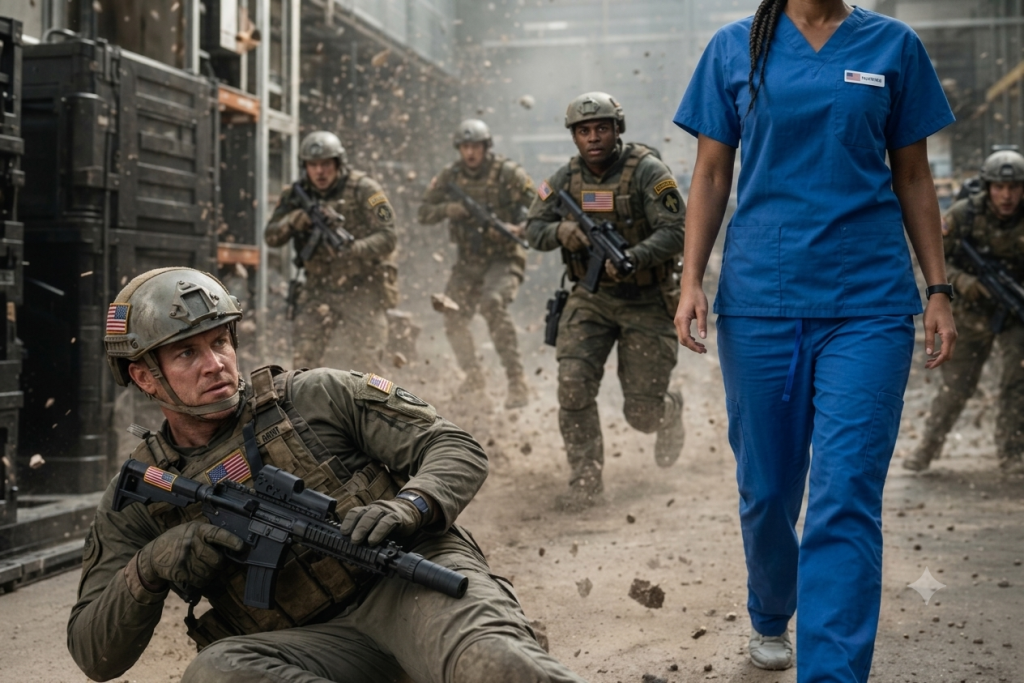
At nine-thirty on a blazing Thursday morning, the joint training grounds at Naval Special Warfare looked exactly the way men imagine power should look.
Steel racks. Tactical gear. Salt air. Sun burning across long strips of concrete until the heat rose in wavering sheets. Operators in motion. Orders snapping through the hanger. Rifles stripped and reassembled. Hydration checks. Simulation teams rotating in and out of live-fire lanes. Everything on that field announced the same message before anyone spoke it aloud: this was a place for people who moved hard, talked fast, and carried themselves like they belonged at the sharp end of danger.
Elena Cross stood near a stack of black medical crates in navy scrubs and looked, to almost everyone there, like the exception.
She had arrived at the base four days earlier as part of a rotating medical support unit. Officially, her job was simple. Monitor vitals. Watch for heat stress. Track hydration. Step in when a drill went sideways and the kind of men who prided themselves on being unbreakable remembered, all at once, that muscles tear and bodies fail like everybody else’s. She wore no rank on that uniform now, just a name badge, a radio clipped at the hip, and the kind of calm face that made people assume she had spent her life in well-lit clinics telling patients to breathe deeply while she checked blood pressure.
If you passed her in a grocery store, you would have noticed the green eyes, the hair pulled back into a severe bun, the quiet economy of her movements, and then moved on with your life.
That was one of the advantages Elena had learned to trust.
People rarely guard themselves against what they misunderstand.
By ten o’clock the lighter mood that comes after successful live-fire blocks had started spreading through the training grounds. Men who had already done the hardest part of the day begin to joke differently. Voices rise. Shoulders loosen. The danger is not gone, but ego starts drifting back in. Elena had spent the whole morning moving between stations with a tablet, checking heart rates, blood pressure, and fluid intake. She spoke only when necessary. “Hold still.” “Drink this.” “You’re done for ten minutes.” “No, that headache matters.” Men twice her size obeyed because medics hold a strange kind of authority in environments built around pain. But they still looked at her as support. Background. Helpful infrastructure. Necessary, but not part of the real center of the room.
Dr. Ian Miller, a trauma surgeon attached to the exercises that week, embodied that attitude better than anyone.
Miller was talented, handsome in a glossy way that photographs well in recruitment brochures, and arrogant enough that he mistook condescension for charm. He walked past Elena as she lifted two heavy trauma kits into the back of the medical Humvee and paused just long enough to smirk.
“Easy there, Cross,” he said, adjusting his sunglasses. “Stay behind the yellow line when the boys start moving. We wouldn’t want you getting dizzy from all the high-speed activity.”
A couple of operators nearby laughed. One of them, Rico Alvarez, leaned against an equipment crate and added, “This isn’t exactly a suburban clinic, ma’am. Things get loud out here.”
Elena adjusted the strap on the medical bag over her shoulder and kept working.
She did not roll her eyes.
She did not snap back.
She did not make the rookie mistake of trying to prove herself with borrowed swagger.
“Understood,” she said, her voice smooth and flat as polished stone.
That answer amused them more than a protest would have. They went back to their gear with the easy dismissal of men who think a person has already been measured simply because they have looked at her.
Elena watched them go.
Not emotionally. Structurally.
Miller favored his left knee just a fraction when he pivoted under pressure. Rico breathed through his mouth when distracted, which dried him out faster than he realized in heat blocks. One of the younger SEALs overloaded his right side every time he lunged for control because he trusted his upper-body strength to solve mistakes made by his feet. Elena noticed all of it. She had been trained to notice. Once you live long enough in dangerous places, observation stops being a skill and becomes a reflex you carry in the bones.
That was the thing nobody on that field understood about Elena Cross.
They thought her quietness meant softness.
They thought the scrubs meant nurture and nothing else.
They thought a woman standing beside water coolers and trauma kits must belong to the category of people who fix damage after stronger people create it.
They had no idea that Elena’s hands remembered how to field-strip a rifle in darkness. They had no idea she knew exactly how long it took panic to travel from one man’s bad decision into another man’s body. They had no idea the deep stillness in her came from years spent in places where noise got people killed.
By noon the heat had turned the concrete floor inside the hanger into a dull, radiating burn. Senior Chief Vance, who supervised the final simulation blocks, called everyone in. The live-fire objectives were done. What remained was a looser exercise, a nonlethal extraction and control drill built to test movement, patience, perimeter awareness, and the ability to handle an uncooperative high-value civilian without escalating into stupidity.
The parameters were simple. One person would act as the asset. Two operators would secure, control, and move that asset to a designated safe zone without losing the perimeter or using excessive force.
Most of the men on the floor had done versions of it dozens of times.
That was why Miller got bored enough to make a suggestion.
“Senior Chief,” he called up toward the observation deck, “let’s make it realistic. Use Nurse Cross as the target.”
Laughter rolled across the hanger.
Vance narrowed his eyes and looked down at Elena. She met his gaze without changing expression. For one second, something unreadable passed between them. Then Elena gave a small, almost invisible nod.
“All right,” Vance barked. “Cross, you’re the noncompliant civilian asset. Miller, Rico, you have three minutes to secure and move her to the safe zone. She’s our only medic, so don’t break her.”
The last line earned another wave of laughter.
To everyone watching, this was comic relief. A way to blow off post-drill energy. They expected Elena to freeze, flinch, or at most twist away once before being gently but decisively escorted across the floor. She was, in their minds, a woman in medical scrubs standing in the wrong game.
Elena stepped into the center of the hanger and let the noise wash over her.
Feet widened a fraction.
Weight dropped, barely perceptible.
Breathing slowed.
There are states of readiness the body never fully forgets once it has learned them under enough fear. Elena had not visited that state in three years, not since she left the Marine Corps and chose a path where saving bodies mattered more than using them. But the body does not confuse memory with identity. It simply responds when called.
Rico approached first with his hands half open and a smile designed to read as patient.
“Come on, Nurse Cross,” he said. “Make it easy on us. We just walk you to that corner and everybody gets to pretend this was exciting.”
Elena said nothing.
Miller angled right, exactly where she expected him to. Front distraction, flank closure, arm control, body turn, forward movement. Textbook. Fine for handling a frightened civilian. Fine for controlling a drunk executive at a diplomatic checkpoint. Fine for almost anyone who did not understand the geometry before it started.
Elena did.
She saw the moisture patch on the concrete near the coolant line leak. She saw the light hitting Miller’s eyes from the upper left. She saw Rico’s shoulders open just enough to tell her he thought the front lane was already his. She felt the shape of the room as a tactical problem. Noise, space, obstacles, weight, momentum.
Miller reached for her arm.
The second his fingertips brushed the fabric of her scrubs, Elena moved.
Not backward.
Not with a strike.
With absence.
One sharp pivot, hips turning under his line of force, center of gravity dropping as she stepped into the space behind his lead shoulder where his leverage disappeared. Miller grasped air and stumbled forward, his own momentum pulling him into emptiness. By the time he planted to recover, Elena was already six feet away near the edge of the crate line, balanced and watching both men at once.
The hanger fell silent.
It was not dramatic at first. More like a laugh cut off in the throat.
Rico blinked, reset, and gave a short nod to Miller. The joking was over. Both men lowered their stance and came in tighter, faster, trying to pin Elena between the equipment crates and the marked lane. For most people, that pressure works because it overwhelms the mind before the body even has time to choose. Elena never let the mind fall behind.
Every time they reached, she was already leaving.
She did not burn energy on brute strength. She used their speed against the shape of the floor. Miller lunged low, trying to wrap and drive. Elena shifted forty-five degrees off line, brushed his wrist just enough to redirect, and let his own rushing weight slam him chest-first into the side of a reinforced crate. Rico came high, trying to box her in. She read the tension in his lead foot before he stepped and vanished through the only lane he had failed to close because he assumed he could close it later with reach.
He could not.
The room got quieter with every failed attempt.
Men who had spent their careers watching elite operators dominate space were now watching two of them chase a medic as if the floor belonged to her and not to them. Elena moved like she had all the time in the world. No wasted motion. No panic. No flashy takedowns designed for audiences. She was not fighting them the way movies teach people to imagine fighting. She was undoing their control before it formed.
Miller came again, embarrassed now, which is the worst emotional state for any trained man to enter a drill with. Embarrassment speeds you up and blinds you to structure. Elena slipped under his line, turned on her heel, and guided his rushing sleeve with two fingers so he ended where she had been a second earlier.
“What the hell?” Miller snapped, breathing harder than he should have been.
Elena’s face did not change.
Rico stopped and held up a hand, not to her, but to Miller.
“Wait,” Rico said quietly.
He was finally seeing it. Her hands were not up in a civilian panic guard. They were low and centered. Her eyes were not wide with fear. They were reading transitions before they happened. Her feet were not scrambling. They were set at pivot points. She was not improvising. She was selecting.
On the observation deck, Senior Chief Vance leaned against the rail.
“Look at her stance,” he muttered to the master chief beside him. “That’s not medical awareness.”
Below them, Miller made one last explosive move driven more by pride than judgment. He surged for Elena’s neck and shoulder line, trying to convert the whole thing into raw size and force.
Elena dropped low, turned, and let him run past the point where balance could save him.
He stopped himself just short of another collision, spun back around, and stood there chest heaving, staring at her as if the laws of the room had changed without permission.
Elena stood perfectly still.
Not even sweating.
“You’re focusing on where I am now,” she said calmly. “You should be focusing on where I’m going to be three seconds from now. You’re overcommitting your weight on the first step, Sergeant, and leaving your right flank open every time you lunge.”
No one on the floor laughed.
The drill ended not with a whistle, but with Rico taking two steps back and lifting both hands.
“Simulation over, Senior,” he called up. “We’re not catching her without escalating.”
Senior Chief Vance descended the stairs slowly, boots ringing on metal loud enough to sound like a second silence. He stopped in front of Elena, studying her face with the kind of focus operators reserve for identifying whether a thing is merely unusual or genuinely dangerous.
“That wasn’t civilian movement,” he said. “Where did you learn to read a tactical enclosure like that?”
Elena tucked one loose strand of hair behind her ear.
“I spent a lot of time in the dirt before I ever put on these scrubs, Senior Chief.”
That answer should have been enough.
It wasn’t.
Miller was still trying to process the humiliation of being outmaneuvered in front of half his team by someone he had mocked for being soft. “No,” he said. “I want the real answer. Where did you learn to move like that?”
Elena looked at him, and for the first time all day the faintest suggestion of a smile touched her mouth.
“The Marine Corps,” she said.
The words hit the room like a door kicked open.
Rico straightened. Vance’s expression shifted into something close to recognition. Even the younger men at the back of the hanger, the ones who had spent the last hour exchanging jokes about nurses and safety lines, went still.
Elena continued because once truth starts moving, stopping halfway only makes it theatrical.
“Five years,” she said. “First Battalion, Fourth Marines. Female engagement teams in Helmand first. Then tactical intelligence. Then field medical support. Before I was a nurse, I was a sergeant. Before I was a sergeant, I was a rifleman.”
No one spoke for a moment.
Military cultures build themselves on labels because labels simplify action. Medic. Surgeon. Operator. Marine. Support. Weapon. Those labels help people move quickly. They also become cages in the minds of arrogant men. The SEALs on that floor had taken one look at Elena’s present uniform and built an entire fantasy of her limits around it. Now, all at once, the walls of that fantasy had collapsed.
Miller sat down on the equipment crate he had nearly slammed into and ran a hand over the back of his neck.
“Why didn’t you say anything?” he asked quietly. “When I made the joke. When I told you to stay behind the line.”
Elena met his eyes without malice.
“Because a sergeant doesn’t need to bark to be heard,” she said. “And because I wanted to see what kind of team I was actually supporting.”
That landed harder than any physical move she had made.
“You learn a lot more about people,” she went on, “when they think they’re superior to you than when they know you’re their equal.”
It is one thing to be embarrassed. It is another thing to realize the embarrassment is deserved.
The men around her had not failed because Elena was secretly invincible. They had failed because they had committed the most basic tactical mistake possible: they had decided what was dangerous before gathering enough information. On a battlefield, that gets people killed. On a training ground, it gets your assumptions exposed in public.
Senior Chief Vance folded his arms.
“Sergeant Cross,” he said deliberately, giving her back a title nobody else there had known to use, “from this point forward, you are not just support staff monitoring hydration and bruises. You’re going to sit in on the after-action review.”
Elena gave one crisp nod. “Understood, Senior Chief.”
Miller looked up at her, still chastened. “I owe you an apology.”
“Yes,” Elena said. “You do.”
To his credit, he gave it plainly.
Not a performance apology. Not a joke wrapped around discomfort. A real one. “I underestimated you,” he said. “And I was disrespectful.”
Elena accepted that with the same economy she had shown all day. “Then don’t do it again.”
The after-action review happened right there on the hanger floor because nobody wanted to lose the honesty of the moment by moving into a room with nicer chairs. Vance had the operators walk through every assumption that had failed them. Why did you choose that angle? Why did you assume compliance? Why did you treat verbal de-escalation as a script instead of an assessment? Why were your first movements built around control instead of understanding?
At each stage, Elena answered when asked and stayed silent when not.
That silence became its own form of instruction. She did not need to dominate the room. The room had already reorganized itself around what she had revealed. Men who had laughed at her an hour earlier were now taking notes while she explained pivot-point defense, commitment of weight, misdirection through overconfidence, and the danger of assuming that quiet equals confused.
“You kept trying to touch the version of me you had already built in your heads,” she told Miller and Rico. “You never responded to what was actually in front of you.”
Rico rubbed a hand across his jaw. “You were reading us.”
“I was observing you,” Elena corrected. “Reading suggests mystery. You were obvious.”
Somewhere near the back of the group, somebody let out a stunned little laugh. Not mocking. Just amazed.
Vance didn’t laugh. “What was the biggest mistake?”
Elena answered immediately. “They believed the environment belonged to them.”
The chief nodded like a man hearing his own training philosophy returned to him in cleaner language.
By late afternoon, the mood on the base had shifted in a way almost no one would have been able to articulate cleanly. The swagger had not disappeared. These were still elite operators. But the field had become quieter, sharper. Men moved with their eyes open. When Elena passed through the hanger on her way back to the aid station, people no longer smirked and called out “Doc” like it was a soft joke. They stepped aside. They nodded. Some addressed her as Sergeant before correcting themselves to lieutenant-grade courtesy out of confusion. She let it pass. Respect does not have to arrive perfectly to arrive honestly.
The strangest part for Elena was not the victory.
It was the familiarity.
She had lived this before, in other forms. Men deciding what she was from a silhouette. Men filing her into categories that made them feel steadier. Men needing a visible demonstration before they offered the respect they should have brought into the room with them. By thirty, Elena had stopped taking that pattern personally. People reveal themselves through assumption. You can learn from that if you stay calm long enough not to turn every insult into a performance.
That evening, after the official activities ended, Elena stood alone for a few minutes outside the medical building watching the sky turn copper over the water. The base was quieter now. Trucks moved slowly between structures. Somewhere in the distance, somebody laughed too loudly and got shushed by instinct. She could feel the old combat readiness draining out of her muscles in gradual increments, like tension leaving wire.
A voice behind her said, “Permission to speak freely?”
She turned.
Miller stood there without sunglasses now, which made him look younger and less composed. Rico was beside him, hands in pockets, the swagger turned down to something more human.
“You don’t need permission,” Elena said.
Miller exhaled once. “I deserved what happened in there.”
“You deserved the lesson,” Elena replied. “What you do with it is up to you.”
Rico gave a sheepish half-smile. “For what it’s worth, I really did think you’d fold in ten seconds.”
“I know.”
“Did you know from the start what we were going to do?”
“Yes.”
“How?”
Elena looked at him. “Because overconfidence is repetitive.”
That got a real laugh out of him.
Miller glanced toward the fading light over the training grounds. “Helmand?” he asked carefully.
Elena nodded.
He said nothing for a moment, then asked, “Bad?”
“All deployments are bad,” she said. “Some are just more honest about it.”
Neither man pushed further.
That night, alone in her temporary quarters, Elena sat on the edge of the narrow military bed and unwrapped the tape from her right wrist, more out of habit than injury. The room smelled faintly of detergent, dust, and metal air-conditioning vents. She could still hear the hanger in her head, the clipped boots, the stunned silence, Miller’s breathing after the last failed lunge. None of it gave her triumph. Triumph had always felt too loud for what skill actually is. What she felt instead was the old familiar fatigue that comes when a buried part of you has to step back into daylight for people who never should have needed the demonstration.
On the small desk under the window sat two things she carried from assignment to assignment: a nursing pharmacology manual thick with tabs and a Marine Corps coin worn smooth at the edges. She picked up the coin and thought about Helmand, not in dramatic flashes, but in textures. Sand inside her boots. The metallic taste of fear before sunrise raids. The weight of local women’s stories when the men left the room. The first time she learned that the difference between healing and fighting is sometimes only what the next ten seconds require.
She had left the Corps not because she broke, but because she was tired of living at the point where every useful skill ended in damage. Nursing gave her a way to keep the discipline, awareness, and steadiness, and turn them toward repair. What amused her now was how often people treated those worlds as opposites. As if the person who knows how to stop a body from failing could not possibly understand how bodies fail in the first place. As if gentleness erases force instead of mastering it.
The next day’s expanded training proved the lesson had gone deeper than bruised pride. Men who had smirked now listened. Questions improved. One operator admitted he always focused on hands first because hands make people feel in control, and Elena made him repeat the drill until he understood that hips tell the truth earlier. Another confessed he relied too heavily on size in close spaces. Elena had him run the enclosure against a smaller female intelligence officer from logistics, then stopped the exercise three times to show how easily “manageable” targets become unpredictable when the person approaching them is thinking about compliance instead of capability.
By the second afternoon, even the veterans had changed their language. Nobody called her sweetheart. Nobody suggested she head back to the clinic. At lunch, a team leader from another unit asked if she would review their medevac interior flow because he had suddenly realized the people closest to casualty care sometimes see tactical choke points faster than breachers do. Elena said yes because that, more than apologies, was the result she respected. A changed system matters more than a humbled ego.
Late on the final evening of the rotation, Rico found her restocking saline packs and held out a patch from his kit bag, not as a joke, but as a gesture. Team insignia. Velcro backing. “Not official,” he said. “Just respect.”
Elena looked at the patch, then at him. “You don’t owe me souvenirs,” she said.
“No,” Rico answered. “But we do owe you the truth. We saw scrubs and missed the operator. That won’t happen again.”
Elena took the patch and tucked it into the side pocket of her medical bag beside the old Marine coin. Different worlds. Same lesson. Never trust the uniform alone. Trust the way a person moves when the room gets serious.
That mattered deeply.
That, more than the apology, told Elena the day had done what it needed to do. Real respect does not immediately start prying into another person’s scars to prove it is sincere.
The next morning, Senior Chief Vance changed the training agenda.
He opened with a short statement in front of the assembled teams. “Yesterday, assumptions created a tactical failure,” he said. “Today, we correct it.”
He brought Elena forward and had her walk the teams through environmental reading from the perspective of someone being enclosed rather than someone doing the enclosing. Weight. Sound. Exit lanes. Blind spots. Floors. Obstacles. The exercise ran for two hours. Nobody joked. Nobody called it cute. By the end of the morning, some of the hardest men on base were openly admitting how much they had missed because they thought dominance and awareness were the same thing.
They were not.
At one point, Elena demonstrated again with a volunteer twice her size. Not to embarrass him. To teach. She let him make a clean, professional approach, then showed the group the exact instant where his hips told the truth before his hands did. She made them watch his feet. Made them watch the space he believed was closed and the smaller space he had left open because he had unconsciously given his own balance more trust than it had earned.
“This is not magic,” she told them. “And it’s not speed. It’s attention.”
That line followed her for the rest of the week.
By Friday afternoon, the story of Elena Cross had already spread beyond the original hanger. In bases like that, stories move faster than official memos, especially the ones that bruise pride and improve training at the same time. She caught operators from other teams looking at her badge, then at her face, then away again with dawning recognition. One of the younger corpsmen asked, half awed and half terrified, if it was true she had ghosted two SEALs without throwing a single strike. Elena told him the same thing she had told everyone else.
“They trapped themselves.”
Which was also true.
The larger truth, the one no one on that base would forget quickly, had nothing to do with humiliating elite men for sport. It was about categories. About what people think they know when they look at a role instead of a person. On paper, Elena was the medic. The support element. The woman in scrubs. The quiet one. Men comfortable in their own status filled the silence around those facts with assumptions and called that understanding. Then reality touched them on the shoulder and stepped out of reach before they could grab it.
On her final day of that rotation, Vance stopped by the medical station with a folder under his arm.
“I added your name to the advanced review schedule,” he said.
Elena looked up from a supply log. “For medical?”
“For training design,” he replied. “We’ve got tactical gaps you see faster than some people with much louder résumés.”
There it was again. The aftereffect. Not admiration. Usefulness recognized.
Elena accepted the folder. “Understood.”
Vance hesitated, which was unusual for a man like him. Then he said, “For what it’s worth, you handled that first day with more discipline than most operators would have.”
Elena considered that.
“People show you who they are when they think they don’t need to be careful,” she said.
He gave one approving nod and left.
That afternoon, as she loaded the last of the medical kits into the Humvee, Miller came by one more time. He looked like he wanted to say something polished and had wisely abandoned the effort halfway.
“I won’t make that mistake again,” he said.
Elena fastened the latch on the kit and looked at him. “You will,” she said. “Just hopefully not the same one.”
He laughed, surprised into honesty.
When he walked away, Elena stood for a moment in the heat and let the sun warm the back of her neck. The base sounded like a base again. Engines. Distant shouting. Metal on metal. Work going on. Her scrubs were still just scrubs. Her badge still just a badge. None of that had changed.
What had changed was the field around her.
Not because she demanded it.
Because when the moment came, action revealed what labels had concealed.
That was the real lesson of Elena Cross. Strength does not always announce itself in the uniform people expect. Discipline does not always arrive in the loudest voice. The most dangerous person in the room is often the one no one bothered to classify correctly because she seemed too calm to threaten their story about themselves.
The men at the training grounds learned something they would carry longer than the embarrassment of one failed drill. Respect is not a prize people earn only after entertaining your doubt. It is a debt you owe every person in the room until reality gives you reason to revise it.
Elena had known that long before she ever stepped onto that hanger floor.
She did not need anyone there to confirm her worth. She had settled that question in dirt, fear, noise, and long nights under foreign skies years earlier. All the drill did was force other people to catch up to a truth she had never lost.
On her way off the grounds, she passed the yellow safety line Miller had joked about on the first morning. She glanced at it once, then kept walking with the same calm stride she had carried from the start.
Invisible if she wanted to be.
Unforgettable once tested.
And somewhere behind her, on a sun-blasted training base full of men who would never again laugh so easily at the quiet medic in navy scrubs, the story had already become legend.
Some lessons arrive as pain. Others arrive as clarity. Elena preferred clarity. It lasted longer, traveled farther, and changed behavior without needing noise. By the time her vehicle passed through the final gate, the men behind her had stopped seeing a nurse who happened to be dangerous. They had started seeing a professional whose quiet had been strength, and whose restraint had taught them more than force could.
THE END
